The full AI SEO course · free · built on live data from my 6-site network
The Rank Everywhere Engine. The full AI SEO course.
Seven modules that build one machine: content that ranks on Google, YouTube, Perplexity and ChatGPT at the same time — researched, written, indexed and improved by AI agents. Every number in this course is pulled live from my own Search Console.
135,874impressions · last 28 days
11,116keywords my network shows for
3,916clicks · last 28 days
6sites, run by agents
7modules in this course
I · The problem
The One-Podium Problem.
Imagine training for years to win one race.
You finally place on the podium — position #4 on Google.
Then you look up.
Your buyers aren't in the stadium anymore.
Some are asking ChatGPT. Some are asking Perplexity. Some never scroll past Google's AI answer at the top.
Some are searching YouTube instead.
You optimised for one podium — and the crowd split across five.
Meanwhile the old way of ranking — one hand-written article a week, pray, wait six months — was already too slow when there was only one podium to win.
The Rank Everywhere Engine breaks that cycle: one machine that puts the same work on every podium at once.
Thinking it?"SEO is dead — AI answers killed it."
Search didn't die. It multiplied. The questions moved to more places — and almost nobody is optimising for the new ones yet.
That's not a funeral. That's the biggest land-grab since Google launched. This course shows you how to take it.
II · How it works, in simple words
One engine, every podium.
Here's the whole course in one breath.
You find the questions your buyers are already asking — using your own Search Console data (Google's free report of every search you appear in) plus AI research.
AI agents write real answers to those questions — proper articles, not slop — and publish them.
You get them indexed (into Google's library) the same day instead of waiting weeks.
Each article gets multiplied: a video, a short, a social post — same work, more podiums.
The machine then reads its own scoreboard, finds what's leaking clicks, fixes titles, and compounds.
Set it up once. The engine runs while you make videos, serve clients, or sleep.
The Rank Everywhere Engine — the fan-out that gives the framework its name
III · Exactly how it works, step by step
One article's journey through the engine.
The engine reads your scoreboard. Search Console lists every keyword you already show up for. My network currently shows for 11,116 of them. The engine scores each one: where's a buyer, where's a gap, where are we leaking clicks?
It picks a winnable fight. Not the biggest keyword — the one with buyers, real impressions, and weak competition. (Module 1 shows you the exact filters.)
An agent writes the answer. A real article: the question answered in the first lines, proof, structure, internal links to your related pages. Reviewed before it ships.
It gets indexed the same day. Publishing isn't ranking — Google has to file your page in its library first. The engine pings the page for crawling instead of waiting weeks. (Module 3.)
It multiplies. The same article becomes a video script, a short, and social posts — each pointing home. One effort, four podiums. (Module 5's answer engines feed on this too.)
The loop closes. Two weeks later the engine re-reads Search Console: what moved, what's stuck at #7 with a weak title, what deserves a refresh. It fixes and goes again. That's why it compounds.
So when someone asks "but what IS it?" — it's a loop: scoreboard → winnable keyword → agent-written answer → same-day index → multiply → re-read the scoreboard. Everything in this course installs one piece of that loop.
IV · The course map
Seven modules — each with a full deep-dive guide.
This page is the course. Each module below teaches the essentials, then links to the complete guide on that topic — so when you want to go deeper on any piece, the full walkthrough is one click away.
Search didn't die. It multiplied. Own every podium.
Module 1 · The Goldmine
Find keywords with buyers — in your own data first.
Most people start SEO by guessing keywords in a paid tool. Wrong way round.
Your Search Console already lists every search you appear in — for free. That's not guesses. That's Google telling you where you're already almost winning.
Three signals to hunt, in order:
Striking distance. Keywords sitting at position 5–15. You're on the doorstep — one refresh or a few internal links pushes you onto the podium.
Content gaps. Keywords you get impressions for with NO page actually answering them. Google is begging you to write it.
Click leaks. Page-one rankings with a weak title, earning a fraction of the clicks they should. (That's Module 4's whole job.)
Live case · pulled from my Search Console this week
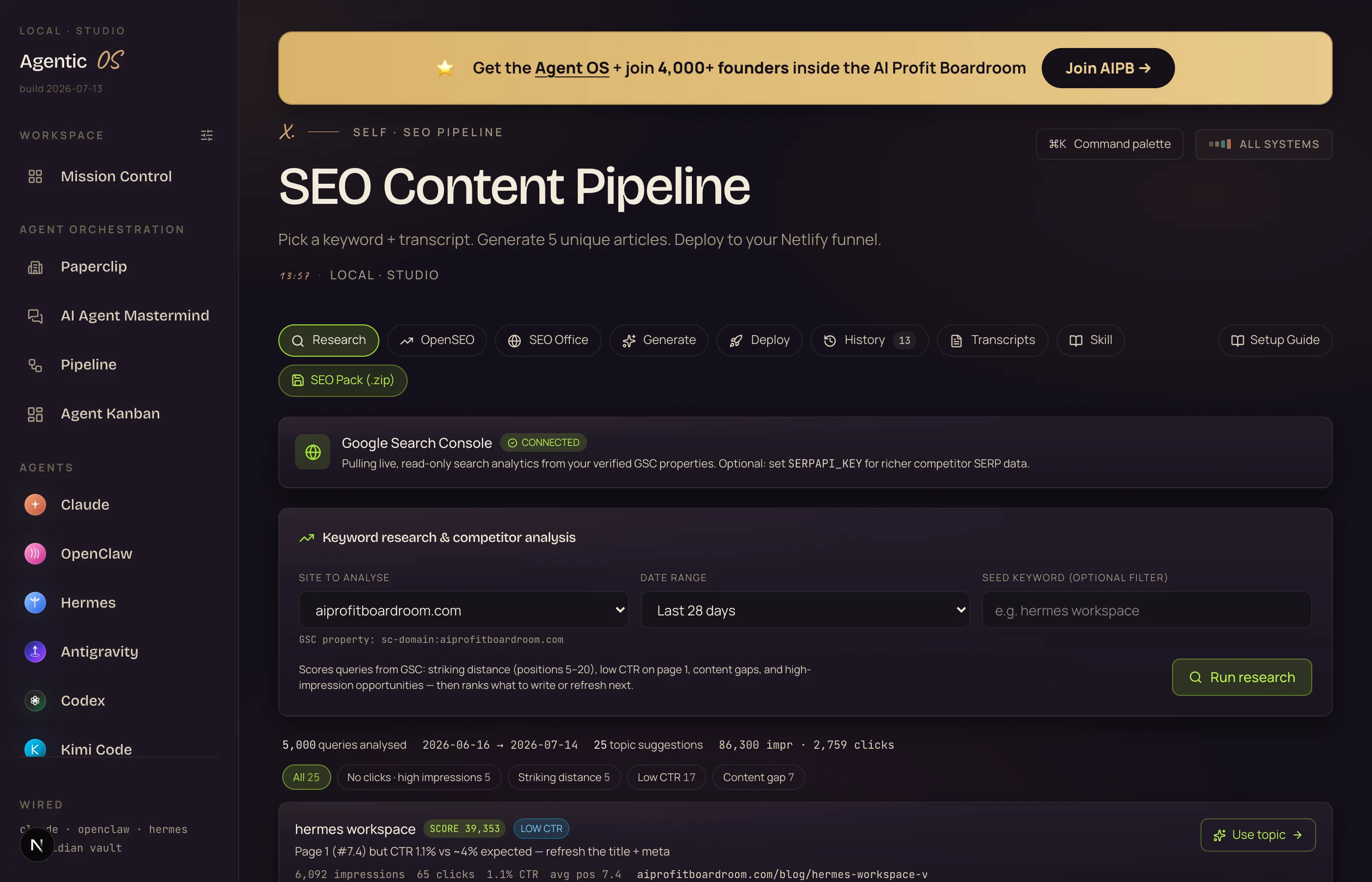
The gap that's begging. My network shows for "ai seo course" — 650 impressions in 28 days, position 21.8, zero clicks. No page targets it. The engine flags it as a CONTENT GAP → this very course page is the answer. You're reading the fix.
The doorstep keyword."hermes moa" sits at position 7.4 with 1,038 impressions — STRIKING DISTANCE. One content refresh + internal links is the move.
The scale. Across 6 sites: 11,116 keywords, 135,874 impressions, 3,916 clicks in 28 days — all found by the agent reading the scoreboard, not by me buying keyword credits.
What you're looking at: my Agent OS pulling live Search Console data for one of my sites — 5,000 queries analysed, 86,300 impressions in 28 days, filtered into No-clicks (5), Striking distance (5), Low CTR (17) and Content gaps (7). Top row: the exact "hermes workspace" click-leak you'll meet again in Module 4, scored 39,353. This is the goldmine, scored automatically.
Thinking it?"I don't have Search Console data — my site is brand new."
Then you start from the AI side: ask the agent what your buyers ask, write the answers, and data starts flowing within days of indexing.
Every site in my network started at zero. The scoreboard fills up fast once you're publishing.
Module 2 · The Newsroom
Content that ranks — written by agents, not slop.
AI content fails when you ask one chatbot to "write an article about X." That's slop, and Google's gotten good at ignoring it.
AI content wins when it runs like a newsroom:
One reporter researches — pulls what's actually ranking, what questions sit underneath, what's missing from every current answer.
One writer drafts — answer in the first two lines, then proof, steps, and specifics. Write like you talk. Short sentences.
One editor reviews — checks facts, adds internal links to your related pages, kills fluff.
Three agents, one pipeline. On my setup that's the Agent Kanban running Planner → Builder → Reviewer — real articles shipping to live sites without me touching a keyboard.
The rules that make it rank: answer the exact question in the opening, cover the entities Google expects (the people, tools and terms every top answer mentions), one page per question, internal links both ways.
Google penalises unhelpful content — its own docs say AI use is fine when the result helps the searcher.
The newsroom process exists exactly for that: research, review, real answers. My network's 135,874 impressions are agent-written pages Google chose to show.
Module 3 · The Index Trigger
Get indexed the same day — publishing isn't ranking.
Here's the step almost everyone skips, then wonders why nothing ranks.
When you publish a page, Google doesn't know it exists. It has to crawl it (visit it) and index it (file it in the library). Left alone, that can take days or weeks — and for a small new site, sometimes never.
The engine never waits:
Sitemap always current — the file that lists every page for Google. Your CMS should update it automatically; verify it once.
Ping on publish — every new URL gets submitted for crawling the moment it goes live, through an indexing service wired into the pipeline. My publishing flow submits every fresh URL the same hour it ships.
Internal links from day one — a new page with zero links pointing at it looks like an orphan. The editor agent links it from your related pages at publish time, so crawlers find it from every direction.
Real case · from my own publishing pipeline
The backlog. At one point I'd shipped 89 guide URLs across six batches without submitting a single one for indexing. Rankings crawled.
The fix. One bulk submission — all 89 URLs queued for crawl in one API call. Indexing is now a non-skippable step in every deploy: publish → verify live → submit. Same day, every time.
Publishing without indexing is printing books and locking them in your garage.
Module 4 · The Click Patch
Stop the leaks — you're already ranking for clicks you don't get.
This is the fastest win in all of SEO, and it needs zero new content.
A page-one ranking should earn roughly 4% of impressions as clicks. When it earns 1%, you don't have a ranking problem — you have a title problem. The searcher saw you and picked someone else.
The fix is a rewrite, not a rebuild: put the answer's promise in the title, front-load the keyword, make the meta description a reason to click, add the year.
Live case · the leak I'm fixing right now
The leak."hermes workspace": position 7.4 — page one — with 6,092 impressions in 28 days. Expected clicks at ~4%: roughly 240. Actual: 65 (1.1% CTR).
The maths. That single weak title is leaking ~175 clicks a month. Across a network, leaks like this add up to thousands of lost visitors — from rankings you already own.
The move. The engine flags every LOW CTR row automatically (you saw the badges in Module 1's screenshot), and a title rewrite ships the same day.
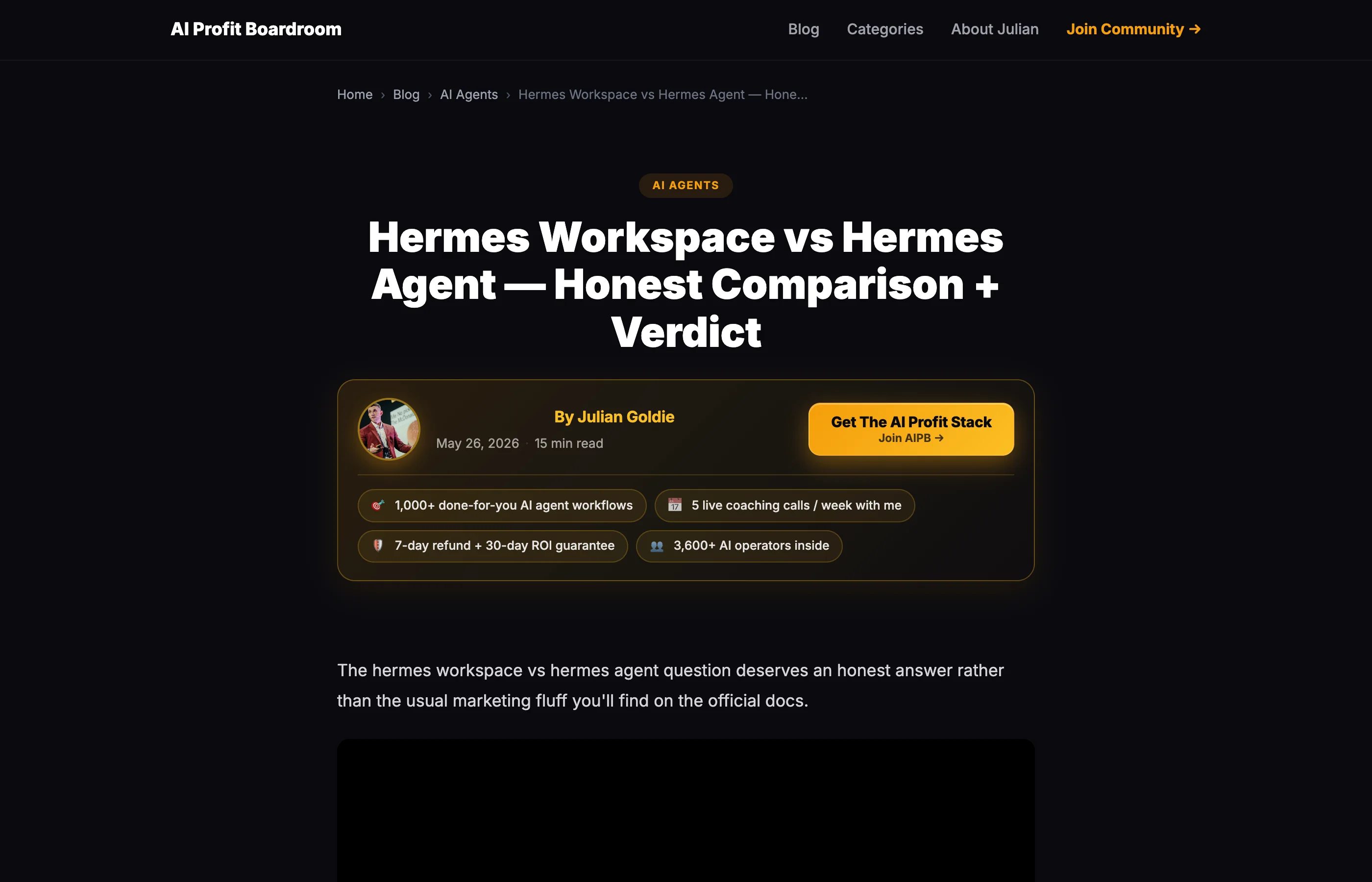
A real click leak from my Search Console this week — the fix is a title rewrite, not new content
Rank in the AI answers — Perplexity, ChatGPT and Google's AI box.
This is the "everywhere" in Rank Everywhere Engine — and the part your competitors haven't started.
AI answer engines (Perplexity, ChatGPT search, Google's AI Overviews) don't rank pages the way classic Google does. They read pages and cite the clearest answer. Which changes what wins:
Answer first. The direct answer in the opening two sentences — quotable, liftable, no throat-clearing. AI engines cite pages they can quote cleanly.
Structure like a reference. Clear headings that ARE the questions, short factual paragraphs, lists and steps. You're writing for a reader AND a machine that summarises.
Be the named source. Fresh dates, real numbers, an author. Answer engines prefer pages that look like a source, not an ad.
Multiply the surfaces. The same answer as a YouTube video gets cited by video-aware engines; the short version feeds discovery. One answer, every format.
I've had pages rank #1 on Google and get cited by Perplexity the same day they were published — that's the same-day index (Module 3) plus answer-first structure doing their job together.
Thinking it?"Won't AI answers just steal my traffic anyway?"
Zero-click searches are real — which is exactly why being the CITED source matters. The citation is the new ranking.
When Perplexity names your site as its source, you get the click that survives. When ChatGPT knows your brand, buyers search for you by name. That traffic converts better than the drive-by clicks you lost.
Module 6 · The Authority Grid
Links still decide who wins the tie.
Two good answers to the same question? Google shows the one from the site with more authority. That's earned two ways, and agents help with both:
The internal grid. Free, instant, ignored by most people. Every page links to its siblings — cluster pages up to the pillar page, pillar down to clusters. The editor agent wires this at publish time. A tight internal grid is why new pages on an established network rank in days, not months.
Real outreach, run by an agent. Guest posts, niche mentions, partnerships — the grind that built my agency. (Link building is literally the business I scaled to 70+ people, and I wrote the book on it — Link Building Mastery.) The Hermes outreach agent finds prospects, drafts the pitches, and manages the follow-ups; you approve sends.
Rule of thumb for this course: nail the internal grid first — it's free and compounds — then layer outreach on the pages that are already close to winning (your Module 1 striking-distance list).
Put the whole engine on agents — and go make videos.
Everything you've learned is a loop a machine can run:
Read the scoreboard → pick the fight → write the answer → index it → multiply it → patch the leaks → repeat.
In my Agent OS this is literally a kanban board. Cards move from Planned → Writing → Review → Published, each column worked by a different agent. The SEO cluster mode plans a whole topic cluster, writes every article, and ships them to a live funnel site — while I record YouTube videos.
Want it bigger? The SEO Office setup runs 25 specialist agents — keyword miner, brief writer, drafters, editors, internal-linker, indexer — like an agency floor on one Mac.
The 28-day numbers at the top of this page — 135,874 impressions, 3,916 clicks across 6 sites — is this autopilot's output. Not a content team. A machine you configure once.
What you're looking at: a real agent-written article live on my funnel network — the exact page behind Module 4's case study, currently pulling 6,092 impressions a month at position 7.4. The machine wrote it, indexed it, and is now fixing its title.
Thinking it?"Doesn't running all these agents burn a fortune in tokens?"
No — the everyday 90% of this (research summaries, drafts, internal linking) runs on a free local model, $0, on your own machine. Free API tiers stack on top.
For the frontier work it drives the CLIs you already pay for — your Claude subscription includes the Claude Code CLI, so nothing bills twice. And the Boardroom's token-efficiency tutorials cut usage further.
You configure the engine once. It clocks in every night forever.
Case studies · the receipts
Four sites, same engine, real climbs.
These are monthly click counts from sites in my own funnel network, before the engine touched them versus after it had been running:
Monthly clicks, before vs after — four real sites from my funnel network
Add the live 28-day network numbers from the top of this page — 11,116 keywords, 135,874 impressions, 3,916 clicks — and the pattern is the point: the engine doesn't spike, it compounds. Every article, every patched title, every citation stacks on the last one.
Members run this same engine on agencies, ecom stores, coaching businesses and SaaS across 38 countries — and post their wins every day, in their own words.
Old way — manual SEO~8 hrs per article · $2k–$5k/mo all-in
Pay a keyword tool, guess which keywords you can win
Write one article a week yourself — or pay $200+ per post
Publish and pray; indexing happens whenever Google feels like it
Never look at Search Console again after setup
Page-one rankings quietly leak clicks through weak titles
Ignore Perplexity, ChatGPT and the AI answer box entirely
Result: 6 months of effort for a handful of rankings on one podium
New way — the Rank Everywhere Engine~1 afternoon to wire · agents run it nightly
Your own Search Console scored automatically — gaps, doorsteps, leaks
The agent newsroom ships reviewed articles daily across the cluster
Every URL submitted for indexing the hour it publishes
The engine re-reads the scoreboard every cycle and refreshes what's stuck
LOW CTR rows flagged and titles rewritten the same day
Answer-first structure gets you cited by the AI engines too
Result: 11,116 keywords, 135,874 impressions across 6 sites — while you sleep
VII · Three beliefs to drop
What actually stops people ranking.
Wrong: "SEO takes six months minimum — it's a long game I can't afford."
Right: Old SEO took six months because every step waited on a human. Same-day indexing, striking-distance targeting and click-leak patches move numbers in days — you saw the real rows above. The long game still compounds; the short game pays for it.
Wrong: "I need to pay for expensive rank-tracker tools before I can start."
Right: Your best keyword database is free and already yours: Search Console. This whole course's case studies came from it. Paid tools are optional accessories, not the engine.
Wrong: "AI answers mean there's no point ranking anymore."
Right: AI answers mean there are MORE places to rank — and almost nobody is competing for citations yet. The engine treats Perplexity and ChatGPT as podiums two and three, not as the apocalypse.
Don't take my word for it
Members post their wins every day — agency owners, ecom founders, course creators, solo operators across 38 countries. Real businesses, real numbers, in their own words.
Connect Search Console. Free, ten minutes, one verification. If your site's new, submit the sitemap while you're in there.
Pull your goldmine list. Export your queries, or wire the research agent to score them (Module 1). Tag every STRIKING DISTANCE, CONTENT GAP and LOW CTR row.
Patch the leaks first. Rewrite the titles on your worst LOW CTR page-one rows. Fastest clicks you'll ever earn — no new content.
Write the three most-begging gaps. Newsroom process: research, answer-first draft, edit, internal links (Module 2).
Index everything the same day. Submit each new URL for crawling the hour it publishes (Module 3).
Multiply your best article. One video, one short, one social thread — pointing home (Module 5).
Send five real outreach pitches. Aimed at your best striking-distance page (Module 6).
Re-read the scoreboard in 14 days. What moved is your playbook. Feed it back in and let the agents take the loop from here (Module 7).
IX · The 30-day roadmap
One month to a running engine.
Week 1Foundations + fast wins. Search Console connected, goldmine list scored, every click leak patched. You'll likely see the first extra clicks this week — from titles alone.
Week 2The newsroom opens. First topic cluster planned; 3–5 gap articles written, reviewed, published, indexed same-day, internally linked.
Week 3Multiply + authority. Best article becomes video + short. Outreach agent starts pitching your striking-distance pages. Answer-first structure applied to your top existing pages.
Week 4Autopilot. The kanban takes the loop: re-score the scoreboard, refresh what's stuck, plan next cluster. You review, approve, and get back to your actual business.
X · Recap
What you walk away with.
You stopped guessing keywords. Your own Search Console tells you where buyers already almost find you — scored automatically.
You stopped writing alone. A reviewed agent newsroom ships real answers daily, at a cost of roughly nothing.
You stopped waiting on Google. Same-day indexing means pages compete this week, not next quarter.
You collected the clicks you'd already earned. Every leaking title found and patched — the fastest win in SEO.
You claimed the new podiums early. Cited in Perplexity and ChatGPT while competitors still argue about whether AI answers matter.
You own a machine, not a chore. The whole loop runs on agents, nightly, compounding — the numbers at the top of this page are its output.
The people building their engine now, while AI search is still settling, are going to be way ahead when it does. Every article, every patched title, every citation compounds.
The AI Profit Boardroom is where the actual Agent OS lives — the templates, the prompts, the daily rooms, the weekly walkthroughs. Same builds you read about here, taught hands-on inside.