New · Thinking Machines Inkling · run on your own key
Thinking Machines just dropped Inkling — a 975-billion-parameter open-weights model. The Ink Machine is how you run it on your own key, inside your Agent OS, and feed it one prompt to ink out a finished app or game.
975Btotal parameters
41Bactive per token
1Mtoken context
35.9seconds · one-shot build
$0.33per million tokens
Straight from Thinking Machines
The official sources. Read it, and try it, yourself.
Everything here comes from Thinking Machines' own launch and docs — nothing second-hand. Here's where to read it and run it:
"Inkling is a Mixture-of-Experts transformer with 975B total parameters, 41B active. It supports a context window of up to 1M tokens… we are releasing a model we trained from scratch with the full weights available, so that people can make it their own."
— Thinking Machines Lab, "Introducing Inkling", 15 July 2026
✦
I · The Problem
The Rented-Brain Problem.
Think about the AI models you use every day.
You don't own any of them.
You rent them, one prompt at a time, from someone else's cloud.
The weights are locked in a black box.
You can't see inside. You can't run it offline. You can't shape it to your work.
The price is whatever they decide, and it changes when they feel like it.
And the moment they retire a model or move it behind a bigger paywall, your workflow breaks.
You built your business on a brain you don't hold the keys to.
The Ink Machine breaks that cycle for good.
THINKING IT?"Running my own frontier model sounds complicated and expensive."
It's one line of config and your own key. No servers, no GPUs, no fine-tuning needed.
A full one-shot build cost me pennies — and it runs right inside a tab you already have.
You built your business on a brain you don't hold the keys to.
II · How it works, in simple words
An open model, running on your key.
Inkling is a frontier AI model from Thinking Machines — the lab Mira Murati (OpenAI's former CTO) started.
Two things make it different from the models you rent:
1. It's open-weights. The full model is public and free on Hugging Face. Nobody can take it away or hide it behind a paywall.
2. You run it on your own key. You grab a key from Tinker — Thinking Machines' platform — and point any tool at it. The model answers to you, not to a middle-man.
The Ink Machine is the simple move: wire Inkling into the coding tab in your Agent OS, and feed it one prompt. It inks out a finished, working thing — an app, a game, a page — in one shot.
One prompt in → Inkling on your own key → a finished, working build out.
III · Exactly how it works, step by step
The whole journey, zero mystery.
Here's what actually happens on your machine, from key to build. This is the real setup I ran.
Get a Tinker key.
Sign in at tinker.thinkingmachines.ai, hit API Keys, create one. It shows the secret once — copy it. This is the only paid part, and it's usage-based (pennies per build).
Drop the key in one config file.
Inkling is served through an OpenAI-compatible endpoint. So any tool that speaks OpenAI can point at it — no special SDK. One line: the base URL, your key, and the model name thinkingmachines/Inkling.
Wire it into opencode.
opencode is the open-source coding tab in the Agent OS. Add Inkling as a provider, and it shows up in the model dropdown right next to the free models.
Type one prompt.
"Build me a neon starfield with a glowing title." Press Enter. opencode sends it to Inkling on your key.
Inkling thinks, then writes the file.
It reasons through the design, then uses the Write tool to drop a complete, self-contained index.html into your workspace. No copy-paste. It builds the real file.
You preview it, instantly.
The build lands in the Workspace tab with a live preview, and every run is saved and logged to your Obsidian vault. Nothing gets lost.
One prompt travels left to right — and lands as a saved, previewed build in ~36 seconds.
So when someone asks "but what IS it?" — the Ink Machine is a frontier model you own the weights to, running on your own key, printing finished builds inside a tab you already have.
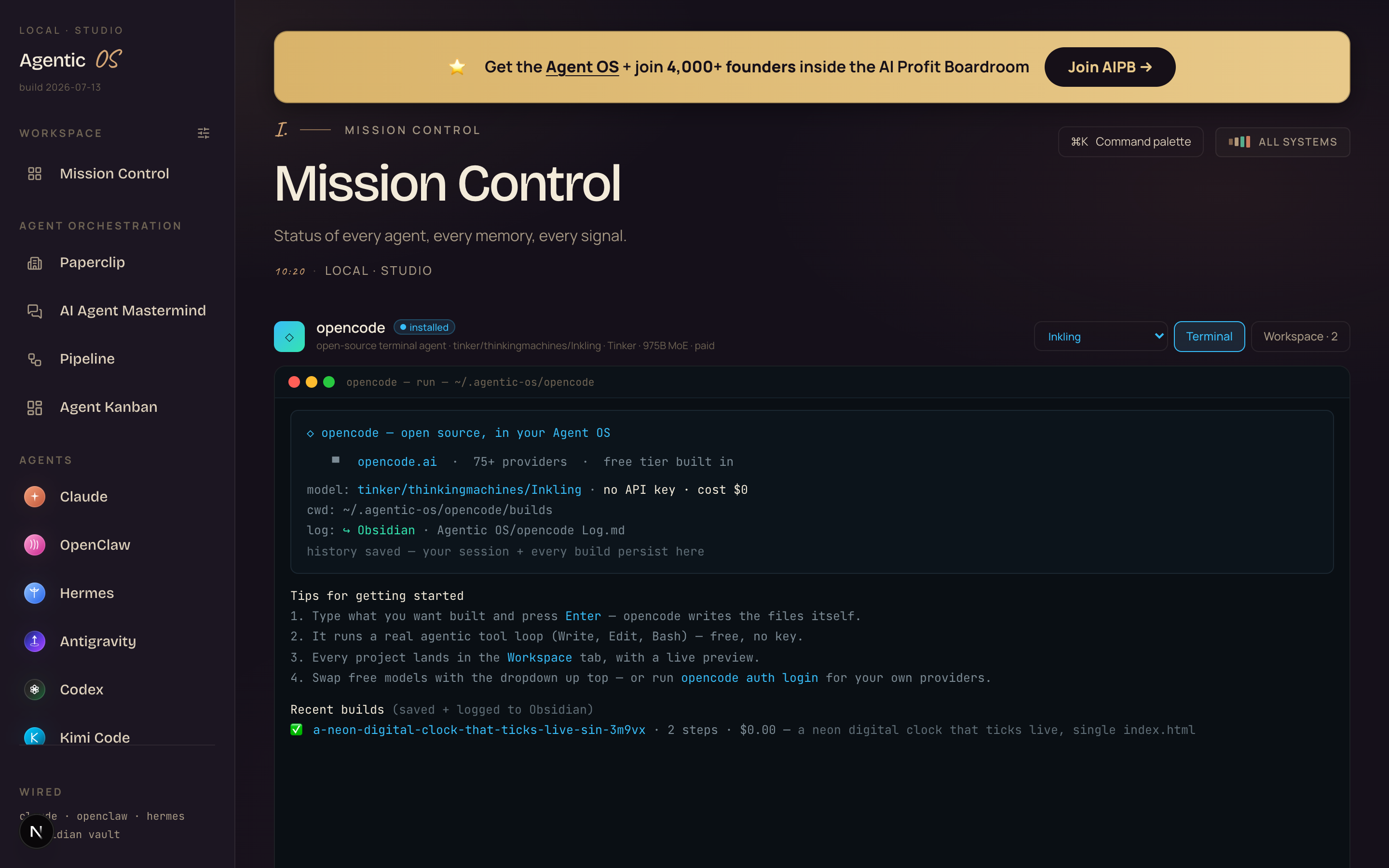
What you're looking at: the opencode tab inside my Agent OS, with Inkling picked in the model dropdown — the sub-line reads tinker/thinkingmachines/Inkling · Tinker · 975B MoE. It sits right next to the free models, in a tab I already had. That's the whole "wiring" — one provider, one dropdown entry.
✦
IV · The framework
The Ink Machine, in four moves.
This is the repeatable play for turning any open-weights frontier model into a build machine you own. Four moves, in order.
i.
Grab the weights
Pick an open-weights model you can actually hold — Inkling's full weights are public. You're not renting a black box; you're taking a real, ownable model.
ii.
Hold the key
Get your own API key and point the tool at it. The model answers to you — your usage, your key, your control. No per-seat middle-man deciding your price.
iii.
Wire the tap
Plug it into the coding tab in your Agent OS as one provider. Now the frontier model lives next to your free models, in a workflow you already know.
iv.
Ink the build
Feed it one prompt. It reasons, writes the real files, and drops a finished build in your workspace — saved, previewed, logged. One sentence in, a working thing out.
You don't rent the brain. You hold the key.
V · Old way vs new way
Renting a brain vs owning the machine.
The old wayrented
Every model you use is a black box you don't own
You can't see the weights, run it offline, or shape it
Price is set by the lab and changes without warning
A retired model or a new paywall breaks your workflow
To get "frontier + governance" you're quoted an enterprise plan
Result: your business runs on a brain you can't control
The new way · the Ink Machineowned · ~$0.33/M
A real 975B open-weights model — the full weights are yours
Run it on your own key, in your own stack, even export it
Usage-based pennies — a full one-shot build cost me cents
No lab can retire it out from under you — it's on Hugging Face forever
No enterprise upgrade needed — one config line, one key
Result: a frontier model that answers to you, printing builds
The enterprise route quotes you a plan. Your own key charges usage — cents for a full build. Same frontier model.
THINKING IT?"Don't I need a Databricks Premium plan or some big enterprise deal?"
No. I nearly upgraded to Databricks Premium for this — then didn't need it.
Inkling runs straight off a Tinker key on an OpenAI-compatible endpoint. One config line. No enterprise tier, no cloud contract.
VI · What it inked out
One prompt. 36 seconds. This came out.
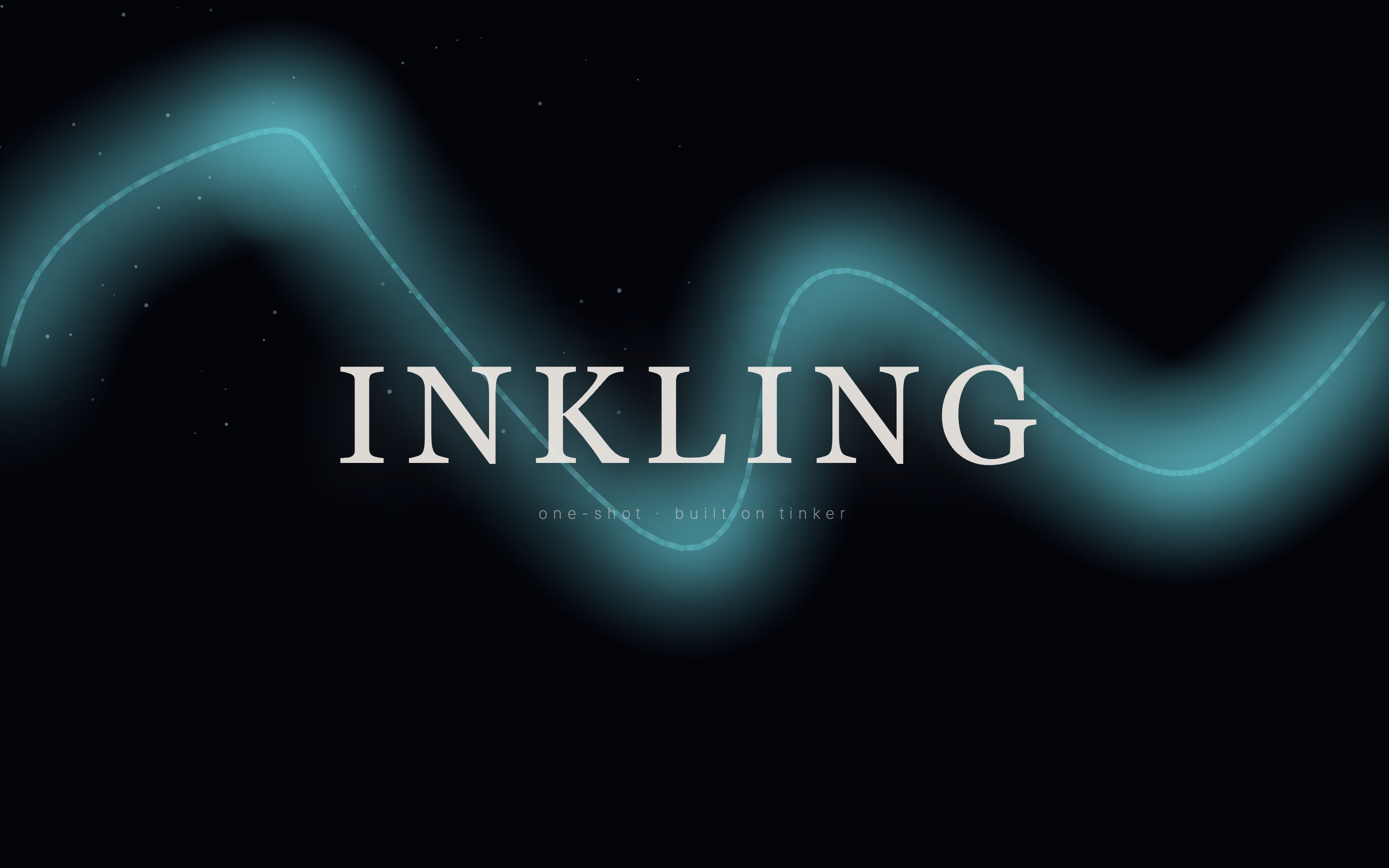
I gave Inkling one sentence: a glowing aurora over a starfield with an INKLING title. No edits, no second pass. This is the actual file it wrote, rendering live in my Agent OS.
What you're looking at: a live, animated generative-art page — Inkling one-shot it in 35.9 seconds for about 1,700 tokens (pennies). Complete, valid HTML with a canvas animation, saved straight into the opencode Workspace tab. One sentence in, this out.
Inkling is a strong open-weights base — ahead of Nemotron 3 Ultra, near GLM 5.2 and GPT-5.6 Sol. Numbers from Thinking Machines' Inkling launch (SWE-bench Verified).
Thinking Machines is honest about it: Inkling isn't the single strongest model on Earth. The closed frontier (Fable 5) still tops the charts. What makes Inkling special is the combination — frontier-class, multimodal, and yours to own and run.
✦
THINKING IT?"Doesn't running the Agent OS burn a fortune in tokens?"
No — that's the biggest myth about it. The Agent OS runs the everyday 90% on a free local model on your own machine (nothing leaving it), free APIs slot in for more, and for frontier work it drives the CLIs you already pay for — your Claude subscription already includes the Claude CLI, and the OS plugs straight into it, so you're not paying twice. Inkling here is the same idea: your own key, pennies per build. Inside the Boardroom there are full token-efficiency tutorials so you cut usage to the bone.
Wrong: "Open-weights models are weak toys — the real power is all closed."
Right: Inkling is a 975B multimodal frontier model that beats Nemotron 3 Ultra on agentic coding and sits right next to GPT-5.6 Sol. Open no longer means weak.
Wrong: "To run a frontier model myself I need GPUs, a server, and a PhD."
Right: You need one API key and one line of config. It's served on an OpenAI-compatible endpoint — any tool that speaks OpenAI can use it, no infrastructure.
Wrong: "I'll wait until this stuff is easier and cheaper."
Right: It's already pennies per build and it's live today. The people wiring their own models in now are the ones who'll own their stack when everyone else is still renting.
Don't take my word for it
Members post their wins every day — agency owners, ecom founders, course creators, solo operators across 38 countries. Real businesses, real numbers, in their own words.
The AI Profit Boardroom is where the actual Agent OS lives — the templates, the prompts, the daily rooms, the weekly walkthroughs. Same builds you read about here, taught hands-on inside.