Publishing isn't ranking.Google has to FIND the page first.
You can ship the best article on the internet and it'll sit invisible for days — sometimes weeks — waiting for a crawl. Indexceptional is how my pipeline kills that wait: every deploy ends with an API call that routes the fresh URLs through three distribution channels and shows me the actual Googlebot visit. Here's the whole setup, copy-paste included.

What it is. See it yourself.
I once shipped 89 pages… and indexed none of them.
Before
June 20th. Six deploy batches. Eighty-nine fresh URLs pushed live across the network.
Guides, comparisons, tutorials — days of agent work, all published.
And then… nothing. Because publishing was where my checklist ended.
Not one of those URLs had been submitted for indexing. They were invisible — live on my server, unknown to Google.
That day the pipeline got a new law: a deploy is NOT done until the URLs are submitted.
After
Now it's mechanical: deploy → verify the page returns 200 → submit the batch to Indexceptional.
Three distribution channels carry every URL, and the dashboard shows the real Googlebot arriving.
The agents do it automatically — it's a standing rule in the system, not a thing I remember.
Since that rule: zero pages shipped unindexed.
One rule. That's the whole difference between "live" and "found."
Why listen to me on indexing.
I run a 7-figure SEO agency (70+ people, AI handling ~80% of ops) and a content network that ships pages daily — every one of them through this exact loop. The results are on Google right now: one keyword, four first-page surfaces, including the AI Overview citing me by name.
No invented quotes. Member wins are in their own words — 158 pages of them, raw.
Read the 158-page wins doc →Commit to closing your own loop this week.
Count your last ten published pages. How many did you actively submit for indexing? If the honest answer is zero, you have pages sitting invisible right now.
Here's the deal.
This week, add ONE step to your publish flow: submit every fresh URL the moment it goes live. That's it. It's the cheapest ranking win that exists — you already did the hard part when you wrote the page.
Deploy → verify → submit. Make it law.
Three channels. Live status. Real Googlebot visits.
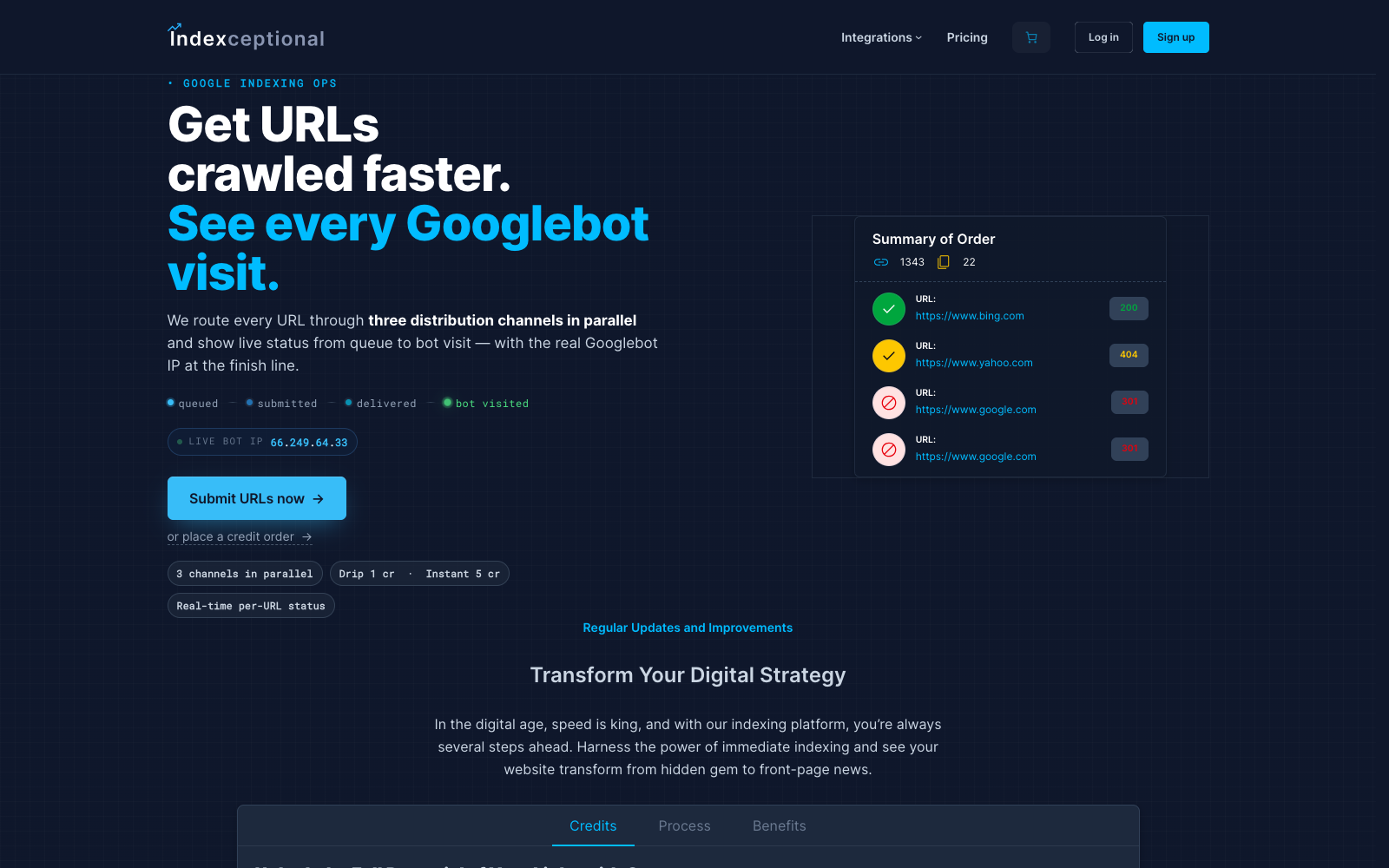
Indexceptional takes your URLs and routes each one through three distribution channels in parallel — then shows the journey live: queued → submitted → delivered → bot visited, with the actual Googlebot IP at the finish line. That last part matters: you're not trusting a "submitted ✓" checkmark, you're watching the crawler actually arrive.
Pricing is simple: 1 credit per URL on the drip lane, 5 credits if you want the instant lane. My balance right now — checked live while writing this guide:
curl -s .../wp-json/index/api/v1/check-balance -u "$EMAIL:$API_KEY"
{"success":true,"data":{"credits":94962}}
Waiting for the crawl vs forcing the crawl.
- Hit publish, close the tab
- Hope the sitemap gets read soon
- No idea if Google ever came
- Fresh content ages before it's even seen
- 89 URLs live, zero indexed (I did this)
- Deploy the batch
- Verify every URL returns 200
- One API call submits the whole batch
- Watch queued → delivered → bot visited
- Standing rule — the agents never skip it
My exact post-deploy loop.
This is the actual flow my agents run after every deploy — three steps, fully scriptable. Swap in your own email + API key (Indexceptional gives you a WordPress-style application password).
Never submit a 404.
After the deploy, curl every fresh URL and demand a 200. Credits are cheap; wasting them on typo'd slugs is silly — and a 404 submission tells Google nothing good.
200 https://agentos.guide/seo-agent-os
200 https://agentos.guide/agents-a1
One API call. The whole batch.
POST the URL list — I always include the home page too, because its link grid just changed and I want that re-crawled as well. That home-page trick alone speeds up discovery of everything the new page links to.
-u "$EMAIL:$API_KEY" -H "Content-Type: application/json" \
-d '{"urls":["https://yoursite.com/new-page","https://yoursite.com/"]}'
Put it in the system, not in your memory.
The reason my pages stopped shipping unindexed isn't discipline — it's that the rule lives in the agent instructions. The deploy script literally is not "done" until the submission returns success. If you automate one thing from this guide, automate the trigger, not the API call.
It's one gear in the Agent OS machine.
Indexing is stage 3 of my SEO pipeline — after the keyword research and the 5-article content engine, before the measurement loop. In the Agent OS, the whole chain runs as one system: the agents write, deploy, verify, submit, and report back.
It's the operating system I run a seven-figure business on. You get the whole thing.
Get the Agent OS →No. The everyday 90% runs on a free local model on your own machine, free APIs pick up the middle, and the frontier work rides the CLIs you already pay for — your Claude subscription plugs straight in, so you're not paying twice. Indexing itself costs credits, not tokens — and at 1 credit per URL, my 94,962 credits will outlive the network.
Why your pages stay invisible.
Wrong: "If I publish it, Google will find it."
Right: Eventually — maybe. Crawl budget is real, new sites get visited rarely, and "eventually" can be weeks. I shipped 89 URLs believing this. Discovery is a step you own, not a favour Google does you.
Wrong: "Submitting a sitemap is enough."
Right: A sitemap is a menu, not an order. Active submission puts the specific URL in the queue and shows you the bot actually arriving — with its IP. Menu vs order is the whole difference.
Wrong: "Indexing tools are a shady grey-hat thing."
Right: There's nothing grey about telling a search engine your page exists. The content still has to earn its ranking — indexing just makes sure the race actually starts.
158 pages of members running this stack — their words, their numbers, raw.
Read the 158-page wins doc →Stop shipping pages into the void.
You now have the exact loop: deploy → verify → submit → watch the bot arrive. You could wire it yourself this afternoon — or you could get the whole machine it belongs to, already assembled, with 3,900+ founders and daily tutorials showing you exactly how it runs.
Every page you published last month that never got submitted is still waiting in line. That's rankings, traffic and sales queued behind one missing API call.
Get the Agent OS →Deploy → verify → submit. Make it your law, then check the next guide in the pipeline. I'll see you in the next one.