The Zero-Token Enginea free AI agent that never leaves your laptop
Magnitude runs 100% on your own computer — no API keys, no token costs, no rate limits. I installed it and tested it on real local models. Everything below is my machine.
Free. Open source. Actually local.
Launched August 8th. The scoreboard says the rest.
"Today's agents are local, but the model isn't. Every prompt, every file, every secret gets sent straight to Anthropic and OpenAI."
— Tom Greenwald, Magnitude co-founder, at launch
The line that hit a nerve
Your agents feel local — terminal, desktop, apps. But every single thing you ask travels to someone else's server: your client list, your contracts, your money questions. Magnitude flips that — the model itself lives on your laptop. Pull the wifi cable and it still works.
Your "local" agent leaks everything
Every "easy" AI option quietly ships your data to the cloud.
That was true a year ago. Magnitude is one install command, and then it makes the technical choices FOR you — picks the models, manages the memory, handles the setup.
If you can install an app, you can run this. My real install is below — watch it.
The Zero-Token Engine™ — three pieces, one install
Cloud AI runs on a meter: every token costs money or counts against limits. A Zero-Token Engine has no meter — the model runs on hardware you already own, so ten thousand questions cost the same as leaving your laptop on.
Local AI pain vs one command
- Install a separate model server (Ollama, llama.cpp)
- Guess which model your machine can handle — nobody tells you
- Download huge files and hope
- Wire the model server to a separate agent tool
- Keep both running and pray they talk to each other
npm install -g @magnitudedev/cli→ typemagnitude- It profiles your chip and memory automatically
- It recommends models for YOUR exact machine
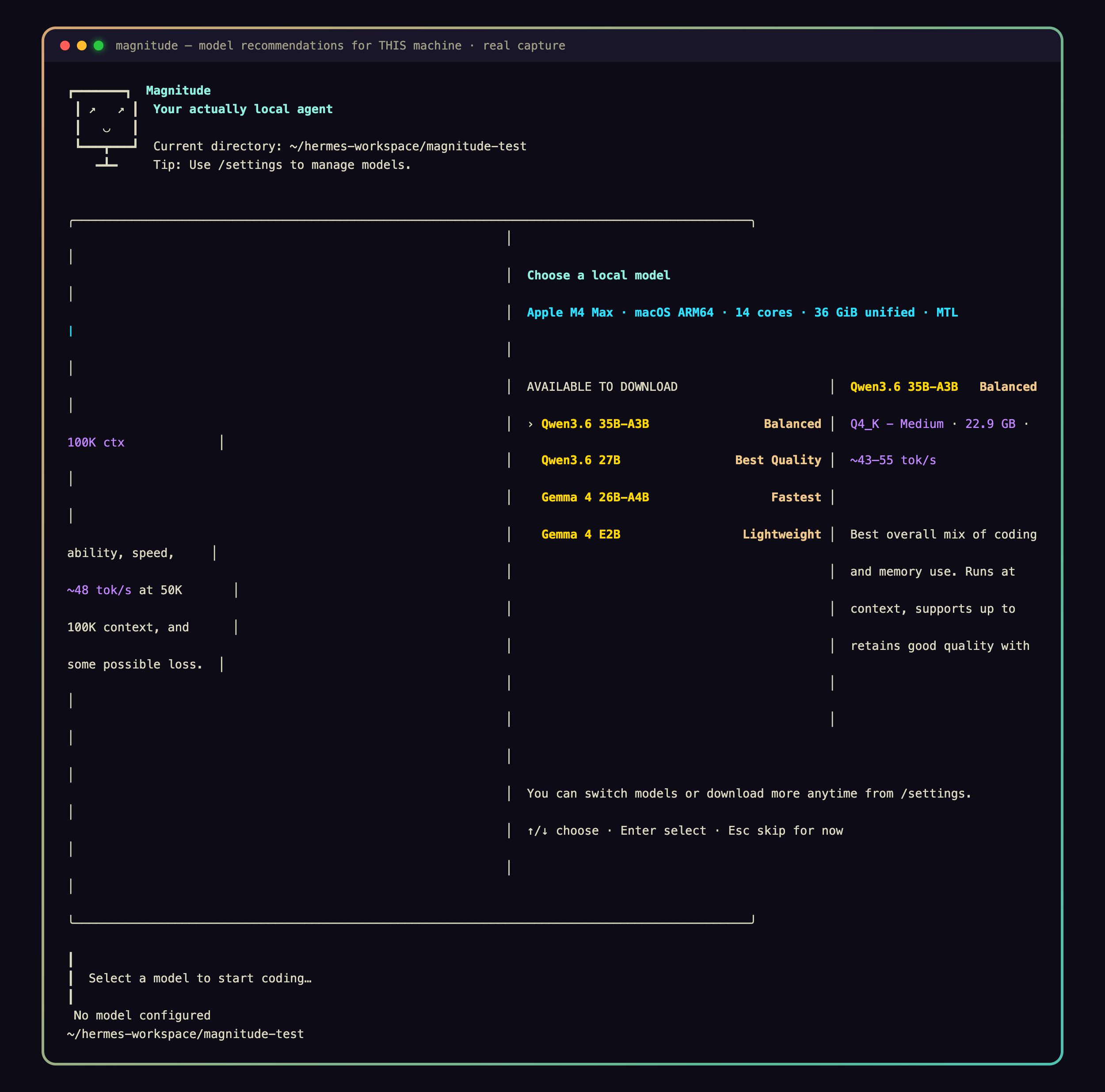
- Four choices: Best Quality · Balanced · Fastest · Lightweight
- Pick one — it downloads and configures everything
Tom answered this directly: no separate inference server to configure and manage — it's built into the agent, spun up and down as you use it, curates models to your exact hardware, and the agent corrects local-model failures. That last part is the difference between a toy and a tool.
Get the Zero-Token Engine wired into your stack.
Inside the AI Profit Boardroom you get the Agent OS — one dashboard where all your agents plug in: your Claude, your Hermes, your OpenClaw, and local agents like Magnitude too. When a tool like this drops, you're not figuring it out alone.
I installed it and ran it. Watch everything.
One command in, Magnitude profiled my machine — and every screen below is the real session, captured live.
What you're watching: the real first run — boot, the hardware profiler reading my machine, 36 models assessed, and the four recommendations appearing. The whole "old way" collapsed into seconds.
"model requires at least 25,926,572,480 bytes of system memory… but only 14,546,599,936 bytes are available"
— the engine, refusing to load the 22.9 GB Balanced model next to my running Agent OS. It measured the doorway instead of jamming the couch — so I switched tiers in /settings, which is exactly what the four-tier ladder is for.
What you're watching: the private-spreadsheet test on Gemma 4 E2B (the 2.6 GB Lightweight tier). It wrote a full pandas script to analyze.py, hit a shell-quoting error, diagnosed itself, fell back to running the file, even pip-installed a missing package on its own — and produced the revenue table. I checked every number independently: all six clients exact, top region exact. 100% offline, ~78 tok/s.
What you're watching: the messy-folder test — it planned the file mapping, created five subfolders, moved files with properly-quoted shell commands, and when tree turned out not to be installed, switched to ls -R by itself. Honest note: on the Lightweight tier it needed a couple of nudges and left some files for a second pass — multi-step autonomy is what the bigger tiers are for.
The spreadsheet test: perfect — every number matched my independent check, fully offline. The folder test: real commands executed, with hand-holding.
One alpha rough edge worth knowing: the default shell safeguards silently held commands in this build — launching with --disable-shell-safeguards unlocked execution. It is a days-old alpha; they shipped a user-requested feature the same day it was asked for.
Private plus spreadsheets changes everything
Out of the box: shell, files, scripts. Then skills snap on.
Hand it the spreadsheet you'd never upload.
Client data, payroll, margins — ask anything, because the data physically cannot leave your machine. There's no server on the other end. Nothing to leak.
Let it read the journal you're not ready to share.
Search, summarize and organize private notes — and it all stays on your laptop.
Point it at the folder you're ashamed of.
Ten years of scattered documents, sorted. Boring — but it's the boring that saves hours every week. (I made it do exactly this below.)
Not a server rack. Probably the laptop you're on.
Tom's own answer: any Apple silicon Mac from 2020 on. The tiers below are what mine was offered.
My test ran on a Mac, not a rig — and when someone asked about CPU-only laptops, Tom was honest: Apple silicon runs well, plain CPU machines will struggle.
That honesty is rare in AI launches. He's not overselling it — and a five-year-old MacBook clears the bar.
They didn't borrow an engine. They built one.
Written in Rust on llama.cpp — and it measures the doorway before moving the couch.
And they move fast: someone asked about pointing it at a separate machine at home — Tom said they were building it that day, and custom endpoints shipped.
The cloud is still smarter. Use both.
A local model on a laptop is not close to Claude or GPT in a data center on hard reasoning — but most daily tasks don't need the smartest model on Earth, and a good harness covers the slip-ups.
What's actually holding you back
Wrong: "Free and local means weak and useless."
Right: The small models of 2026 beat the big cloud models of two years ago. Qwen and Gemma on a normal Mac read documents, build spreadsheets and organize files — my tests below are the receipts.
Wrong: "AI moves too fast — I'll wait until it settles."
Right: It's not going to settle — Magnitude shipped a feature the same day a user asked. The winners aren't the smartest people; they're the ones with a system for learning each tool as it lands.
Wrong: "Owning AI is for engineers with server racks."
Right: The whole point of this launch: one command, four choices, and the machine you already own. Renting intelligence is now a choice, not a requirement.
Members post their wins in a 158-page doc — real businesses, written in their own words.
Read the 158-page wins doc →The price of private AI labor just went to zero
Once the model is on your machine, every extra task costs nothing. Not cheap — zero.
This launch is the whole answer: local agents run the everyday 90% at literally zero, and the OS drives the subscriptions you already own for frontier work.
Token-optimisation tutorials live inside the Boardroom.
Your move. This week.
Renters watch their limits. Owners run free labor.
This guide gives you the Zero-Token Engine — the launch, the machine test, the receipts. The Boardroom gives you the system around it: the Agent OS dashboard where your Claude, Hermes, OpenClaw, Free Claude Code and local agents like Magnitude plug in together, the zip file, video tutorials, the 30-day roadmap, daily updates as new versions ship, four weekly coaching calls, the prompt library, and a member map with someone online 24/7.
The people who understand this shift early get to build with free labor while everyone else watches their usage limits. That window is open right now.
Decide which one you are tonight.
Get the Agent OS →