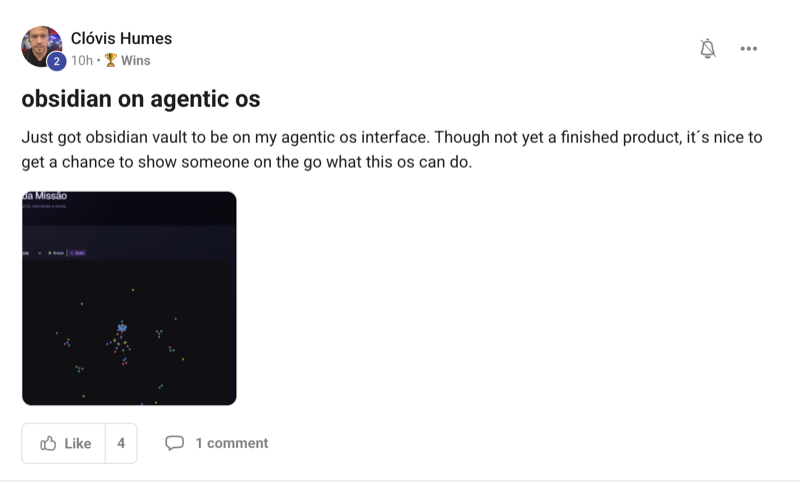
Prime Agent or Hermes — which one should you actually run?
Everyone's been asking since Prime Agent dropped on August 6.
I've had both running on my machine, side by side, on the same jobs.
And the honest answer beats a winner.
These two agents learn in opposite ways.
One keeps its own notebook. The other reads yours.
I'll spell out every difference — no scores — and at the end I'll show you the setup where you don't pick at all.
Aug 0
the day Prime Agent dropped — MIT open source
0K
GitHub stars on Prime Agent already
$0
both are free — they log in with what you already pay for
The whole guide in one picture: Prime Agent writes and edits its own notebook — Hermes, the way Julian runs it, reads the shared vault that every agent on the machine reads.
01 · the two agents, in 30 seconds
Two terminals. Two very different stories.
Quick backgrounds before the differences — both free, both open source, both living in a terminal.
◆ Prime Agent
Prime Intellect — dropped August 6, 2026, MIT open source
Logs in with your Claude or ChatGPT subscription, 20+ providers, or free local models
95.5% on ARC-AGI-3 — self-reported by Prime Intellect, so label it that way
11.4K GitHub stars and climbing
Mac + Linux (Windows via WSL) · no security sandbox yet — it runs real code
◆ Hermes
Nous Research — free, open source, terminal-first
Plugs into everything: subscriptions, OpenRouter, free local models via Ollama
Live X search and MCP connections built in
Profiles, skills and toolsets you can swap per job
Julian's daily driver inside the Agent OS for months
The launch tweet · 2.8M views
Here's how Prime Agent announced itself
Prime Intellect's launch tweet is the whole pitch in one post: a self-improving RLM harness, token-efficient by design, and tool calling written as code instead of clicky menus.
It pulled 2.8 million views — that's why your feed won't stop asking "Prime or Hermes?"
Hold that question — it's the wrong first question.
The right one is where you want your agent's lessons to live, and that's exactly what this page spells out.
02 · the framework
The Two Notebooks Test.
Every learning agent writes its lessons somewhere — call that place its notebook.
Prime Agent keeps its OWN notebook; Hermes, the way Julian runs it, reads YOURS — and every difference on this page hangs off that one split.
✍️The self-writing notebookPrime Agent writes, edits and owns its notes about itself. Nobody else reads them — it just gets sharper.
📖The shared notebookThe Obsidian vault in Julian's Agent OS. Hermes reads it, Claude reads it — every agent reads the same pages.
🧭The test itselfFor any agent you ever try: ask "where do its lessons live?" — that one question predicts how it will grow.
"One keeps its own notebook. The other reads yours."
03 · difference 1 — how they work
One deep tool vs a wide toolbox.
Prime Agent has ONE tool — a live Python session that never resets — so everything it does is written as code, and big files sit outside its memory while it grabs only the piece it needs.
Hermes is a toolbox — skills, tools, profiles and connections — you speak plain English and it picks the right tool, from X search to other models to image and video generation.
The anatomy split: Prime thinks in code inside one live Python session — big things stay out of its head. Hermes hears plain English and reaches into a toolbox.
THINKING IT?"Terminal agents sound too technical for me."
Both install with one pasted command, and from then on you type plain English.
The real test I ran below is literally one sentence: "find the CRITICAL line in this log."
04 · difference 2 — how they learn
This is the core: where the lesson lands.
Prime Agent runs a Continual Harness — notes about itself, reviewed every 25 turns by a separate pass that makes small evidence-backed edits, each one snapshotted and rollbackable while the base instructions never change.
Type /refine and a correction gets baked in permanently — I recorded it happening on my machine.
Prime's Continual Harness: every 25 turns a separate pass reviews the work and makes one small, snapshotted edit to the agent's own notes — while the base instructions stay locked.
Hermes has automatic behaviour learning built in — and then Julian adds the bigger layer: a shared Obsidian vault inside the Agent OS where every session, business fact and style rule gets saved.
Claude reads that vault. Hermes reads it. Every agent on the machine reads the same notebook.
The shared notebook: one Obsidian vault at the centre, every agent reading the same pages. The vault memory and schedules are Julian's Agent OS layer around Hermes — not core Hermes features.
Spell it out: correct Prime, and Prime gets smarter. Correct the vault, and the whole agent team gets smarter.
Lesson-in-the-tool vs lesson-across-everything — neither is wrong, they're built for different jobs.
The one line to remember from this whole section: correct Prime → Prime gets smarter. Correct the vault → every agent gets smarter.
THINKING IT?"How would I even know what my agent learned?"
Both notebooks are readable files on your disk — Prime's is JSON you can open, the vault is plain Markdown notes.
You can read every lesson, and in Prime's case roll any of them back.
THINKING IT?"Doesn't running an Agent OS burn a fortune in tokens?"
No — that's the biggest myth about it. The everyday 90% runs on free local models on your own machine, free APIs slot in for more, and for the frontier work it drives the CLIs you already pay for — your Claude subscription already includes the Claude CLI, and both Prime Agent and Hermes log in with those same subscriptions, so you're not paying twice.
And inside the Boardroom there are full token-optimisation tutorials, so you cut usage to the bone and never think about it again.
06 · difference 3 — while you're away
Two ways to work while you sleep.
Prime Agent's overnight power lives inside its sessions — daemon-backed (close the laptop, it keeps working, reattach later), heartbeats that wake it on a rhythm, a persistent /goal, bounded /autonomous runs with budgets, even agent-to-agent messaging.
Hermes runs background agents and parallel fan-outs — and in Julian's Agent OS the overnight power lives in the OS around it: real cron schedules, like his competitor watcher at 6:00 and his YouTube analyzer at 6:20, which both ran this morning.
Same need, two homes: Prime keeps overnight power inside the session (daemon, heartbeats, /goal). In Julian's setup, Hermes gets it from the OS — cron jobs that genuinely ran this morning.
THINKING IT?"I don't want my laptop grinding all night."
Neither setup needs that — Prime's autonomous runs take budgets you set, and the Agent OS jobs are two short scheduled bursts at 6:00 and 6:20.
You decide the rhythm; nothing runs unbounded.
07 · the demo — four real jobs, side by side
Same job, both agents, on camera.
I gave both agents the same four jobs on this machine — nobody loses, the paths differ, and the differences tell you what each one is FOR.
Job 1 — find one critical line in a giant log
What you're watching: real sessions from this machine, replayed at reading pace. Same 7.1 MB, 120,001-line log. Prime Agent (left) writes a tiny Python loop — the file stays out of its head. Hermes (right, on grok-4) picks a terminal tool. Both land on line 83219, which I verified by hand.
Job 2 — teach it how you like something written
What you're watching: real sessions, replayed at reading pace. Prime (left): correct it once, run /refine, and the lesson is baked into its own notebook — the JSON it saved is on my disk. Hermes (right): the order-confirmation rules live in one vault note, and the real email it drafted follows all five rules — as will every other agent that reads that note.
Job 3 — watch something on a schedule
What you're watching: an animated recreation of real data captured on this machine today. Left: the real prime-agent daemon status (pid 95679) plus the documented /goal + heartbeat flow. Right: the two real launchd jobs and this morning's real radar output — timestamped 6:03 AM, headline included.
Job 4 — spawn helpers
What you're watching: real sessions, replayed at reading pace. Prime (left) spawns two child agents as a function call — await rlm() — and reports WARN: 2,475 and DEBUG: 1,295. Hermes (right) hands the same jobs to background agents in plain English and returns the same totals. I checked both against grep: exact match.
08 · when to reach for which
Two lanes. No scoreboard.
Reach for Prime Agent for long, deep, self-contained work — big coding jobs, research marathons, one agent grinding for hours and getting sharper as it goes (Prime Intellect's own demos include building emulators from a spec).
Reach for Hermes as the connected agent wired into your world — memory, schedules, tools, live search, business context — the agent that already knows you.
Descriptive, not scored: the deep solo lane and the connected lane. The real question underneath is simply — where do you want your lessons to live?
And you don't have to choose: both are free, both log in with what you already pay for, and both run side by side on the same machine — mine are, right now.
Right: Each installs in one command — and a shared vault means a new agent just reads the same notes everyone else does. The system carries the complexity, not you.
Wrong: "Self-improving agents are risky — who knows what they're teaching themselves?"
Right: Prime Intellect tells the cheating story themselves — an agent once saved Factorio cheating tricks as skills. That's exactly WHY the notebook is reviewable: small, snapshotted, reversible edits, and the vault is plain readable notes. Review what your agent learns — you stay the boss.
Wrong: "This space moves too fast — I'll fall behind whatever I pick."
Right: Tools change weekly; lessons compound. Every rule you bank in a notebook carries forward to the next tool — the notebook is the part that lasts.
Don't take my word for it
158 pages of members who already worked through these exact doubts — real businesses, real wins, in their own words.
Install both — free, minutes each. Prime Agent is one command from the GitHub page; Hermes is one command from Nous Research. Both log in with the subscriptions you already pay for.
Give Prime one deep task. A long coding or research job — then correct it once and run /refine, and watch the lesson land in its notebook.
Give Hermes one connected task. Something that needs your world — a live X search, a file on your machine, a rule from your notes.
Then decide where your lessons live. That's the Two Notebooks Test — run it on every agent you ever try.
THINKING IT?"Won't running two agents double what I pay?"
Both are free and both log in with what you already pay for — the same Claude or ChatGPT subscription can drive either, and free local models via Ollama drive both at $0.
The AI Profit Boardroom is where the actual Agent OS lives — the shared vault memory, the morning schedules, the prompts, the daily rooms. Same setups you just watched, taught hands-on inside.