The Book Brain EngineHermes agents can learn any book now
One command. Point Hermes at a PDF or a book, and it reads the whole thing once, breaks it down, and turns it into a skill it can use forever. Here's what it means, and my real run.

The Re-Upload Problem.
You've got a book your AI should know.
A sales book. Your brand guidelines. Your standard operating procedures.
So you dump the PDF into the chat.
And one of two things happens.
Either the AI chokes, because the book is too big for its working memory.
Or it reads it once, answers your question — and forgets everything the moment the chat ends.
Next conversation, you upload the whole thing again. And again. Paying to re-feed the same book, forever.
It's like hiring an assistant who reads your entire company handbook every morning, forgets it by lunch, and reads it again tomorrow.
The Book Brain Engine™ ends that cycle: the book gets read once — and becomes part of how your agent thinks.
The command is literally /learn followed by the file location. You don't write code. You don't build anything.
If you can attach a file to an email, you can do this.
The book stops being a file. It becomes a brain.
Instead of dumping a book into your AI's short-term memory, the Book Brain Engine converts it into a permanent skill.
It reads the whole thing once.
It pulls out the frameworks, the decision rules, the mistakes to avoid.
Then it builds a small set of files: an index, one file per chapter, a glossary of key terms, and a cheat sheet of quick-reference rules.
From then on, your agent carries that brain around. Ask a question, and it doesn't re-read the book — it checks the index, opens the exact chapter it needs, and answers from the real content.
One question's journey through the brain
The hidden tax this kills has a name — the project calls it the Discovery Loop Tax. The old way, an agent navigates a big PDF fresh in EVERY conversation: table of contents, wrong section, backtrack, re-read. The Book Brain Engine pays that navigation cost exactly once, at conversion.
So when someone asks "but what IS it?" — it's one command that moves knowledge from renting to owning.
Teknium answered this one directly: the main skill file caps around 100,000 characters, but it's built to point at compact reference files per topic.
The brain has a table of contents — it only opens the pages it needs, so book size stops mattering.
The announcement, in his own words
"Just /learn and point it to any pdf or book you have"
This is the moment the engine went native. Teknium — cofounder and lead engineer of Hermes Agent at Nous Research — shipped book-learning as a built-in command. In the replies he confirmed the practical details: the main skill file caps around 100k characters and just points to compact reference files, and yes, epub works.
Where /learn started
The command itself arrived earlier this summer — "pass it sources, past sessions, URLs, docs, whatever you think will help it learn, and it'll go from 0 to 1 to create you a skill." The August update is what taught it to swallow whole BOOKS with the expansive knowledge-base layout. Before this, Hermes skills had to stay small — around 200 lines, no reference files. Now a skill can be a subject, not a trick.
I fed it a whole book. Here's what happened.
I didn't want to just report this — so this morning I pointed /learn at a full book: Sun Tzu's The Art of War, as an epub.
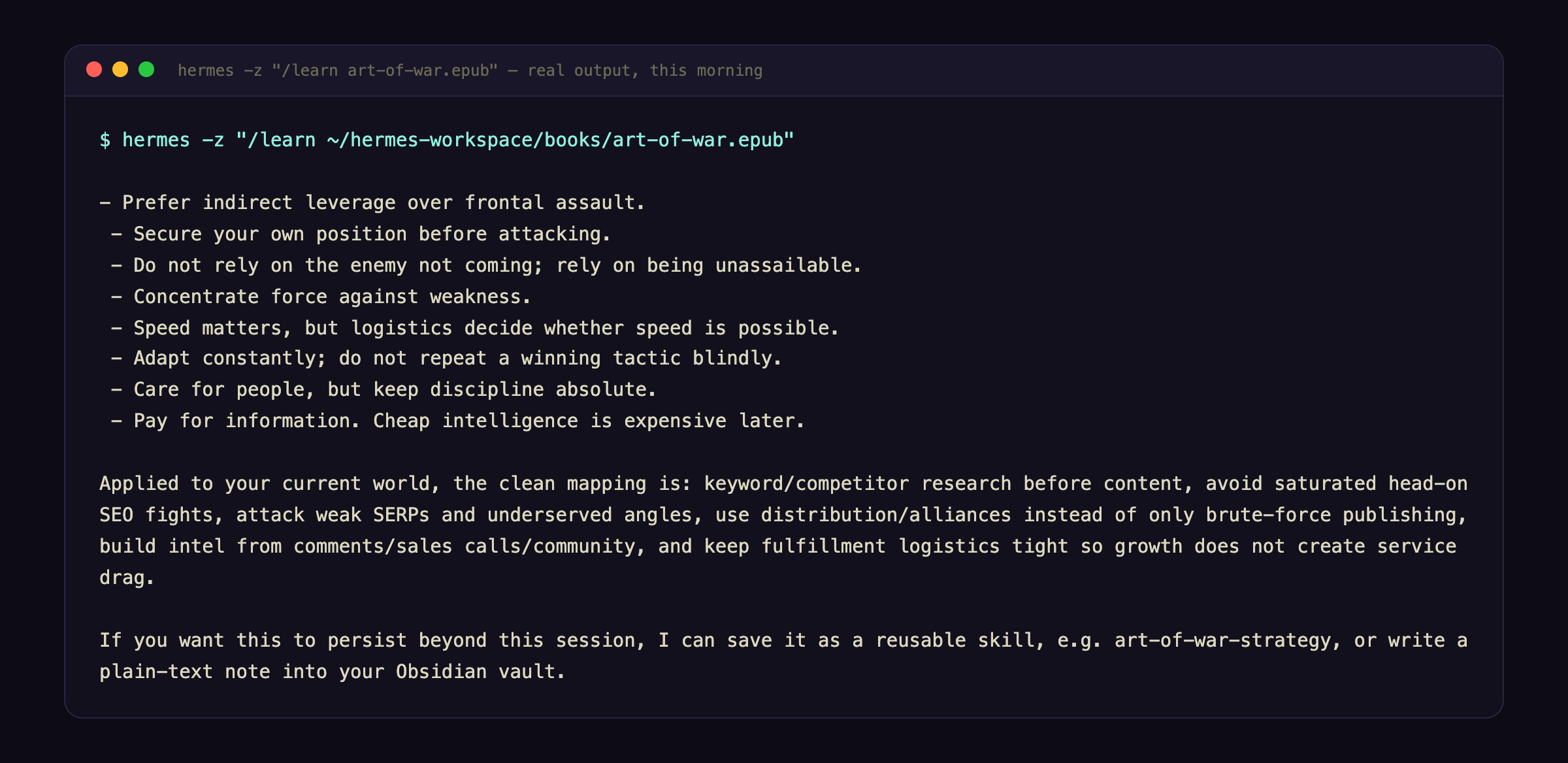
What you're looking at: Hermes mid-digestion — it read the epub and distilled the principles, then mapped them to my actual world unprompted: keyword research as scouting, attacking weak SERPs instead of saturated head-on fights, building intel from sales calls. The book is already being APPLIED, not summarised.
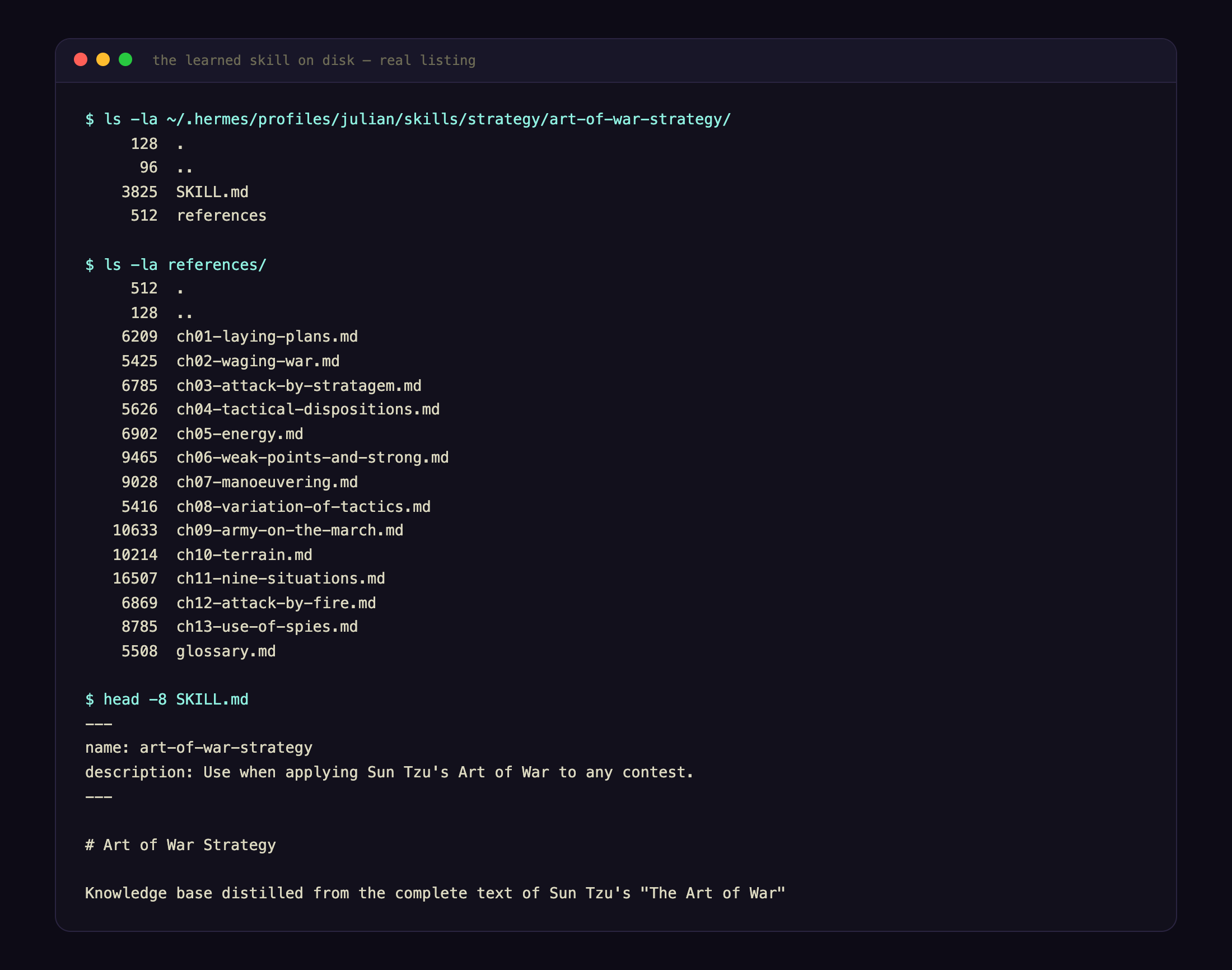
What you're looking at: the brain on disk after the run — a lean SKILL.md index plus the reference files. This folder IS the book now, structured for instant lookup. My agent carries it into every future session.
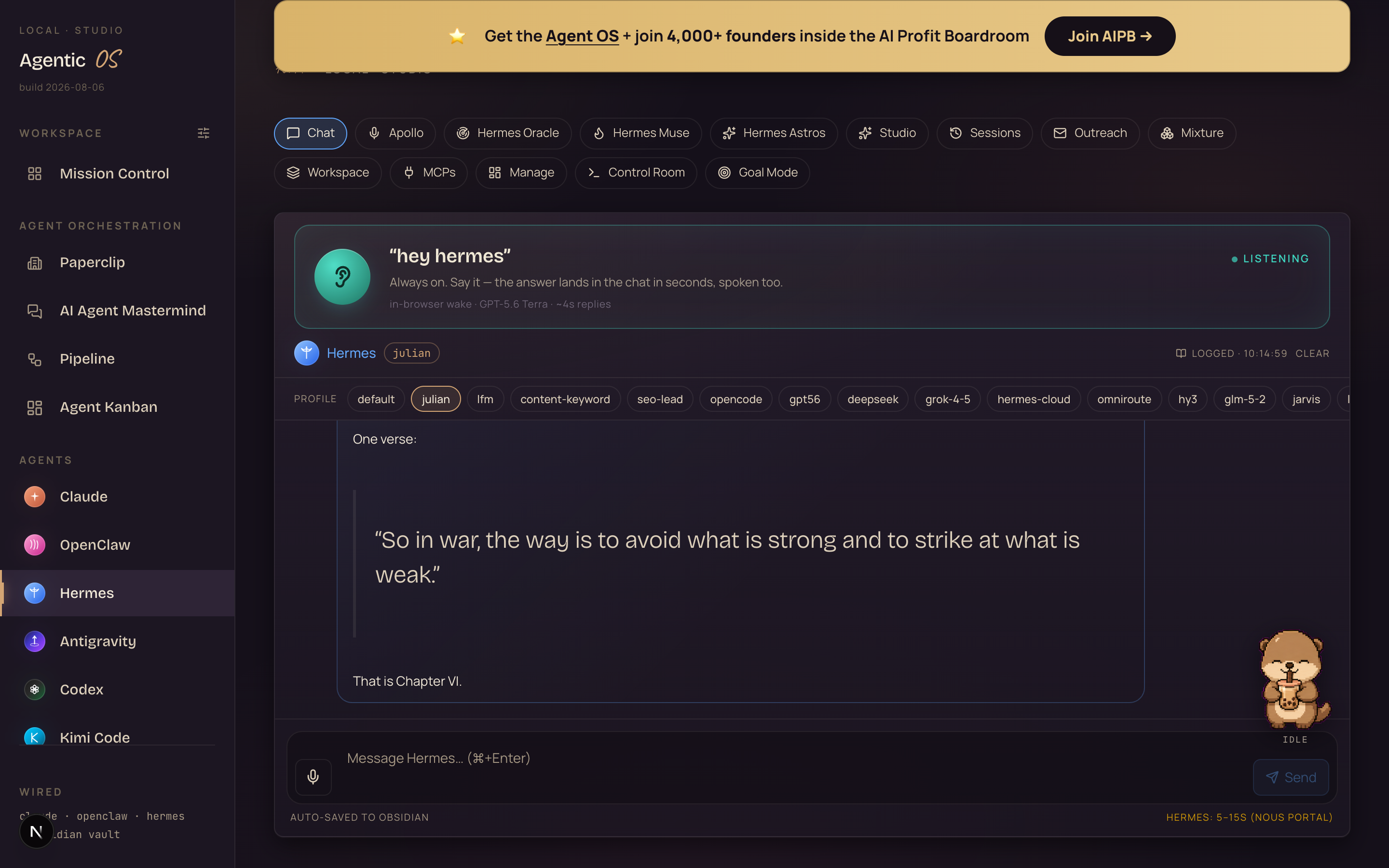
What you're looking at: the payoff — a fresh conversation, no upload, and the agent answers a strategy question by opening the exact chapter it needs from the learned skill. No re-reading, no re-feeding.
Why your agent just got 50× cheaper at knowledge
Every question you ask an AI costs tokens, and tokens cost money and time.
The engine's own testing, measured on real books, found the skill answers with 24 to 51 times fewer tokens than dumping the book into context.
That's exactly why this approach matters: the agent answers from the actual chapter files, not from vibes. The structure exists specifically to stop the guessing.
And the extraction runs locally on your machine — MIT licensed, fully open source, your documents stay yours.
It's not about books. It's about YOUR documents.
Everyone hears "feed it a book" and thinks about reading. But the engine works on any structured document — and that's where the business wins live.
Your client onboarding doc becomes a skill.
Every agent task follows your exact process — without you explaining it each time.
Your program materials become a skill.
Your agent answers client questions the way YOU would answer them — from your actual frameworks.
Your brand voice guide becomes a skill.
Every product description and email your agent writes actually sounds like your brand.
One document. One command. Permanent knowledge.
Look at what waiting costs here: a skill library you start this week is an asset that grows every week — your books, your SOPs, your niche knowledge.
The gap between the person with fifty skills and the person with zero doesn't close on its own. It widens.
The Book Brain Engine™ — five layers
The exact system, bottom to top. Screenshot it.
Renting knowledge vs owning it
- Find a great sales book, read it, remember 5% in three months
- Your AI never truly saw it at all
- Dump the PDF per chat — choke, or answer-and-forget
- Pay the Discovery Loop Tax on every conversation
- Knowledge leaks out of the business constantly
- Run /learn — ten minutes later the book is a structured brain
- Every email, script and outreach pulls the book's real frameworks
- Answers cost an index-lookup plus one chapter, not a whole book
- Stack the next book on top. And the next.
- Knowledge accumulates instead of leaking
This update is literally a token-SAVING machine — 24-51× fewer per answer. The everyday 90% runs on free local models and free APIs, and frontier work drives the subscriptions you already own. Full token-optimisation tutorials live inside the Boardroom.
What's actually holding you back
Wrong: "My AI already read that PDF — it knows it."
Right: It knew it for one chat, then forgot. A learned skill is permanent — the book becomes part of how the agent thinks, in every future session.
Wrong: "Skills are for developers automating little tasks."
Right: That was true — skills capped at ~200 lines. This update made skills expansive: whole subjects, organized like a brain. The best first skills are business documents, not code.
Wrong: "Whatever I build will be locked into Hermes."
Right: The format follows the open Agent Skills standard — the same skill works across Claude Code, Copilot CLI and Amp. You're building a portable asset.
Members post their wins in a 158-page doc — real businesses, written in their own words.
Read the 158-page wins doc →Get the Book Brain Engine built for you.
You can wire this yourself with the steps below. Or get the whole thing done inside the Agent Operating System — Hermes installed, /learn ready, and a playbook for which documents to feed it first.
Your first book brain. This week.
Step 1: Get Hermes Agent (free, open source).
One-click install now — the walkthrough is in my one-click guide. Then run hermes update so you're on the build with book-learning.
One trap to skip: that literally bit me this morning — /learn's book mode ships in the newest update; on an older build the command exists but can't do the expansive knowledge-base layout.
Step 2: Pick ONE document and run /learn on it.
/learn ~/Documents/your-book-or-sop.pdfThe book you always recommend, or your most-used internal doc. PDF or epub, any book file on your machine.
Step 3: Ask questions you know the answers to.
Watch it pull from the actual content — the index, then the exact chapter. That's when the trust clicks.
Step 4: One skill a week.
In three months you've got a specialist. And the direction this is heading — whole libraries folded into one brain, contradictions cross-checked between books — the engine already supports folding new documents into existing skills.
Which book do you hand it first?
Hermes isn't just a chat window — it's a Telegram bot, a Discord bot, a scheduler with persistent memory that can spawn sub-agents.
Combine that with /learn and you get something new: an agent that runs on a schedule, remembers everything, and permanently learns from any document you give it. Feed it your industry's reference material and cron a weekly newsletter draft — that's a knowledge worker that studied your exact field, working while you sleep.
Agents that build up expertise over time, the way a good employee does. Except the employee forgets, and the agent doesn't.
Readers re-upload. Operators build libraries.
This guide gives you the Book Brain Engine — the command, the mechanics, my real run, the receipts. The Boardroom gives you the machine around it: the Agent OS where Hermes, Claude, OpenClaw and Free Claude Code share one memory — so the skills Hermes learns from your books feed workflows across your whole stack. Daily tutorials, four coaching calls a week, the 30-day roadmap.
Readers bookmark this page and keep pasting PDFs into chat windows. Operators join, run /learn on their first document this week, and start stacking a library nobody can take away.
Decide which one you are tonight.
Get the Agent OS →