II · my story · why this matters
I was you. Then I built this.
Before
Ranking sites with AI was a nightmare.
I had one tool for keyword research, paying $99 a month.
I had a separate writing tool, paying another $50.
Content went into a Google Doc. I'd publish manually. I'd post to community boards manually. I'd write internal links manually.
Each step lived in a different app. None of them talked to each other.
And nothing ever ranked the way it was supposed to — because by the time I'd done all the steps, the content was generic and the keyword opportunity was gone.
Then I wired seven agents into Agent OS — and the whole pipeline ran on one screen.
After
Now I open one dashboard.
I tell agent one: "Pick me a keyword I can rank for." It checks my domain authority and returns three candidates.
Agent two writes the source piece. Agent three multiplies it into a community post, a video script, and an infographic. Agent four ships them. Agent five renders the video. Agent six wires the internal links. Agent seven watches who cites me back.
I check the rank-1 placements in Google + AI Overviews + community search next week.
Monthly SEO tooling bill: $0.
The whole agency runs on this engine now — 70+ staff use this pattern for client work.
You can have this too. Same seven agents. Same Agent OS. Same free harness.
Before you scroll on —
Commit to transitioning today. Not tomorrow.
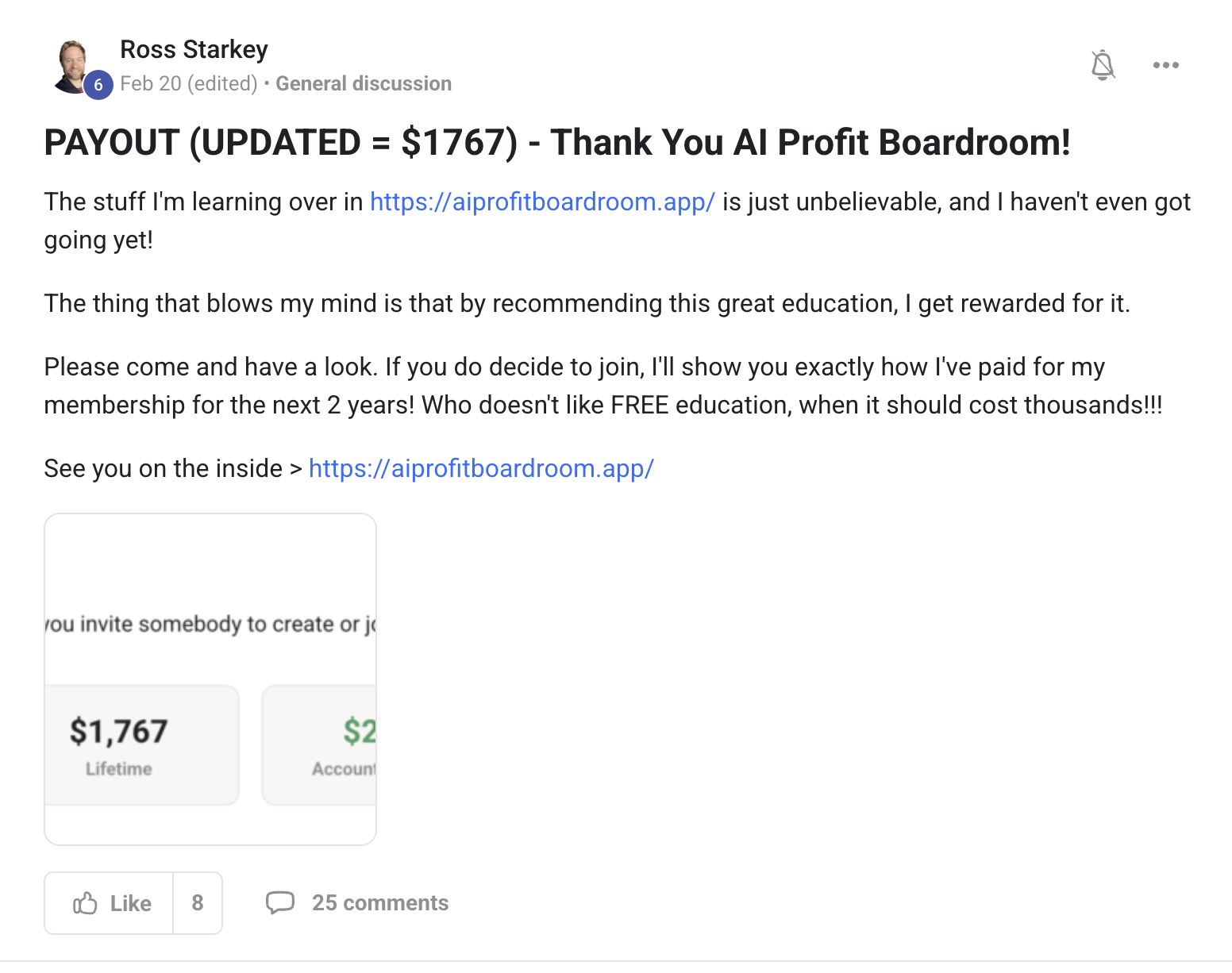
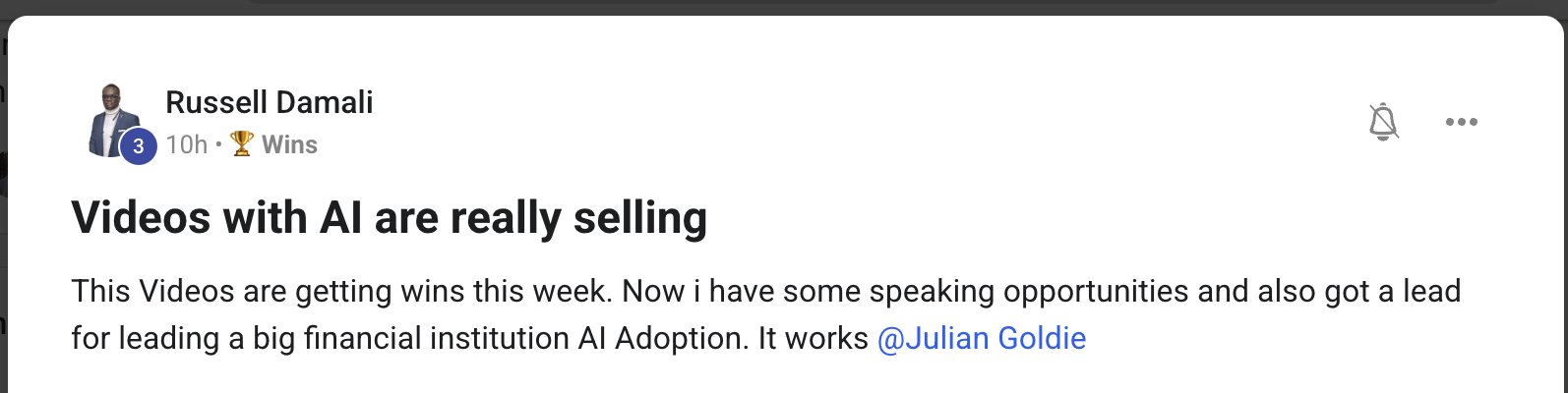
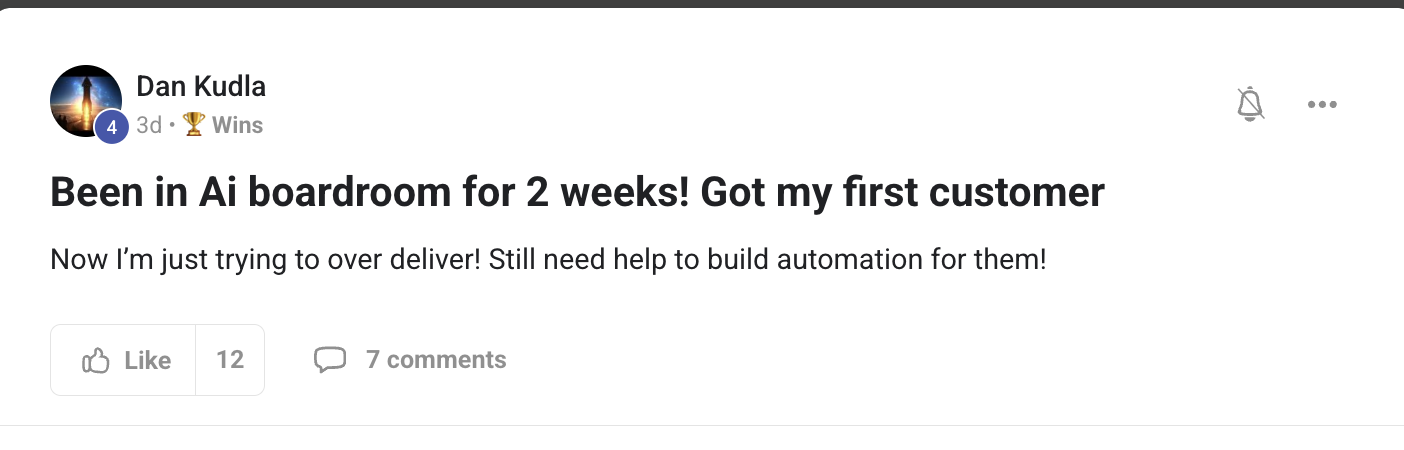
You've seen the proof above. Real members. Real rankings. Already happening.
The next 10 minutes show exactly how I wired the seven SEO agents into Agent OS.
So here's the deal.
If you're reading this — promise yourself one thing right now. You're going to finish this guide AND set up agent one (keyword research) before you sleep tonight. Just one of the seven. Because the moment you make this transition, your whole SEO workflow stops being a tool stack and starts being a system.
The people sitting still are paying for keyword tools they barely use. The people building today are running their own pipelines that rank for free.
Be one of those people.
Commit to the transition. Commit to wiring agent one today. This changes everything about how you rank.
IV · the framework
The Goldie Ranking Engine™.
Seven agents that turn one keyword into rank-1 placements across every surface that matters.
Each agent has one job. Each job feeds the next. By the end of the pipeline, you've got a source post, a community thread, a video, internal links pointing in, and a citation monitor watching it all. One Sunday-night session — a week of compounding rankings.
The pipeline — each station feeds the next, light flows left to right.
i.
Keyword agent — pick winnable keywords.
Reads your existing domain authority. Returns three keywords you can actually rank for today, not in six months. You stop competing for keywords above your weight class.
ii.
Source agent — write the canonical piece.
One blog post, dense, structured for AI citation. Quotable paragraphs. Real numbers from your Obsidian vault. Schema markup pre-baked. You stop writing generic content that never ranks.
iii.
Multiplier agent — one source, five formats.
Reshapes the source into a community thread, a social video script, an infographic brief, a podcast script, and a short-form snippet. Each one tuned for its platform. You stop starting from scratch on every channel.
iv.
Shipper agent — posts go live.
Pushes each format to its destination — your blog, the community board, the social platform, the email list. Handles scheduling. You stop manually publishing five different versions of the same idea.
v.
Video agent — HyperFrames render.
Takes the video script. Renders the talking-head video with your AI avatar overlay. MP4 lands in your Workspace tab. You stop paying for video SaaS subscriptions.
vi.
Internal-linking agent — boost old posts.
Scans your existing content. Finds where the new piece naturally fits. Adds links back from old posts to the new one and forward to relevant existing ones. Every new piece lifts every old one — automatically.
vii.
Citation-monitor agent — watch the rank.
Tracks Google search results, Google AI Overview citations, AI Mode mentions, community-search rankings. Logs when your brand gets named in an AI answer. You stop guessing whether the pipeline worked.
V · david's question
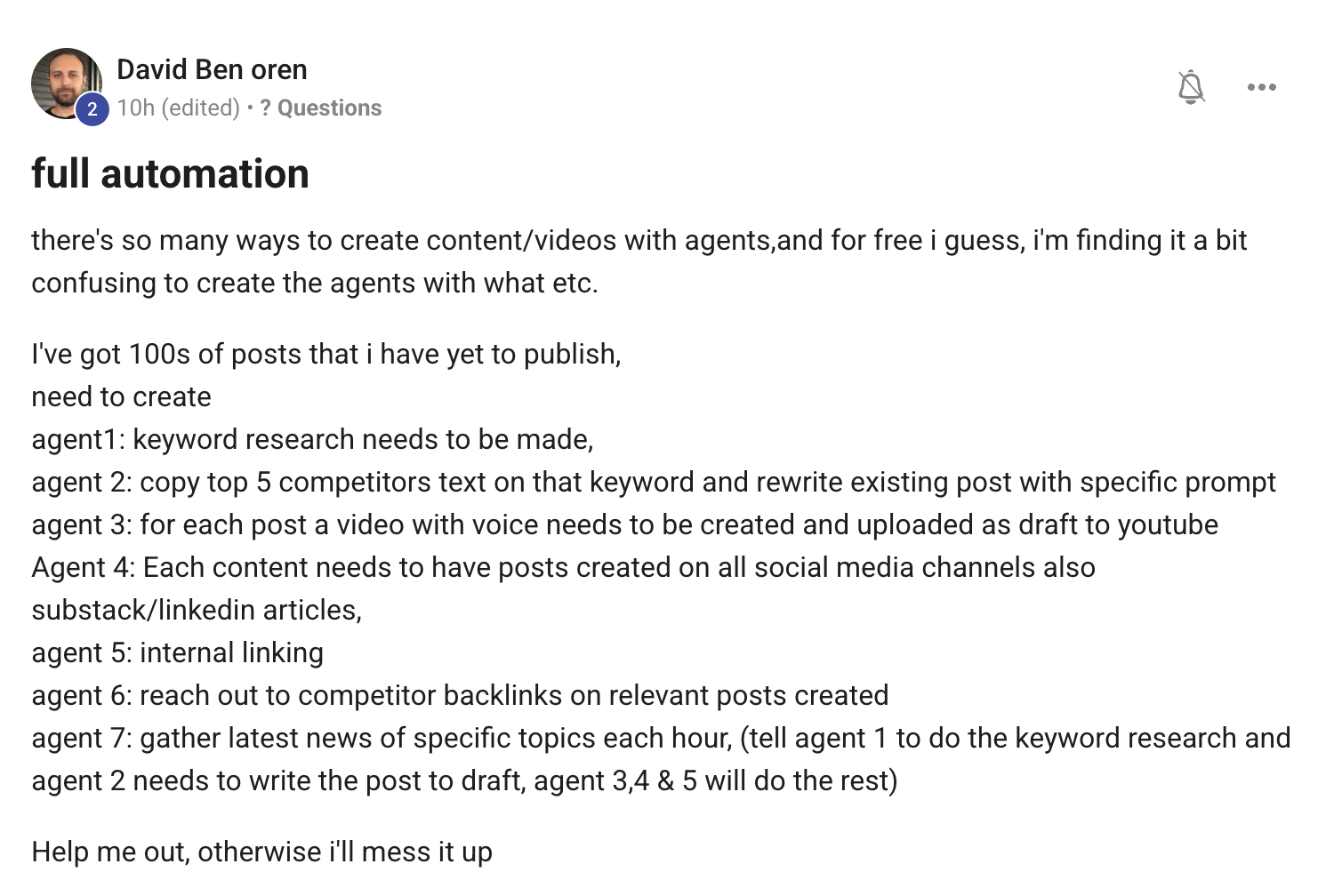
"Help me out, otherwise I'll mess it up."
This guide is the answer to David's question from inside the Boardroom.
David's original post — 100s of posts to publish, 7 agents in mind, asking for organisation help.
David's list maps almost exactly onto the Ranking Engine framework above. Here's how his original seven map to mine:
- David's Agent 1 (keyword research) → Ranking Engine Agent 1 (Keyword). Same job.
- David's Agent 2 (copy top 5 competitors + rewrite) → Ranking Engine Agent 2 (Source). Same job, broader scope — instead of just rewriting competitors, the Source agent writes a canonical piece using your Obsidian vault + competitor research.
- David's Agent 3 (video with voiceover) → Ranking Engine Agent 5 (Video). Same job.
- David's Agent 4 (post to all social channels) → Ranking Engine Agent 4 (Shipper) plus Agent 3 (Multiplier) — one creates the per-platform version, the other ships it.
- David's Agent 5 (internal linking) → Ranking Engine Agent 6 (Internal-linking). Same job.
- David's Agent 6 (competitor backlinks) → A Hermes skill you build yourself (see Custom Workflows section below). I'd run this as a weekly job, not per-post.
- David's Agent 7 (gather latest news for posts 3, 4, 5) → A second instance of Agent 1 — a "news keyword" version, scheduled daily. The output feeds Agent 2.
So David, here's the move: don't worry about running seven agents in parallel from day one. Run them as a pipeline. Agent 1 hands off to 2. Agent 2 hands off to 3. And so on.
"Seven agents in sequence beats seven agents in parallel. The pipeline is the thing."
Thinking it?
"Seven agents sounds like too much complexity for one person."
Each agent is one tool call with one prompt. Total complexity = seven prompts.
Hermes can run all seven inside one Goal Mode session. You don't manage them individually — you set the goal and the orchestrator chains them.
The "seven agents" framing is for how you think about the pipeline. Operationally, it's one goal, one session, one finished result.
You stop managing tools. You start running a system.
✓
Members running all seven agents inside a single Hermes Goal Mode session — one ask in, finished ranked content out.
XIV · custom workflows
How to build your own agents.
The seven agents above are the engine I run. Yours might need a different shape — maybe you need a competitor-backlink agent (like David asked for). Maybe a press-mention agent. Maybe a local-SEO agent for service-area businesses.
Here's the pattern for building your own custom workflow inside Agent OS.
step 1.
Define the one job the agent does.
One sentence. Verb at the front. "Find competitor backlinks I could replicate." Not "do SEO." The narrower the better.
step 2.
Write the skill in Markdown.
Hermes uses skill.md files. Create one in ~/.hermes/skills/competitor-backlinks/:
# Competitor Backlinks Finder

You find backlinks pointing at competitor sites that
my site could realistically replicate.

## Input
- competitor domain
- my domain
- topic area

## Process
1. Use the web tool to find pages linking to
   competitor's top-ranking posts on the topic.
2. For each link, check if my content covers
   the same angle.
3. Filter for sites that link to AI/SEO/
   automation content.
4. Output a list of 10 candidate sites with
   the exact page that links to my competitor
   and the suggested email pitch.

## Output format
A markdown table with columns: linking site,
linked page, my replacement page, suggested
outreach angle.
step 3.
Wire it into the pipeline.
Add the skill to a Hermes Goal Mode template. The orchestrator now calls it as part of the chain — e.g. after Agent 7 reports rank, the competitor-backlinks skill fires for any piece sitting at rank 4–10 (the sweet spot for backlink leverage).
It becomes part of your engine without disrupting the existing seven.
step 4.
Schedule it in the Kanban.
Open the Kanban panel. Create a new column "Backlink Outreach." Drop the agent's output there as cards. You (or a VA) work through them weekly.
Custom workflows live in the same dashboard as the canonical seven. No separate tool. No new bill.
"The seven agents are the starting kit. Custom workflows are the upgrade kit."
Three beliefs holding you back.
✕ "SEO is dead because of AI Overviews."
SEO that depends on being below the AI answer is dead. SEO that gets you named INSIDE the AI answer is the new game.
✓ The Ranking Engine is built specifically to win that game.
Dense source content + multi-platform distribution + citation tracking = exactly the signals AI Overviews reach for. Members report getting cited inside Google AI Overview answers using this pipeline.
✕ "Seven agents is too much to manage."
Not if they run as a pipeline inside one Hermes Goal Mode session. You don't think about them individually — you set the goal and watch the chain.
✓ Pipeline thinking beats parallel thinking.
One ask in. Finished, ranked content out. The "seven" is for how you understand the system — not how you operate it.
✕ "Free agent harness can't compete with paid SEO tools."
Paid SEO tools sell keyword data + content briefs. Hermes does both — and writes the content, multiplies it, ships it, and tracks the rank.
✓ The paid tool was the bottleneck, not the enabler.
Agency owners running the Ranking Engine cancel Ahrefs in month one. Ship more client work in month two.
Don't take my word for it
258 real members already broke through these beliefs. Their wins — real keywords, real rankings, real revenue — are documented here.
Read the 158-page testimonials doc →