The Hermes Agent Army™One command. A whole army of agents.
Most people run one AI chatbot. Inside my Agent OS, Hermes is an army — 30+ profiles, 14 battle-stations, voice command, a 24/7 radar, outreach and SEO squads — and every mission saves itself to my vault. Here's the whole army, and how to raise yours.

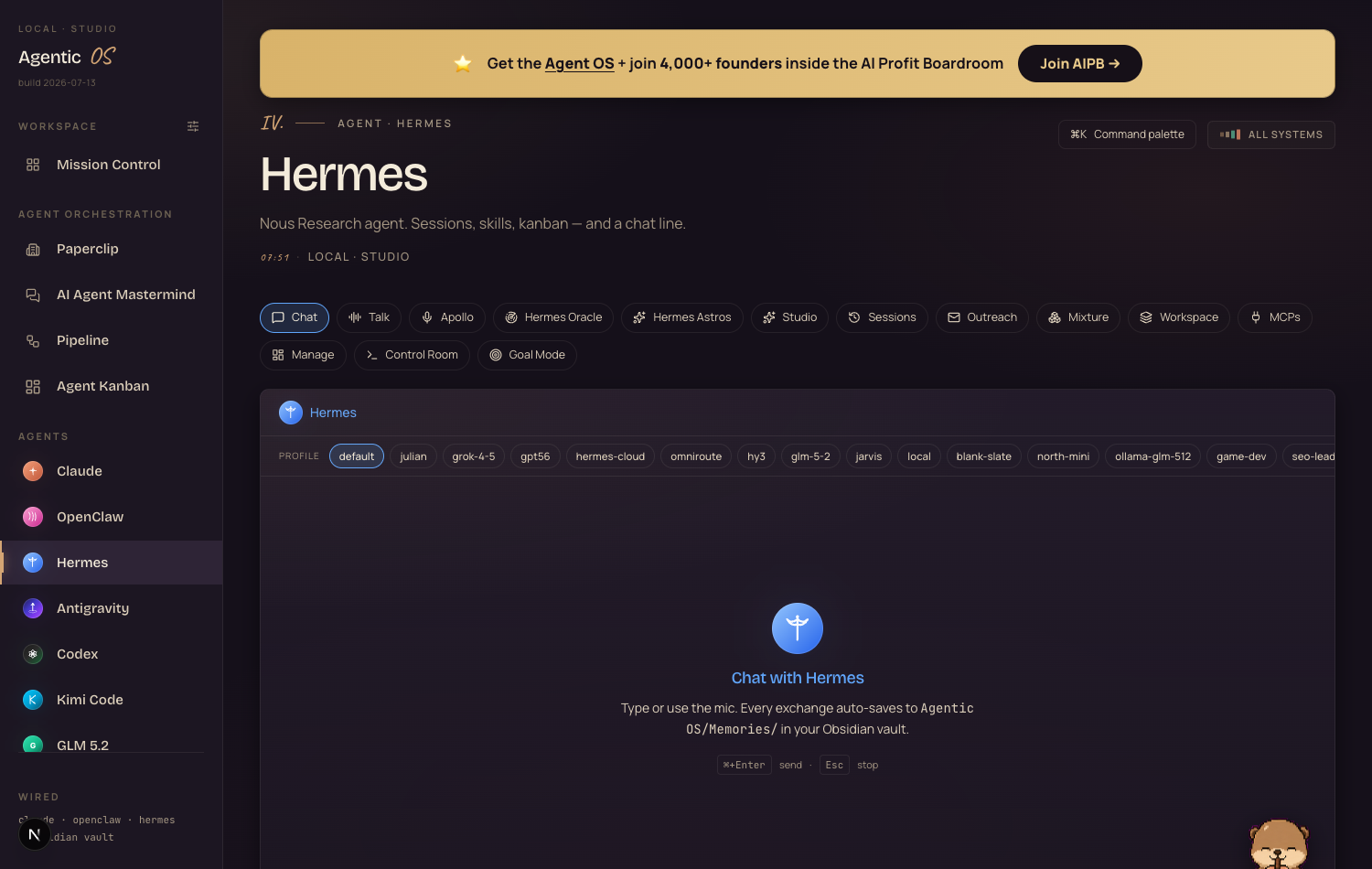
That's not a mockup. Count the buttons: Chat, Talk, Apollo, Oracle, Astros, Studio, Sessions, Outreach, Mixture, Workspace, MCPs, Manage, Control Room, Goal Mode. One agent behind all of them. Let me walk you through the army.
"Type or use the mic. Every exchange auto-saves to Agentic OS/Memories/ in your Obsidian vault."
— the Hermes chat line, word for word as it reads in my Agent OS (screenshot above)
I was the only employee of my AI. Then I raised an army.
Before
I had one chat window, and I was its secretary.
Every job meant me typing, waiting, copying the answer somewhere, then starting the next one.
Research, outreach, SEO, video — one at a time, all through me.
My AI was smart. But it was one worker, and I was its manager, courier and filing clerk.
Then I turned one Hermes into an army inside my Agent OS.
After
Now one command line reaches 30+ profiles across 14 stations.
A radar watches my competitors while an outreach squad fills my pipeline.
I talk to it out loud while it builds; missions run in parallel while I sleep.
And every exchange auto-saves to my vault — the army never forgets a thing.
Same agent you can download today. Here's how the army is organised.
This army runs a 7-figure business every day.
The screenshot up top is the actual Hermes tab I work from — inside the same Agent Operating System that runs my agency, my content machine and my SEO funnels. The army isn't a concept. It's on shift right now.
I'm not going to paste invented quotes here. The wins are real and written by the members themselves — agency owners, ecom founders, course creators, solo operators across 38 countries running their own Hermes armies. Read them in their own words.
Read the 158-page wins doc →Commit to recruiting your first soldier today.
You've seen the army on screen. Real, live, mine.
The next few minutes show you its five divisions — and every one of them started as a single profile on a laptop.
So here's the deal.
Promise yourself one thing right now: before you sleep tonight, you'll stand up ONE Hermes profile and give it one real job from your business. Just one soldier, one mission. Because the moment one agent finishes a job you didn't do yourself, you'll understand why the army changes everything.
The people still typing into one chat window are working FOR their AI. The people raising armies have AI working for THEM.
Recruit one soldier today. The army grows from there — that transition changes how your whole business runs.
You hired a genius and made it a typist.
Here's the problem with how almost everyone runs AI — including me, for far too long.
You've got the smartest employee in history sitting in a chat window. And its entire job is waiting for you to type.
It can't start anything on its own. It can't watch your competitors overnight. It can't send the outreach, plan the cluster, or build the page while you're on a call — because the moment you stop typing, it stops working.
Worse: it forgets you between sessions, it can only do one thing at a time, and every extra AI you subscribe to lives in its own silo with its own tab.
The problem was never the model. The problem is that one chat window turns an army-grade agent into a single typist — and you into its secretary.
The fix isn't a smarter model. It's organisation. That's the framework:
The Hermes Agent Army™ — five divisions.
An army isn't a crowd — it's organised. Mine has five divisions, and each one is a thing you can build:
The Commander — one line of command
You. One chat line (typed or spoken) that reaches the entire army. You give missions, not instructions.
The Ranks — 30+ profiles, one agent
Each profile is Hermes in a different uniform: SEO writer, game builder, content editor, voice butler. Swap soldiers with one click.
The Stations — 14 places the army fights
Chat, voice, radar, outreach, studio, kanban and more — every station is a job the army does without you.
The Fan-Out — missions in parallel
Delegate a mission to the background and keep commanding. Ten jobs run at once; you're never the bottleneck again.
The War Log — the army never forgets
Every exchange auto-saves to your Obsidian vault. Every mission makes the next one smarter.
One chatbot vs an army.
Same AI underneath. Completely different business, because one of them scales past your keyboard.
- Type a prompt, wait, copy the answer out by hand
- One job at a time — YOU are the queue
- Re-explain your business every session
- No radar, no outreach, no voice — just chat
- Close the tab, lose the work
- Your AI stops the second you stand up
- One command line — typed, or spoken out loud
- 30+ profiles: the right soldier for every job
- 14 stations: radar, outreach, SEO, studio, voice
- Missions fan out and run in the background
- Every exchange auto-saved to your vault
- The army works while you sleep
The army doesn't replace what you pay for — it orchestrates it. Your Claude subscription, your Codex, your GPT: each one becomes a soldier in the ranks, commanded from the same line, sharing the same vault. You stop juggling their tabs and start commanding them together. Nothing you own gets wasted; it all gets enlisted.
The Commander + the Ranks — one line, thirty uniforms.
Everything starts at the chat line. Type a mission — or hit the mic and say it — and Hermes takes it. But here's the trick that makes it an army: the profile row. Each profile is the same Hermes wearing a different uniform — its own model, its own keys, its own skills, its own memory. My row runs from julian (the everyday commander) to seo-lead (the SEO squad leader) to game-dev, content-writer, jarvis, and a free local soldier that runs 100% on my Mac.
You do this: say "write me five title ideas for tomorrow's video" in the everyday profile, then click over to seo-lead and say "plan a cluster for [your keyword]." Same chat line, different specialist. That's the whole skill of commanding the army: pick the uniform, give the mission.
Opposite. Profiles are free — they're configurations, not accounts. Most of mine run on free models: a local one at $0 on my own Mac, free API models, open-weights like GLM. The paid ones ride the subscriptions I already own. An army of thirty costs about the same as the one chatbot you're running now.
The Stations — 14 places the army fights.
Look back at that screenshot — the row of buttons across the top of the Hermes tab. Every one is a station where the army does a real job:
Talk + Apollo — command the army out loud. Apollo is the realtime voice butler: you speak, it acts, hands-free while you make coffee.
Hermes Oracle + Astros — the radar division. Oracle watches AI news on X 24/7 with real tweet permalinks; Astros watches competitor YouTube channels and drafts your titles.
Outreach — the pipeline division: finds leads, drafts the emails, fills the sheet.
Studio + Workspace — the builders: apps, pages, videos — every output saved and previewable.
Goal Mode + Sessions + Control Room — mission control: set a goal, watch the army run it, every session logged.
Mixture — the war council: multiple models debate your question and hand you the consensus.
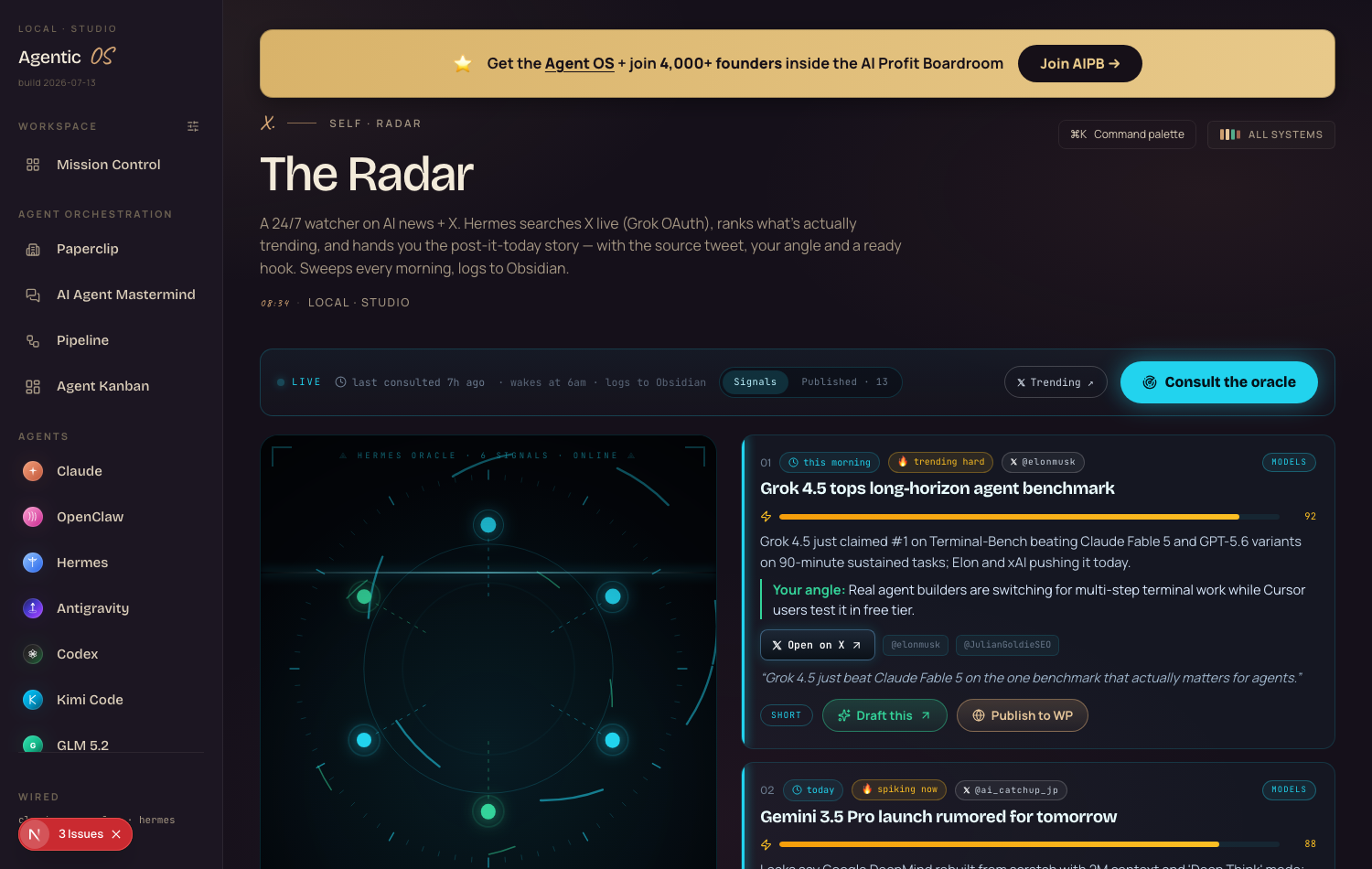
The army looks complex because you're seeing the finished HQ. You don't build 14 stations on day one — you install Hermes (one command), open the chat line, and add stations as you need them. Members who'd never opened a terminal are commanding armies. The dashboard makes it point-and-click; the weekly calls set it up with you step by step.
The Fan-Out — missions in parallel.
Here's where the army stops being a metaphor. Hermes can delegate missions to the background — hand a job to another profile and keep the chat line free. My SEO squad runs this way: a lead profile plans the cluster, then fans the articles out to writer profiles that run in the background, and finished pages come back to the kanban. Ten missions in flight, one commander, zero waiting.
You do this: give the squad leader one mission — "publish a 5-article cluster on [topic]" — and walk away. The fan-out handles planning, writing, and shipping in parallel. You review finished work on the kanban instead of babysitting a chat.
Not when the army shares one brain. Every soldier reads the same vault — your voice, your offers, your standards — so the ten background missions come back sounding like you, not like ten random freelancers. And the kanban means you review before anything ships. Command and control stays with you; only the grunt work leaves.
The War Log — the army never forgets.
Look at the bottom of that first screenshot: "Every exchange auto-saves to Agentic OS/Memories/ in your Obsidian vault." That one line is the fifth division. Every chat, every mission, every win gets written to the vault — so the army you command in month six knows everything the army learned in month one. One chatbot forgets you overnight. An army with a war log compounds.
You do this: nothing. That's the point — the war log writes itself. Your only job is to occasionally read your own vault and watch your business turn into documentation the army trains on.
No — that's the biggest myth about the Agent OS. The army runs the everyday 90% on a free local model (on your own machine, $0, nothing leaving it), free APIs and open-weights models slot in as extra soldiers, and for the frontier work it drives the CLIs you already pay for — your Claude subscription already includes the Claude CLI, and the OS plugs straight into it. You're not paying twice.
It's a layer on top of what you already own, not a new meter. And inside the AI Profit Boardroom there are full token-optimisation tutorials, so you cut usage to the bone and never think about it again.
Raise your army in 8 steps.
Here's the exact enlistment order. One afternoon, top to bottom:
Install Hermes
One command in the terminal. That's the whole recruitment office.
Open the chat line
Give it one real job from your business today — not a test prompt, a real mission.
Recruit a free local soldier
Add a local model with Ollama. Now the everyday 90% runs at $0 on your own machine.
Create your first three profiles
A daily commander, one specialist for your biggest bottleneck, and the free local one.
Point the army at your vault
Connect Obsidian so every exchange auto-saves. The war log starts today.
Man your first station
Pick the one that hurts most — radar, outreach, or SEO — and switch it on.
Run your first fan-out
Give a squad leader a mission with three parts. Watch them run in the background while you keep working.
Command out loud
Turn on voice and give tomorrow's first mission without touching the keyboard. You're the commander now.
From one soldier to a standing army in a month.
Skip the recruitment. Get the Hermes Agent Army wired in.
You can raise this army yourself — Hermes is free to download, and this page is the field manual. Or you can get my finished Agent Operating System inside the AI Profit Boardroom: every division already built, every station wired, set up with you step by step on the weekly calls.
You're not buying a chatbot. You're getting the army I run a 7-figure business with — recruited, trained and standing at attention.
Get the Agent OS →What's keeping you at one chat window.
Wrong: "One really good AI chat is all I need."
Right: one chat makes YOU the queue — every job waits for your keyboard. An army works in parallel, in the background, out loud, and while you sleep. The ceiling isn't the model's brain; it's the single window you've trapped it in.
Wrong: "Agent armies are for developers."
Right: the whole point of the dashboard is that the army is buttons, not code. Install once, click a profile, type a mission. Members who'd never opened a terminal run radar, outreach and SEO squads today.
Wrong: "I'll add agents later, when the tools mature."
Right: the army compounds — every mission logged to the vault makes the next one smarter. Starting later doesn't just delay the benefit; it forfeits the compounding. The people who figure out agents now will be far ahead when everything settles.
158 pages of members already commanding their own armies — real businesses, real wins, in their own words.
Read the 158-page testimonials doc →The five divisions you just toured.
Stop chatting with AI. Start commanding it.
Raise it yourself — or take command today.
You have the field manual now: Commander, Ranks, Stations, Fan-Out, War Log. Hermes is free — you can start recruiting tonight. Or take the shortcut: the finished Agent Operating System inside the AI Profit Boardroom, with the whole Hermes Agent Army already standing, plus every other division of the OS — Claude, Codex, the free local engine, the bench that tests every new model the day it drops.
It's the CLIs you already pay for and the free soldiers you don't, wired into one dashboard with shared memory and a commander's chair with your name on it. I built it in one session. You get the whole thing, set up with you step by step.