The GPT-5.6 Playbook™

6 ways I run GPT-5.6
— all live in my Agent OS today

GPT-5.6 launched this week. Benchmarks are one thing — here's what it's actually doing on my machine right now: powering Codex on a ChatGPT login, running long-horizon goals in a sandbox, generating this page's own hero image, driving a Hermes agent, being operated by Claude for benchmark builds, and sitting inside the Agent OS that ties it all together. Every screenshot below is from my setup.

A glowing golden sun-core engine in a dark command room with six holographic work stations projecting code, a game, a galaxy, an agent, boards and charts
6 use cases All verified on my machine $0 metering on the Codex play 1 dashboard for all of it
✦ ✦ ✦
1 · the map

One model family, six jobs

This isn't a features list from a press release. Each of these six is something GPT-5.6 does in my daily setup — and this guide shows the real screens.

GPT-5.6 sol · terra · luna 1 · Codex ChatGPT OAuth · $0 2 · Goal Mode long-horizon · sandboxed 3 · Images this page's hero 4 · Hermes agent -p gpt56 · tool calls 5 · Claude drives it benchmark builds 6 · The Agent OS one dashboard, all tabs
One model family in the middle — six jobs running off it

Quick context if you missed the launch: GPT-5.6 ships as three tiers — Sol (flagship), Terra (everyday), Luna (fast and cheap) — all with a 1M token context. I benchmarked and build-tested the tiers against each other in the Three-Tier Engine™ guide. This playbook is the follow-up: what to actually do with it.

2 · before the plays

Three doubts you might have

"New model hype. My setup works fine."
Fair — and nothing here requires throwing your setup away. Every play below is additive: a tab, a profile, a config file. The Codex play alone is worth the look because it runs the flagship on a subscription you probably already pay for, with zero API metering.
"This will take a weekend to wire up."
Each play is minutes, not hours. Codex is a login. The Hermes profile is two small files (both printed below). Goal Mode is built into the Codex tab. The heaviest item — the Agent OS itself — installs in an afternoon and the other five plays come with it.
"I'm not technical enough for 'agentic workflows'."
Every play here is driven from a dashboard tab in plain English. "Set a goal, watch it run" is the whole skill. The config files below are copy-paste — and if you get stuck, the community this playbook comes from has five live calls a week.
✦ ✦ ✦
3 · play 1

Codex + workspace: the flagship on your ChatGPT login

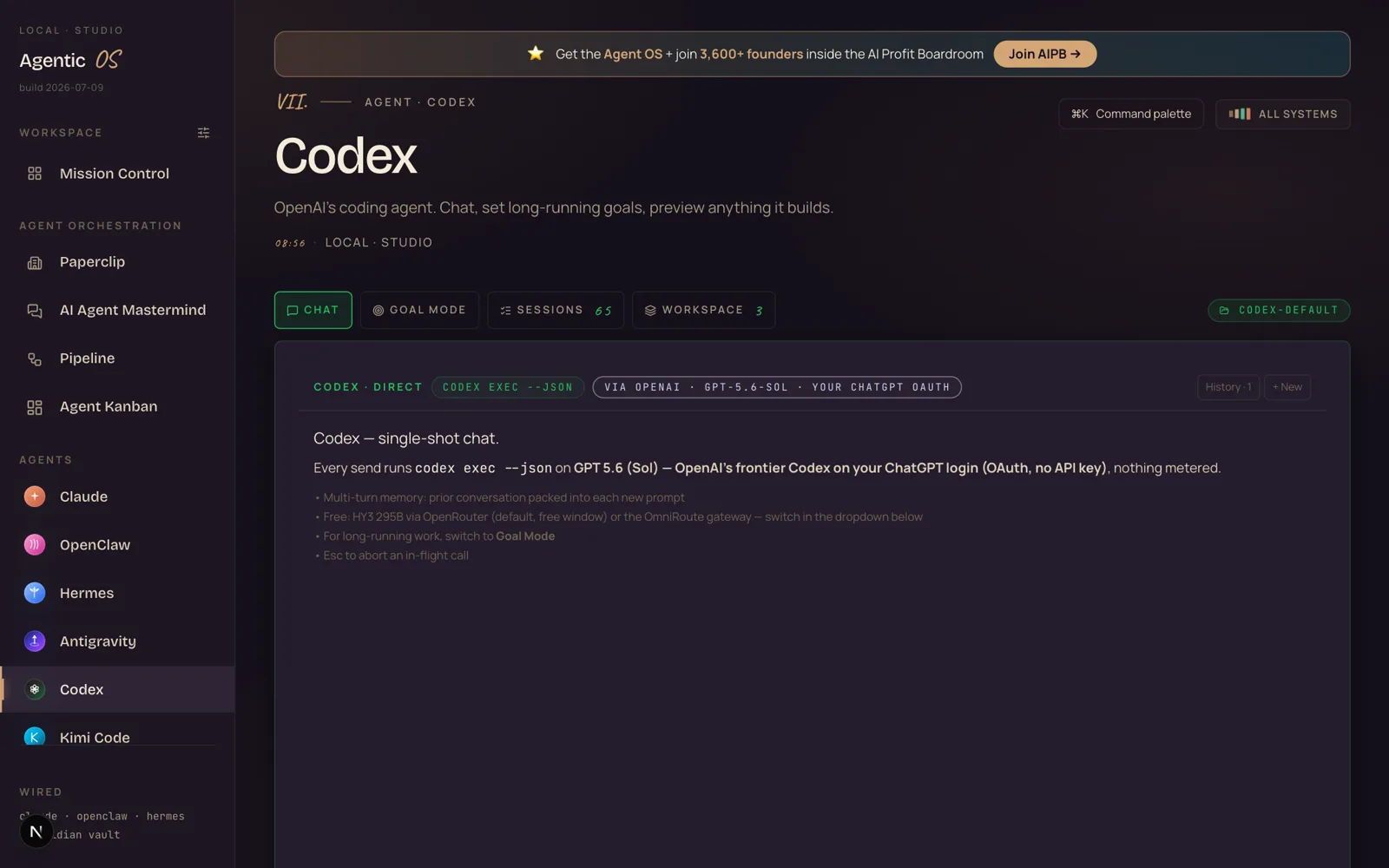
Codex is OpenAI's coding agent, and with 5.6 it defaults to Sol. The unlock: it authenticates with a ChatGPT login — OAuth, no API key — so a Plus/Pro subscription you already pay for covers frontier coding runs.

The Agent OS Codex tab: single-shot chat running codex exec on GPT-5.6 Sol via ChatGPT OAuth, with Chat, Goal Mode, Sessions and Workspace tabs
My Codex tab — the pill reads "VIA OPENAI · GPT-5.6-SOL · YOUR CHATGPT OAUTH". Nothing metered.

In my Agent OS it's a tab: every send runs codex exec on Sol, prior turns get packed into the next prompt for memory, and anything it builds lands in a workspace with one-click preview. 65 sessions on the counter so far.

Straight from a terminal, the same play is:

npm install -g @openai/codex # 0.144+ knows the 5.6 family codex login # ChatGPT OAuth — no API key codex exec "refactor this repo's auth flow and run the tests"
"What's the catch on 'nothing metered'?"

Subscription rate limits instead of per-token bills — heavy use hits a quota window rather than a surprise invoice. For most people that trade is strictly better: predictable cost, frontier model.

4 · play 2

Goal Mode: hand it an objective, not a prompt

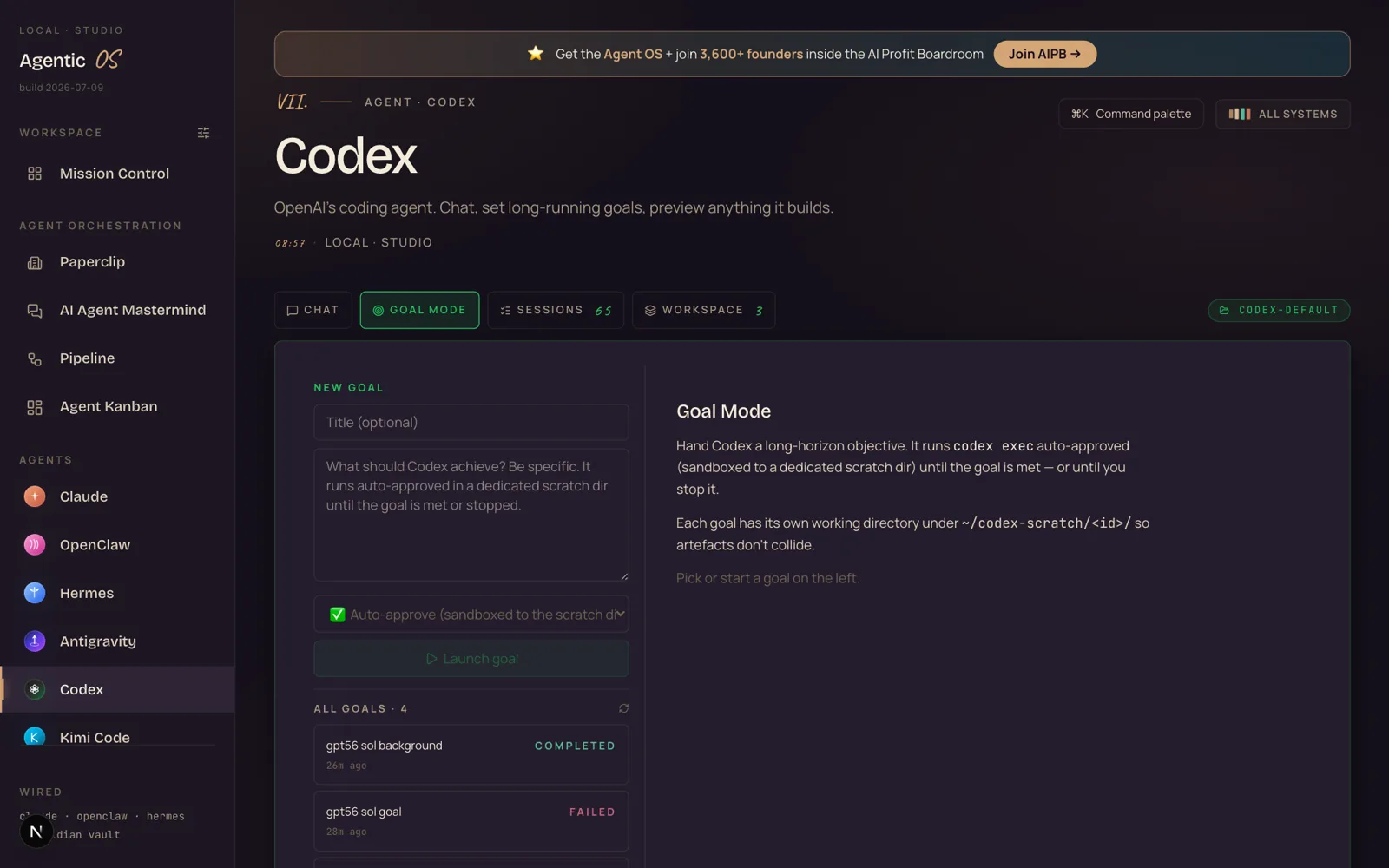
The biggest habit change with 5.6. Instead of chatting step by step, you write a goal — Codex runs codex exec on repeat, auto-approved inside a sandboxed scratch directory, until the goal is met or you stop it.

Goal Mode in the Agent OS Codex tab: a new-goal form with auto-approve sandbox checkbox, and a goal list showing gpt56 sol background COMPLETED
Goal Mode in my Codex tab — a real "gpt56 sol background" goal marked COMPLETED, another marked FAILED. It shows you both.

Each goal gets its own working directory under ~/codex-scratch/ so runs never collide. You can see in my screenshot that goals genuinely complete — and genuinely fail. That FAILED badge is the point of the design: long-horizon autonomy needs honest status, not vibes.

What I put in goals: "build X and make the tests pass", "convert this folder of scripts to TypeScript", "produce a working demo page for Y". Things with a checkable finish line. GPT-5.6's benchmark profile — top scores on Terminal-Bench and Agents' Last Exam — is exactly this shape of work.

"Auto-approved AI running commands sounds dangerous."

That's what the sandbox is for — goals run in a dedicated scratch directory, not loose on your machine. Blast radius is one folder. You review what comes out before anything touches a real project.

5 · play 3

Image generation from the same key

The OpenAI key that runs your 5.6 text calls also runs image generation. The hero image at the top of this page? Generated while I wrote this guide — one API call, about 40 seconds.

The exact call that made it:

curl https://api.openai.com/v1/images/generations \ -H "Authorization: Bearer $OPENAI_API_KEY" \ -H "Content-Type: application/json" \ -d '{ "model": "gpt-image-2", "prompt": "A glowing golden sun-core engine in a dark command room, six luminous work-station pods projecting holographic tasks...", "size": "1536x1024", "quality": "high" }' # response: base64 image → save as hero.png

Every hero image on this site comes from this pipeline. In the Agent OS the same call powers thumbnails, guide art and video keyframes — one key, scripted, no design-tool subscription. At high quality a 1536×1024 image costs about $0.19.

"Is AI art good enough for real marketing?"

Scroll up. That hero is a first-take output from a two-sentence prompt — on-palette, on-theme, usable immediately. For blog heroes, thumbnails and social cards, it cleared my bar a long time ago; product photography is the place you'd still hire a human.

6 · play 4

A Hermes agent profile on GPT-5.6

Hermes is the autonomous agent in my stack — sessions, skills, kanban, tool-calling. Giving it GPT-5.6 as a brain is a two-file profile, and I verified the full tool loop before writing this: it ran a real shell command and reported back.

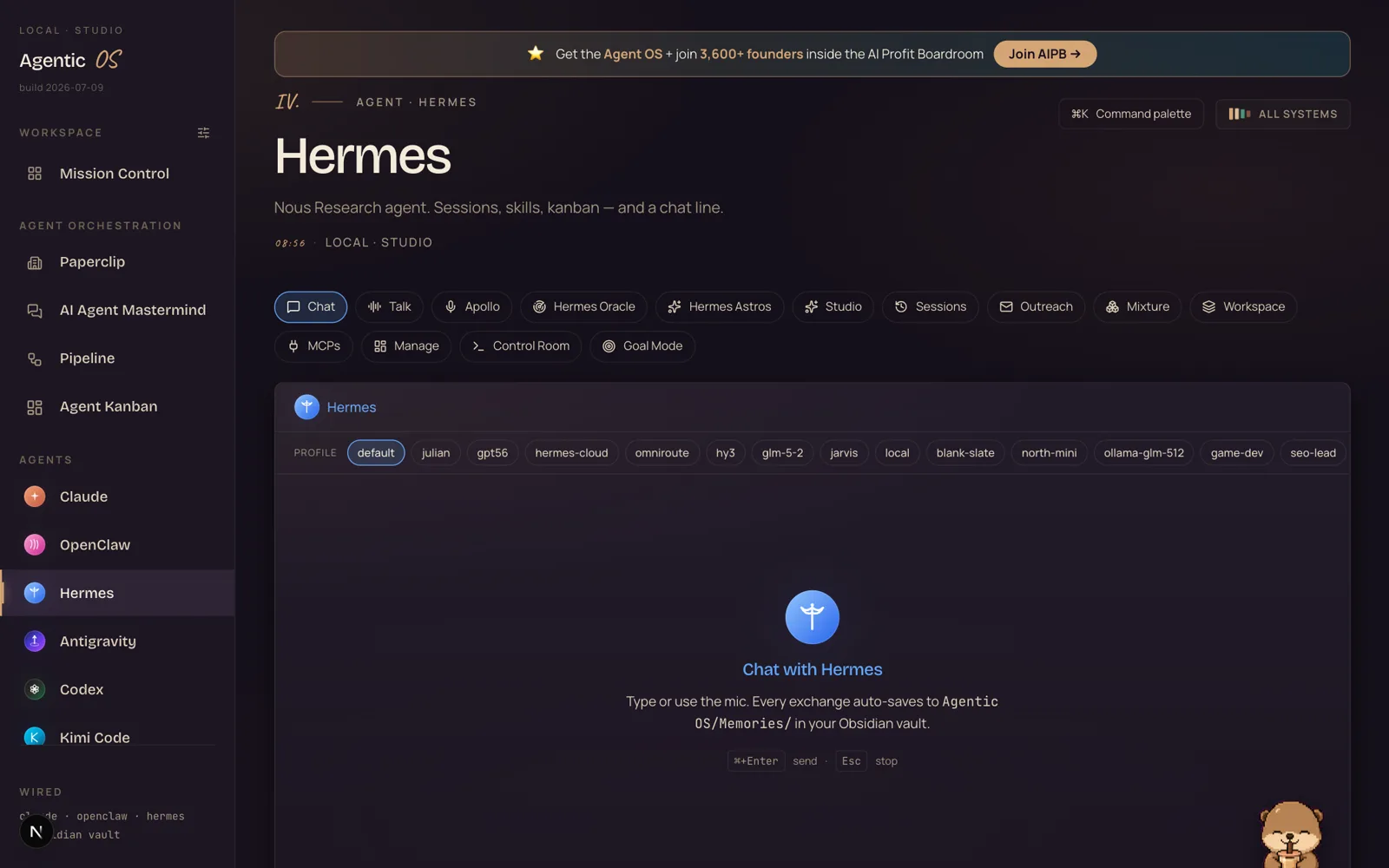
The Agent OS Hermes tab with profile chips including the new gpt56 profile alongside default, julian, omniroute and others
The Hermes tab — see the profile row: default · julian · gpt56 · hermes-cloud · omniroute…

Create ~/.hermes/profiles/gpt56/config.yaml:

model: default: openai/gpt-5.6-terra provider: openrouter base_url: https://openrouter.ai/api/v1 api_mode: chat_completions toolsets: - hermes-cli

Add an auth.json with your OpenRouter key in the credential pool, then:

hermes -p gpt56

Swap -terra for -sol on hard agentic days or -luna for cheap volume — one word.

One real gotcha from testing: pointing Hermes straight at api.openai.com fails — OpenAI's endpoint rejects a session_id parameter Hermes sends (HTTP 400). Routing through OpenRouter's openai/gpt-5.6-* models accepts it fine. Twenty minutes of debugging, saved for you.

"Why not just use ChatGPT instead of an agent?"

ChatGPT answers when you ask. An agent profile works when you don't — Hermes on GPT-5.6 runs scheduled jobs, kanban tasks and multi-step tool chains without you in the loop. That's the difference between a chatbot and a worker.

7 · play 5

Claude operating GPT-5.6: one AI benchmarking another

My favourite play, because it's the shape of where this is all going. When GPT-5.6 launched, I didn't test it by hand — I had Claude (Fable 5) run the whole evaluation: call the 5.6 API, fire identical build prompts at all three tiers, screenshot the results in a headless browser, and even play the games it built before judging them.

You one sentence "compare the tiers" Claude the operator plans · scripts · judges GPT-5.6 sol · terra · luna the workers 9 builds, one shot each Results played + shot guide ships itself
The operator chain — one sentence in, a tested comparison out

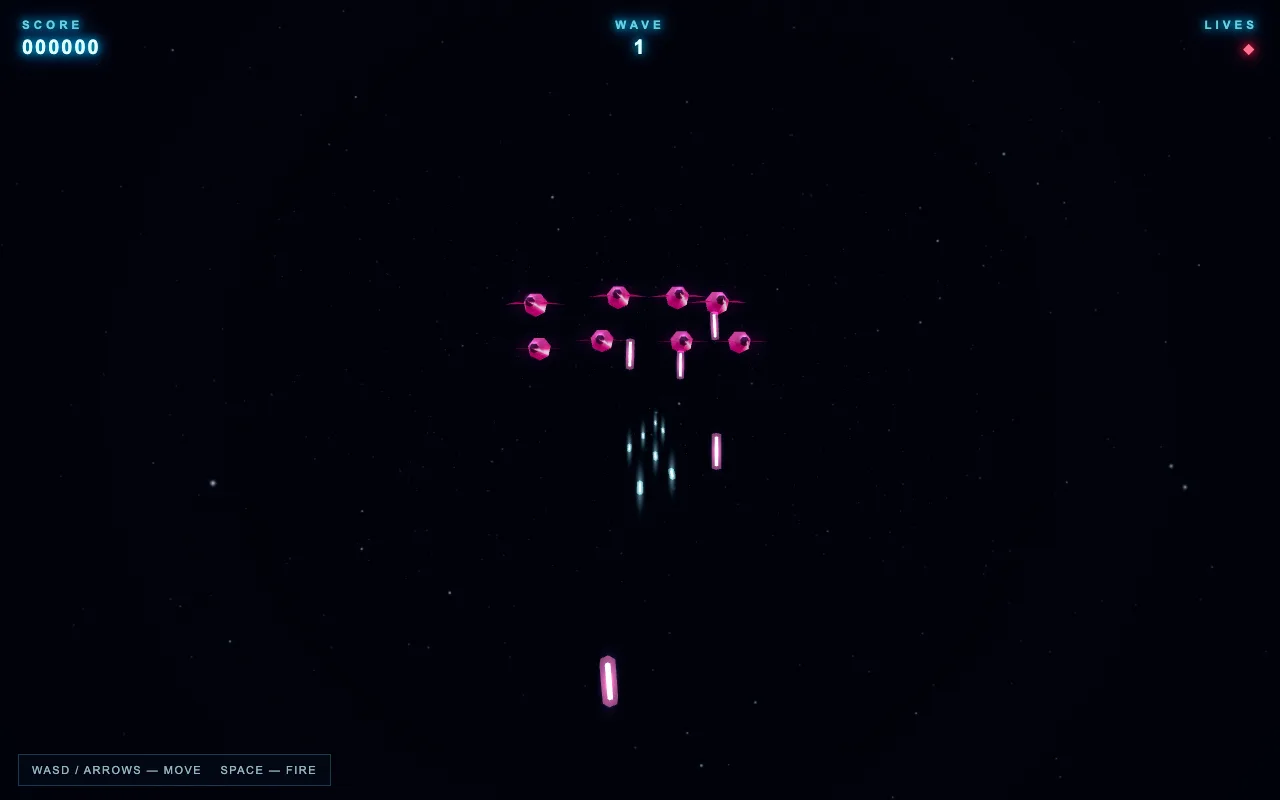
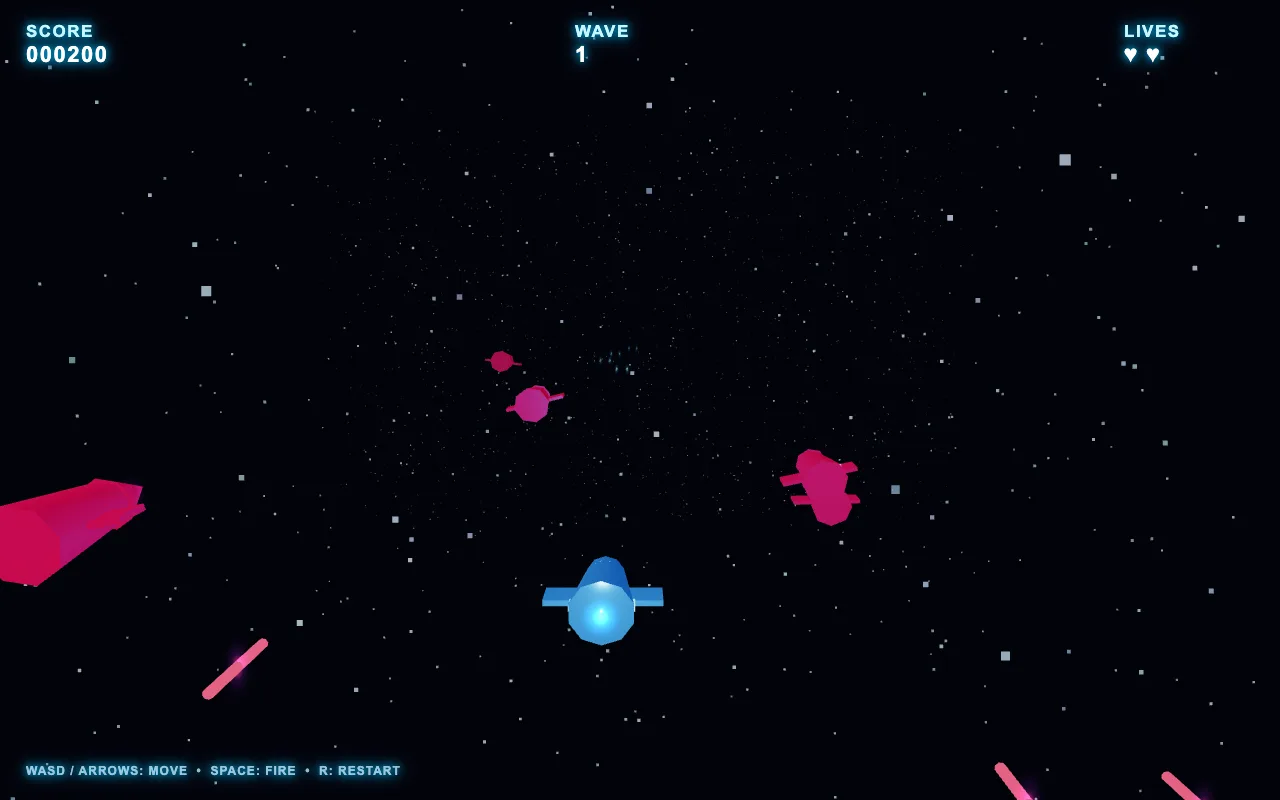
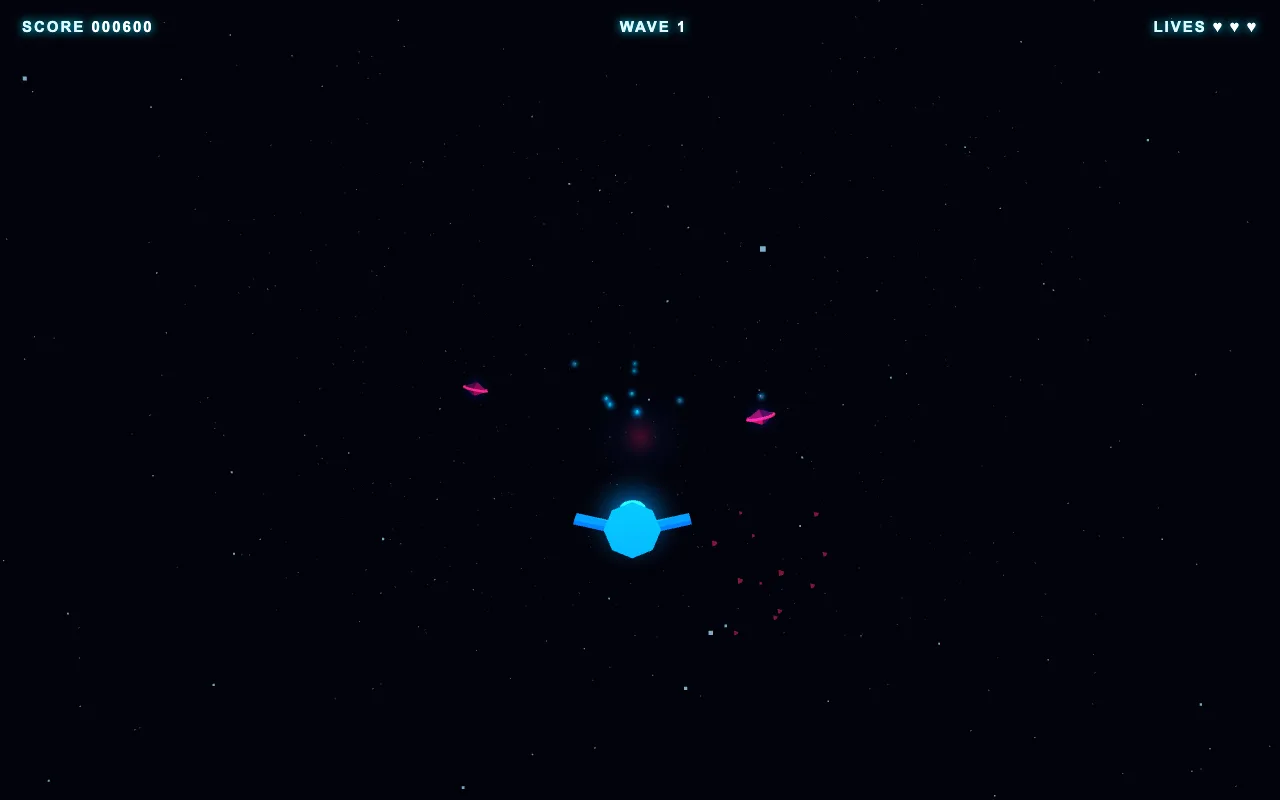
Here's what that produced — the same arcade-game prompt, one shot to each tier, screenshotted mid-play by the pipeline (these are the GoldieBench-style tests we run on every new model):

Sol's space shooter mid-play with enemy formation and lasers
☀️ Sol
124s · $0.34 · deepest game
Play it →
Terra's space shooter mid-play with pink enemy ships
🌍 Terra
50s · $0.13 · solid middle
Play it →
Luna's space shooter mid-play with glowing player ship
🌙 Luna
28s · $0.03 · fast + clean
Play it →

All nine builds across three tasks ran with zero console errors, and every one is playable from the full showdown guide. The lesson bigger than the benchmark: models operating models is a real workflow now. The expensive reasoning happens once, in the operator; the workers get swapped as better ones ship.

"Why would I use two AIs when one is fine?"

Same reason a foreman doesn't lay every brick. The operator holds the plan, quality bar and judgment; the workers produce volume. When GPT-5.7 drops, my operator re-runs the same evaluation in an afternoon — that's leverage you can't get from one chat window.

8 · play 6

The Agent OS: where all of it lives

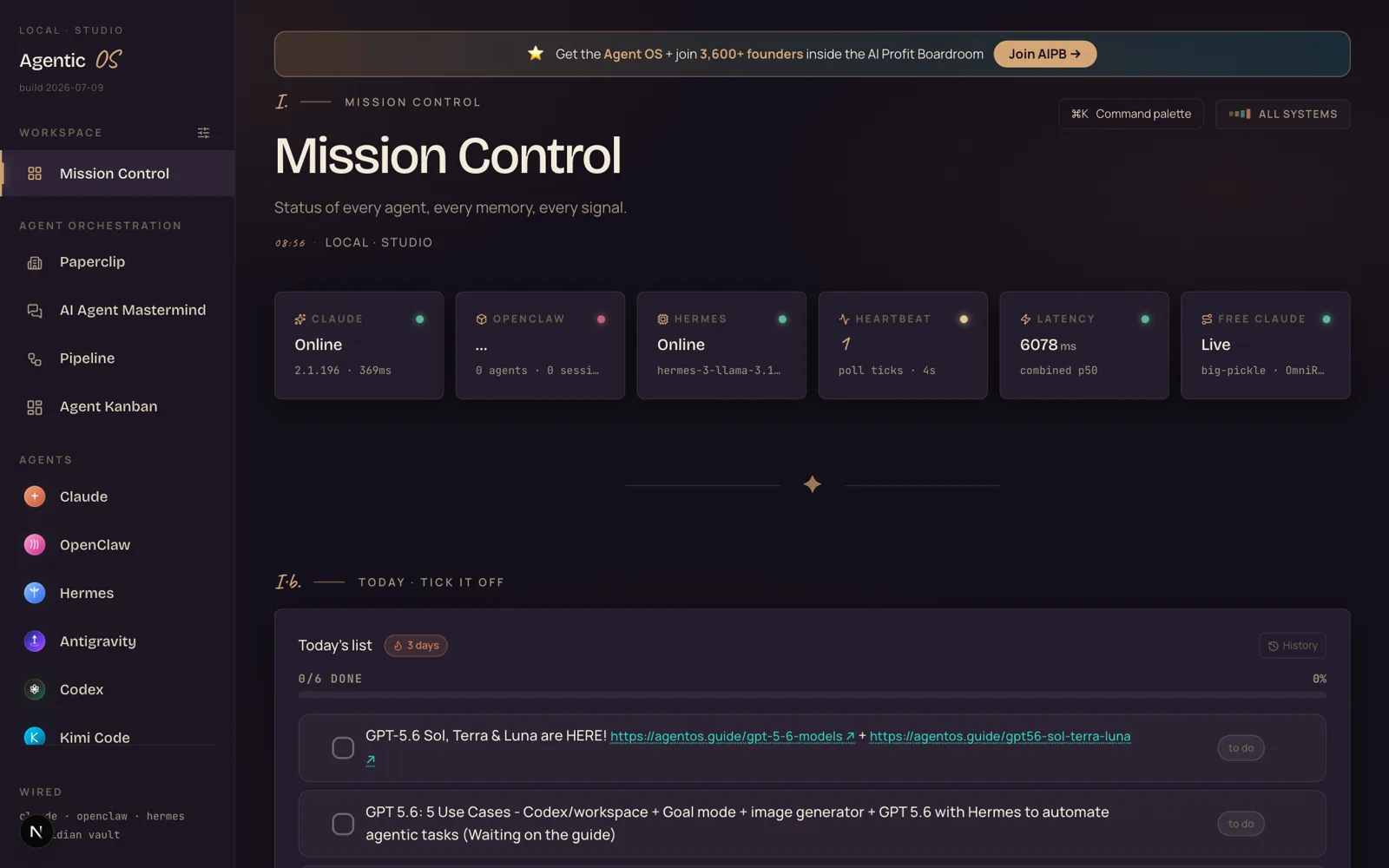
Plays 1–5 aren't five browser tabs and a pile of terminals. They're sections of one dashboard — Mission Control up top, agents down the sidebar, every model wired in.

Agent OS Mission Control: Claude, OpenClaw and Hermes status cards, heartbeat and latency, plus a today list with GPT-5.6 tasks
Mission Control this morning — agent status, heartbeat, latency, and today's list. You can see this very guide on it.

This is the point of the whole playbook. A new model family dropped this week, and slotting it in took an evening: Codex flipped its engine to Sol, a Hermes profile got two files, the image key stayed the same, and the benchmark pipeline ran itself. The OS is what makes new models additive instead of disruptive.

It's built on the same parts you've seen all guide — Next.js dashboard, agent CLIs, local models via Ollama, and tabs that embed anything with a port. If you want the deeper tour, that's the Five-Layer Agent OS guide.

9 · before and after

What changes when the plays stack

MODEL LAUNCH, OLD WAY A week of tab-hopping
  • Read threads about benchmarks, form no opinion
  • Try it in a chat window, type "write me a poem"
  • Rewire tools by hand, one config at a time
  • Pay API rates for things a subscription covers
  • Forget half the capabilities exist (images, goals)
WITH THE GPT-5.6 PLAYBOOK™ Productive the same week
  • Codex on the flagship via a login you already pay for
  • Goals running sandboxed while you do other work
  • One agent profile file — GPT-5.6 joins the workforce
  • Claude benchmarks it against your real tasks
  • Everything visible on one Mission Control screen
✦ ✦ ✦
The GPT-5.6 Playbook™ — pre-wired inside

Want this whole setup without building it?

Everything in this playbook — the Codex tab, Goal Mode, the Hermes profiles, the image pipeline, the benchmark harness — is the Agent OS I run my business on. Inside the AI Profit Boardroom you get the system plus the people running it on real work.

The complete Agent OS — every play in this guide as a working tab
Model-routing playbooks — which tier for which job, maintained as models ship
Free + local engines — run everyday work at $0
Agent Kanban — agents that keep working while you sleep
5 live coaching calls a week — get unblocked on your exact setup
1,000+ prebuilt agents — ready to run and customise
New-model briefings — tested takes like this one, as they drop
4,000+ members in 38 countries — someone's online when you're stuck
Join the AI Profit Boardroom → The full system, pre-wired
10 · what members are doing

The results people are getting

The Boardroom is 4,000+ founders and operators — agency owners, ecom founders, course creators — running stacks like this on real businesses. So far, 258 wins have been documented across 38 countries.

3,600+ members inside AIPB
258 documented wins
38 countries
400K YouTube subscribers
163K X followers
29K+ Udemy students

Members post their wins as they happen — cost savings, first agents shipped, client work automated. They're all collected in one doc you can read right now.

Read the member wins doc (158 pages) →
11 · the recap

The six plays, one line each

1.

Codex + workspace

The flagship coding agent on a ChatGPT login — nothing metered.

2.

Goal Mode

Objectives, not prompts — sandboxed runs until done, with honest FAILED badges.

3.

Image generation

Same key, ~$0.19 a hero image. This page's art is the receipt.

4.

Hermes agent

Two files make GPT-5.6 an autonomous worker. Route via OpenRouter, not api.openai.com.

5.

Claude operates it

One AI benchmarks another — 9 builds, played and screenshotted, while you do something else.

6.

The Agent OS

One dashboard where a new model family becomes an evening's wiring, not a migration.

✦ ✦ ✦
One more thing

The model is the engine. The system is the car.

GPT-5.6 is genuinely good — but a good engine on a workbench moves nothing. The six plays above are what turn it into shipped pages, finished builds and agents that work overnight.

If you'd rather start from a working car than a crate of parts, that's what the Boardroom is for. 3,600+ people inside, five live calls a week, and every new model gets wired in and tested like this one was.

Join the AI Profit Boardroom → skool.com/ai-profit-lab

258 documented member wins · 38 countries · 5 live calls a week