The 5-Layer Agent OSBuild your own Agent Operating System, one layer at a time
Most people run AI as 14 scattered tabs. I run mine as one operating system — stacked in 5 layers: Foundation → Memory → Router → Agents → Loop. Here's exactly how to build your own, mostly for free.

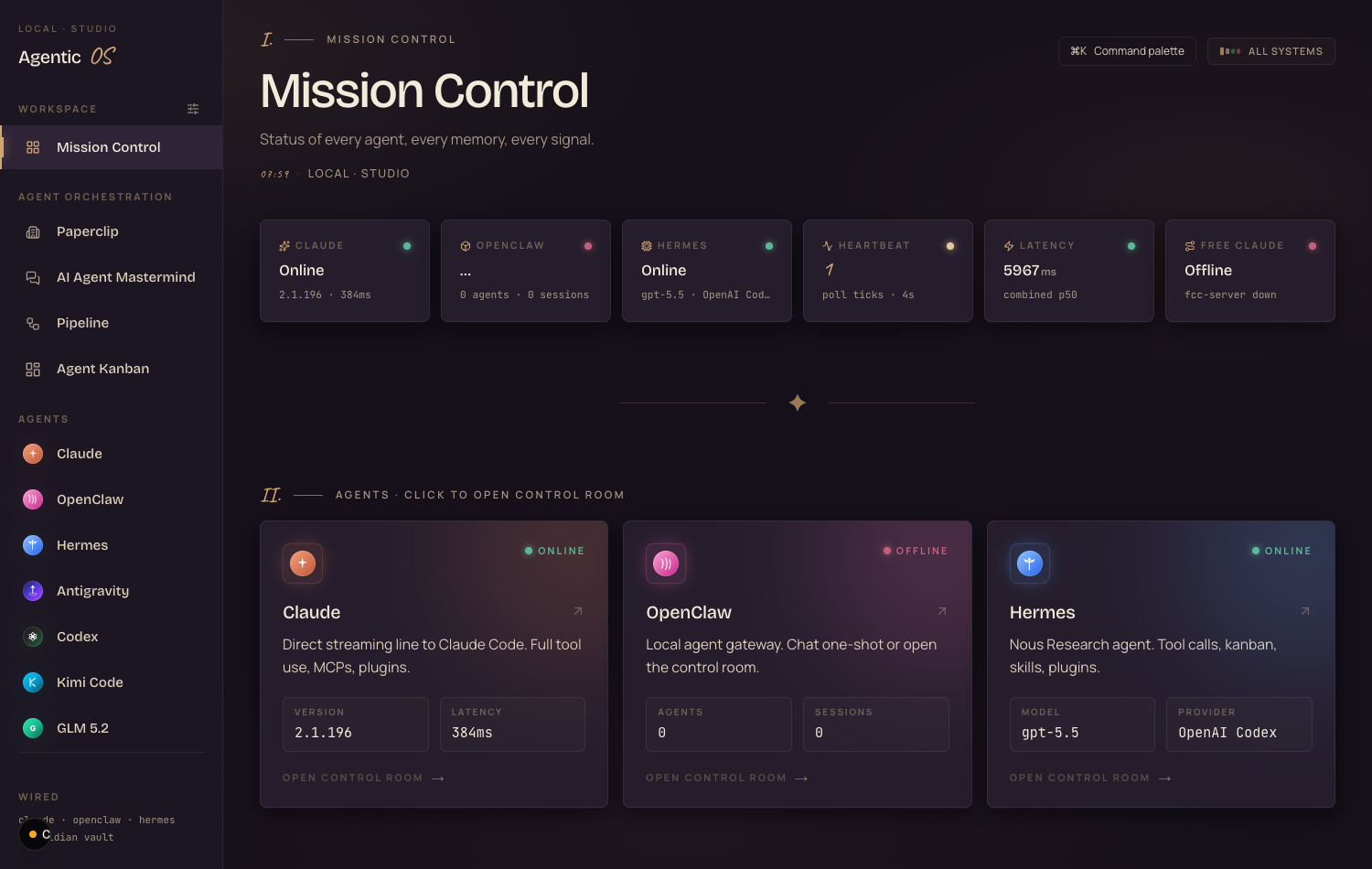
That's not a mockup — it's the OS I run a 7-figure business from. By the end of this page you'll know the 5 layers it's built on, and how to stack your own. Let's build it.
I ran AI as 14 tabs. Then I built it into an OS.
Before
I had ChatGPT in one tab, Claude in another, a coding tool in a third.
Every session I re-explained my business, my clients, my voice from scratch.
Files got lost. Context got lost. Nothing remembered anything.
And I was paying for every one of them, every month.
It was a pile of tools, not a system.
Then I stopped collecting tools and started stacking layers.
After
Now it's one Agent OS — every model and agent on one screen.
They share one memory, so they know my business cold, every time.
Each job goes to whichever model wins it — mostly free ones.
Agents do the real work while I sleep, and it gets stronger every week.
You can build the same thing. Five layers. Here's each one.
I run a 7-figure business from this one dashboard.
The screenshot up top isn't a demo. It's the Agent Operating System I actually work from — every frontier model wired in, shared memory, agents running jobs across my whole business. These 5 layers are how it's built.
I'm not going to paste invented quotes here. The wins are real and written by the members themselves — agency owners, ecom founders, course creators, solo operators across 38 countries who've built their own Agent OS. Read them in their own words.
Read the 158-page wins doc →Commit to building layer one today.
You've seen the OS. Real, running, mine.
The next few minutes give you the whole blueprint — all 5 layers, in order.
So here's the deal.
Promise yourself one thing right now: before you sleep tonight, you'll stand up the first layer — one dashboard with your models wired in. Just layer one. Because the moment you stop juggling tabs and start stacking layers, everything about how you work with AI changes.
The people still collecting tools are getting buried by them. The people building an OS are the ones AI actually works for.
Build layer one today. Stack the rest this week. This is the moment your AI starts working like a system, not a pile.
The 5-Layer Agent OS™.
An operating system isn't one app. It's layers, each doing one job, stacked so the whole thing runs itself. Build these five in order and a pile of AI tools becomes a machine that works for you:
Foundation — every model in one place
Wire every model into one dashboard: a free local model, free APIs, and the CLIs you already pay for. No more 14 tabs. One place to work from.
Memory — one shared brain
Give every agent a shared vault of your business, clients, and voice. Stop re-explaining yourself. Every answer comes back grounded in who you actually are.
Router — the right model for the job
Send each job to whichever model wins it. Free-first for the everyday 90%, the frontier only when it counts. Best output, near-zero spend.
Agents — the work gets done
Agents that plan, build, write, research and ship — on their own, in parallel, while you're away. One ask becomes ten finished jobs.
Loop — it compounds
One dashboard you command, and everything it learns feeds back in. Every new model, every new tool plugs in and makes the whole OS stronger — automatically.
A pile of tools vs an operating system.
Same AI. Completely different result — because one is a system and one is a mess.
- ChatGPT here, Claude there, a coding tool in a third tab
- Re-explain your business every single session
- Files and context lost the moment you close a tab
- Pay a monthly bill for every tool separately
- Nothing talks to anything — no memory, no handoff
- You are the glue holding it all together, by hand
- Every model + agent on one screen (Foundation)
- Shared memory — it knows your business cold (Memory)
- Each job routed to the model that wins it (Router)
- Agents ship real work while you sleep (Agents)
- It compounds — stronger every week (Loop)
- The system is the glue. You just point it.
The Foundation — every model, one screen.
Layer one is the ground everything stands on: one dashboard with every model wired in. Not 14 tabs — one place. A free local model for the everyday work. Free APIs for more. And the CLIs you already pay for (your Claude subscription already includes the Claude Code CLI) plugged straight in, so you're not paying twice.
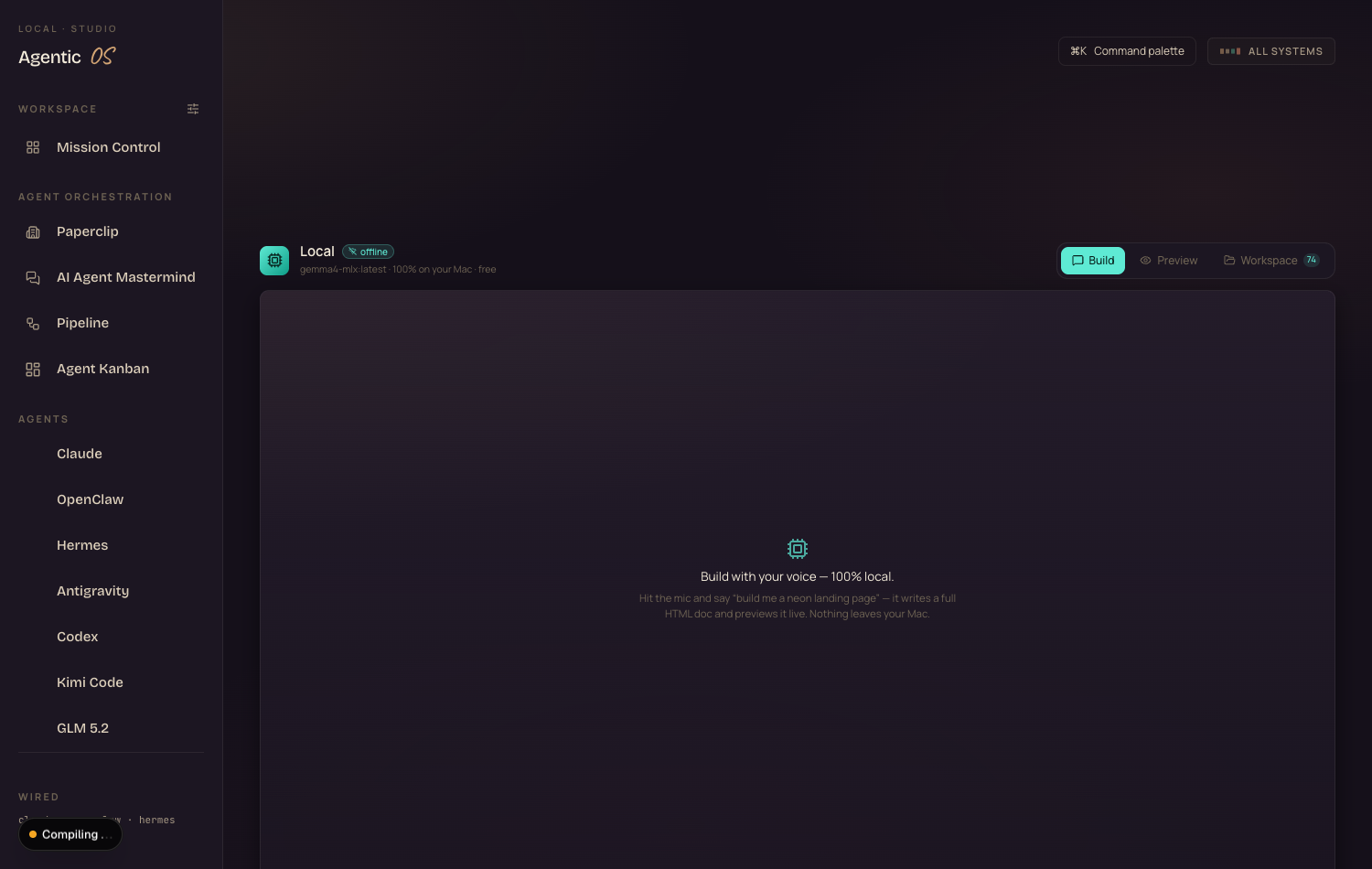
You do this: pick one model as your home base, wire the rest in beside it, and never open a scattered tab again. The everyday 90% of your work runs on the free local one — the paid frontier models are there for when a job actually needs them.
No — that's the biggest myth about it. The Foundation runs the everyday 90% on a free local model (on your own machine, $0, nothing leaving it), free APIs slot in for more, and for the frontier work it drives the CLIs you already pay for — your Claude subscription already includes the Claude CLI, and the OS plugs straight into it, so you're not paying twice.
It's a layer on top of what you already own, not a new meter. And inside the AI Profit Boardroom there are full token-optimisation tutorials, so you cut usage to the bone and never think about it again.
The Memory — one shared brain.
A model with no memory is a stranger you re-introduce yourself to every morning. Layer two fixes that: one shared vault — your business, your clients, your offers, your voice — that every model and agent reads before it answers. Stop wasting 20% of every prompt re-explaining who you are. It already knows.
You do this: keep a plain folder of notes about your business — who you serve, what you sell, how you talk. Point the OS at it. Now when you ask any agent for a landing page, an email, an SEO plan, it writes it as you, for your customer — not a generic stranger.
It doesn't have to. The memory layer is a folder of notes on your own machine — the free local model reads it without a single byte leaving your Mac. You decide what's in it and what stays private. This is the opposite of pasting your business into a random chat box every day.
The Router — the right model for the job.
Layer three is the intelligence: you stop asking "which model is best" and start sending each job to whichever one wins that job. A free open model for visuals and everyday builds. The frontier model only for the hard 10% where it earns its price. Best output every time — near-zero spend.
You do this: keep a simple rule — everyday drafts, visuals, and builds go to the free model; anything where "almost right" isn't good enough goes to the frontier. Test them head-to-head once (that's what GoldieBench is) so you actually know which wins which.
Not anymore. Open-weights models like GLM 5.2 top the bench for whole categories of work and cost nothing. And because a local one runs on your own machine, there's no rate limit to hit at all. The router just makes sure each job lands where it wins — you're never stuck waiting on a meter.
The Agents — the work gets done.
Layers 1–3 give you a smart, cheap brain that knows your business. Layer four puts it to work: agents that plan, build, write, research and ship on their own — in parallel, while you're asleep or on a call. One ask becomes ten finished jobs.
You do this: hand the OS a goal, not a task. "Launch the new offer." It spins up agents — one drafts the page, one writes the emails, one plans the SEO, one cuts the video — and they work at the same time. You come back to finished work, not a to-do list.
Yes — because agents don't care what you sell. Members run agencies, ecom, coaching, SaaS, content, local services. The jobs differ; the engine room is the same: a brain that knows your business, routed cheap, doing the work in parallel. You point it at your goals; it runs them.
The Loop — it compounds.
The top layer is what turns a setup into an operating system: everything it does feeds back in. Wins get logged to memory. New models get tested and slotted into the router. New tools plug in as new agents. You don't rebuild — you extend. The OS you run in six months is far stronger than today's, and you barely lifted a finger.
You do this: whenever a new model or tool drops, you don't panic-migrate — you test it against your bench, and if it wins, it slots in. Your OS quietly absorbs every advance in AI instead of being left behind by it. That's the whole point: you built the system once; now it upgrades itself.
Same — my early versions broke constantly. The difference is the Loop: an OS that improves itself instead of rotting the moment a new tool drops. You're not chasing every release anymore; the system tests and absorbs them for you. That's what makes this one the version that actually lasts.
Skip the build. Get the whole Agent OS wired in.
You can absolutely build all 5 layers yourself — that's what this page is for. Or you can get the finished Agent Operating System inside the AI Profit Boardroom, already stacked, so you're running it this weekend instead of next quarter.
You're not buying a tool. You're getting the whole operating system I run a 7-figure business from — the five layers, stacked, ready to point at your goals.
Get the Agent OS →What's keeping you in the pile.
Wrong: "Building an OS is too technical for me."
Right: it's five plain layers, built one at a time — models in a dashboard, a folder of notes, a routing rule, a goal, a loop. Members who'd never opened a terminal are running theirs. You add one layer at a time, not all at once.
Wrong: "I'll just keep using separate tools — it's fine."
Right: separate tools have no memory, no handoff, and a bill each. An OS gives you shared memory, routed spend, and agents that finish jobs. Same AI, a completely different result — and usually a smaller bill.
Wrong: "I'll wait until the tools settle down."
Right: they won't settle — and that's exactly why you build the Loop. An OS that absorbs each new model beats chasing every release by hand. The people building the system now are the ones who'll be far ahead when it settles.
158 pages of members who already built their own Agent OS — real businesses, real wins, in their own words.
Read the 158-page testimonials doc →The five layers you just learned.
Stop collecting tools. Stack the five layers.
Build it this week — or get it wired in today.
You now have the whole blueprint: Foundation, Memory, Router, Agents, Loop. Build it yourself, layer by layer — I'd love that. Or take the shortcut: the finished Agent Operating System inside the AI Profit Boardroom, every layer already stacked and set up with you on the weekly calls. Either way, you stop juggling tabs and start running a system.
It's every CLI you already pay for and the free local + free open models, wired into one dashboard with shared memory, routing, agents, and the bench to test every new model the day it drops. I built it in one session. You get the whole thing.