Claude Opus 5 just dropped — near-Fable-5 intelligence at half the cost, more than double Opus 4.8 on Frontier-Bench, and it's already the Claude running inside my Agent OS. Here's the full benchmark breakdown, and how to switch to it.

Here's the trap everyone building with AI is stuck in.
The smartest models cost the most.
So every day you make the same tired choice.
Pay top-tier prices for top-tier answers — and watch the bill climb every time an agent runs.
Or drop to a cheaper model and accept dumber output, more retries, more cleanup.
Run a real agent loop — one that codes, browses, checks its own work — and the flagship tax hits on every single step.
That's why most people keep AI agents as a toy instead of running a business on them. The good brain is too expensive to leave on.
The Opus 5 Command Engine breaks that trade for good.
Usually — yes. This launch is the exception, and the benchmarks below are Anthropic's own.
Opus 5 lands within 0.5% of Fable 5 on CursorBench while costing half as much per task.
Claude Opus 5 is Anthropic's newest model, launched July 24, 2026.
The headline is simple: it delivers nearly all the intelligence of Claude Fable 5 — Anthropic's top model — at half the cost.
Same price as the old Opus 4.8 ($5 in, $25 out per million tokens), but a big jump in what you get for it.
It ships in two speeds: standard, and a Fast mode that runs about 2.5x faster.
And it's available everywhere you already use Claude — the API, Claude Code, the apps, and now inside the Agent OS.
Every number here is from Anthropic's own launch post. Here's what each one means for you.
The honest one-liner: Opus 5 gives you almost the smartest Claude there is, at the price of the mid one.
Fair. That's exactly why I'm not stopping at the marketing — I'm running Opus 5 through GoldieBench myself (Section VII), building real games scored by an independent judge against every rival.
Vendor benchmarks get you in the door. My own live board is the receipt.
"Opus 5 delivers nearly all the intelligence of Claude Fable 5 at half the cost."
— Anthropic, Introducing Claude Opus 5, July 24, 2026
Opus 5 ships with a Fast mode that runs roughly 2.5x quicker, at twice the base price.
So you get a dial, not a fixed setting.
Standard for the deep, cost-sensitive work an agent grinds through all day.
Fast when you're sitting there waiting on an answer and want it now.
Anthropic also shipped automatic fallback routing (a flagged request quietly routes to a backup model) and — a small thing that matters for agents — changing tools mid-conversation no longer wipes the prompt cache, so long agent runs stay cheap.
It's a per-call choice, not a subscription. You leave standard on for the 90% of work that runs in the background.
Fast is there for the handful of moments you're actually waiting. You pay for speed only when you want it.
Here's the part that matters for how you actually work.
Opus 5 isn't just a model I read about — it's the model powering the Claude surface inside my Agent OS right now.
The Agent OS is the dashboard I run everything from: Claude, Hermes, OpenClaw, Codex and more, all in one place with one shared memory.
The moment Opus 5 dropped, I switched the Claude engine over. Every Claude chat, every build, every agent task in the OS now runs on Opus 5.

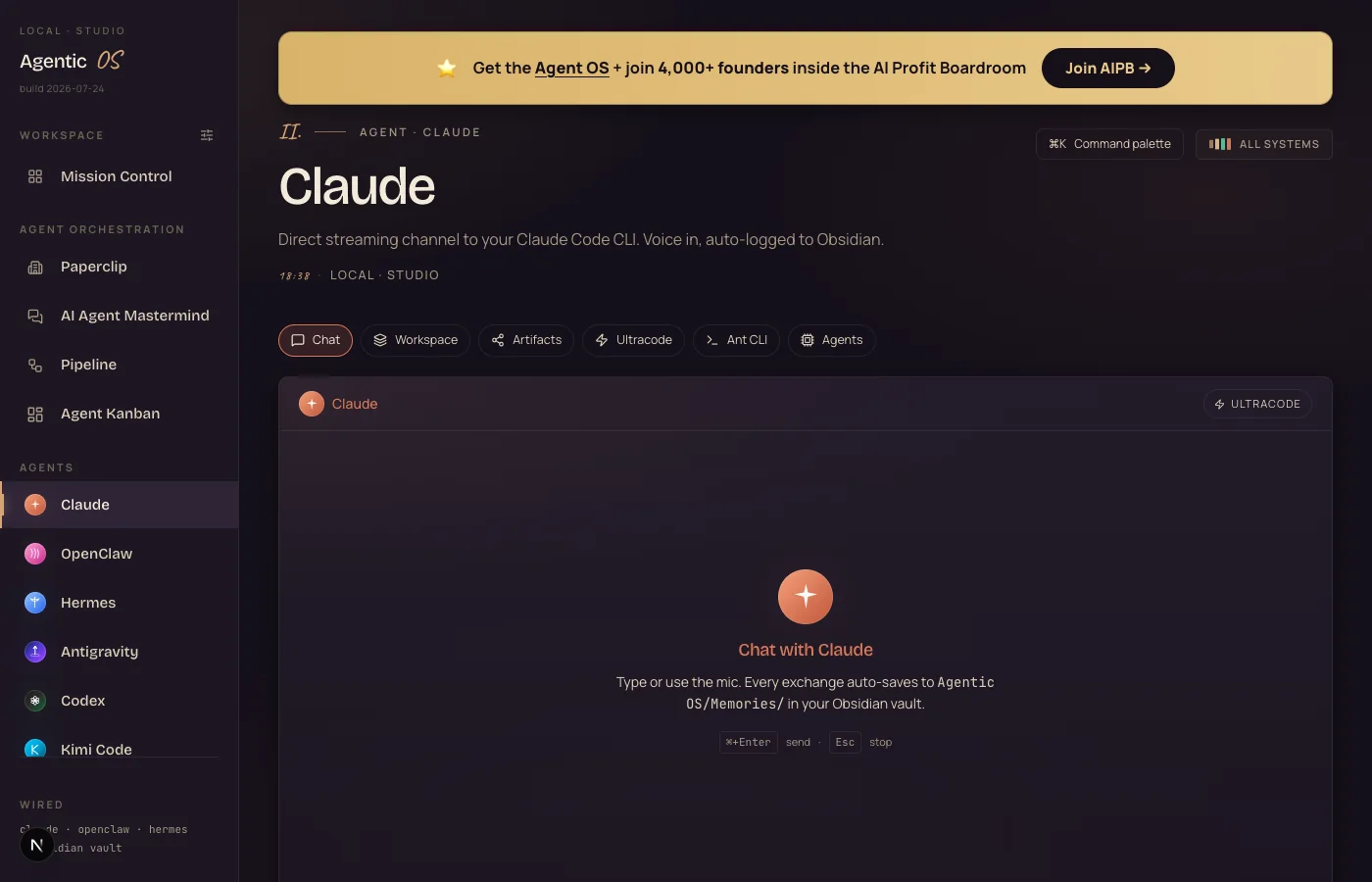
What you're looking at: the Claude tab in my Agent OS (build 2026-07-24). Under the hood it now spawns claude-opus-5 — verified at the process level, not by asking the model (models guess their own name wrong; what matters is what the CLI actually runs). Type or talk, and every exchange auto-saves to my Obsidian memory.
Because the whole OS shares one memory, Opus 5 doesn't just answer smart — it answers smart about your business. It knows your clients, your goals, your voice, every session.

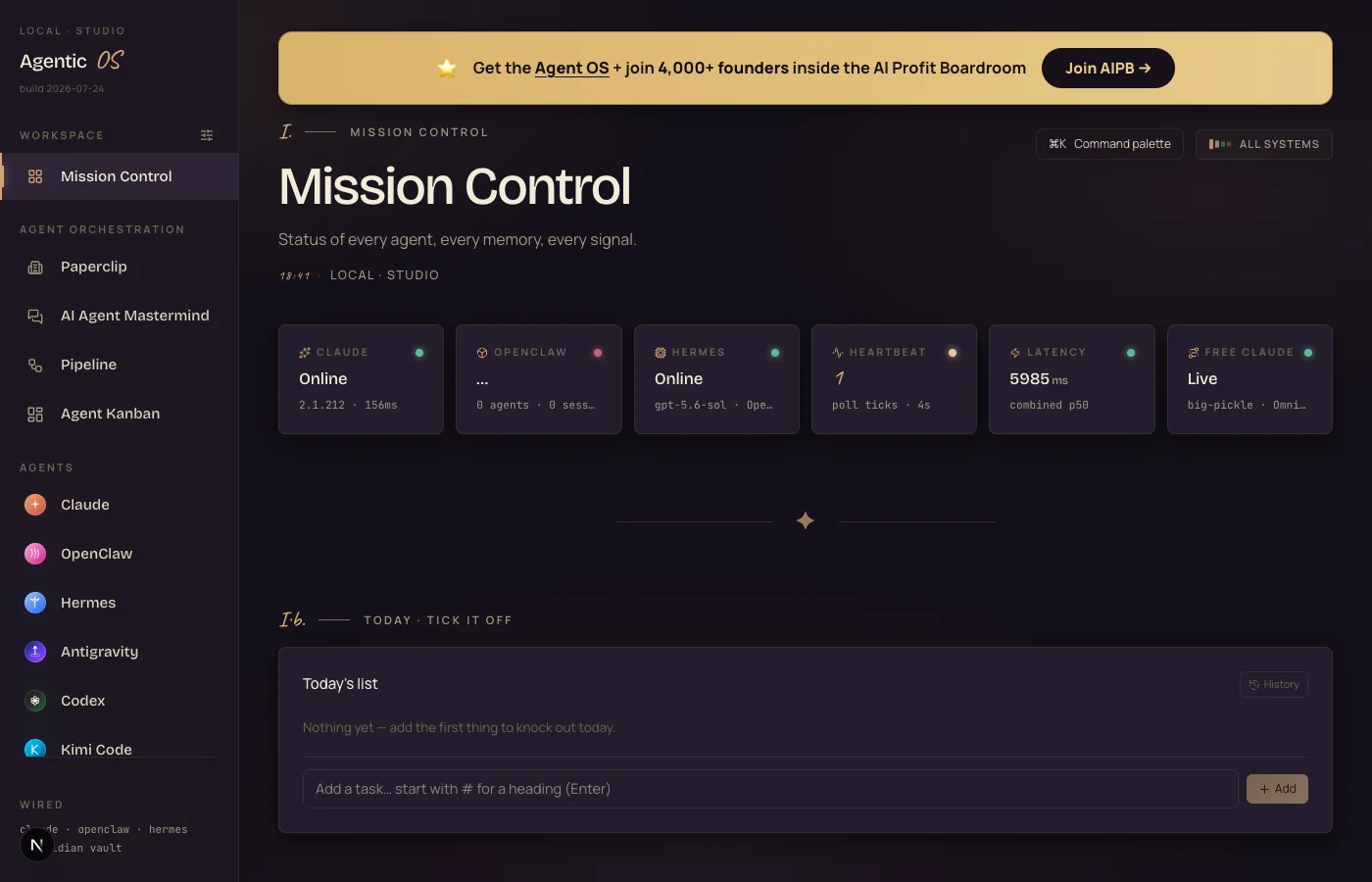
What you're looking at: Mission Control — the front door of the Agent OS. Every agent, every memory, every signal on one screen. Opus 5 is the Claude engine behind it all now.
No — that's the biggest myth about it. The everyday 90% runs on free local models on your own machine, free API tiers slot in as agent profiles, and for the frontier work it drives the Claude subscription you already pay for — the Agent OS plugs straight into your Claude Code CLI, so you're not paying twice.
And Opus 5 being half the cost of the top model means even your paid calls got cheaper this week. Inside the Boardroom there are full token-optimisation tutorials on top.

Talk is cheap, so I'm running Opus 5 through GoldieBench — my open AI-model leaderboard where every model builds the same one-prompt games and gets scored by a vision judge.
Opus 5 is building the full set of 3D games right now — dragon realms, dungeon crawlers, driving sandboxes, flight sims — each one skill-directed, playtested, and scored against every other frontier model.
They're uploading to the board as they finish. Watch Opus 5 climb it live, and play the builds yourself:
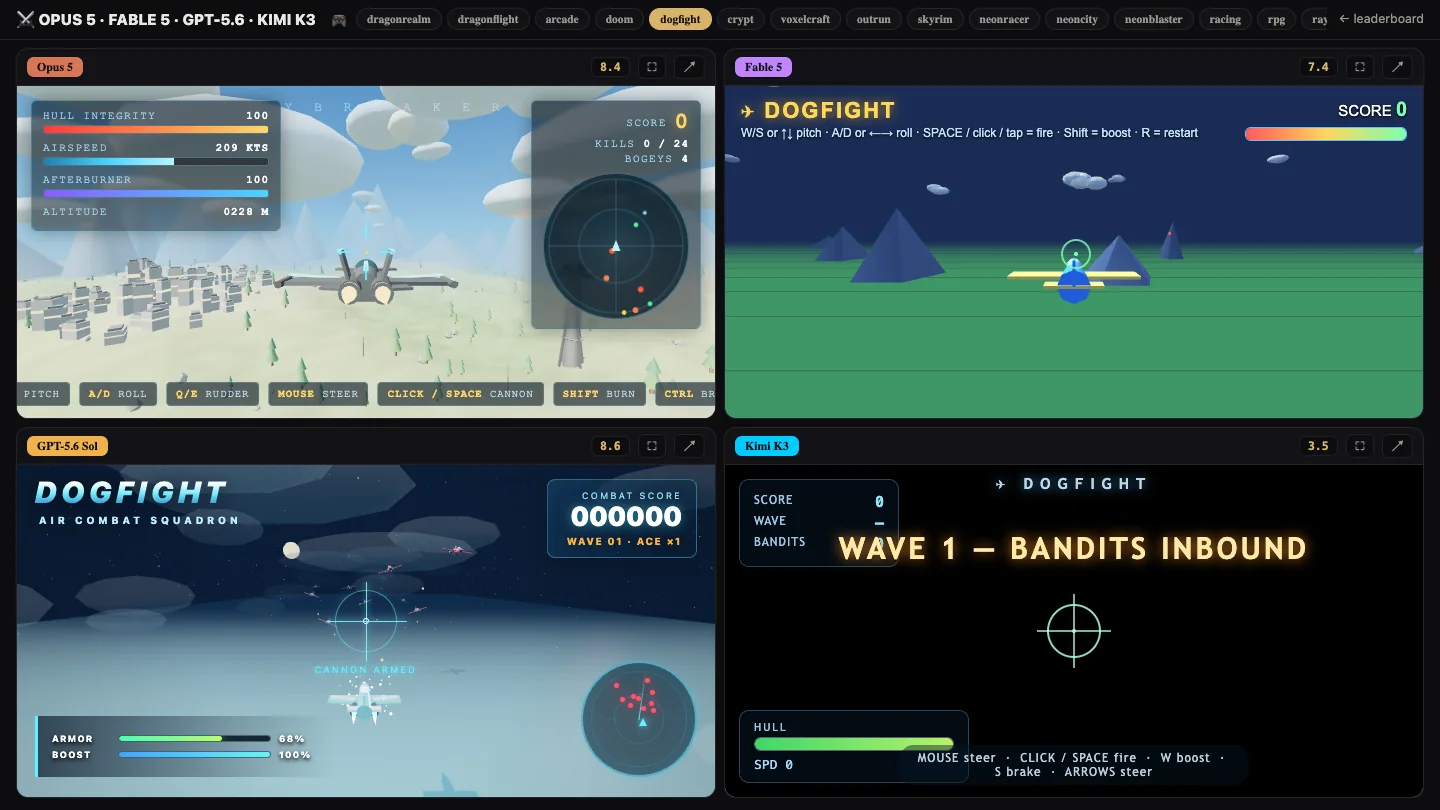
Here's the head-to-head that matters — Opus 5 against the three models everyone compares it to, building the exact same game, side by side. Play any of them:
What you're looking at: the live 4-way battle — Opus 5, Fable 5, GPT-5.6 and Kimi K3 each building the same one-prompt game. On this dogfight, GPT-5.6 scored 8.6, Opus 5 8.4, Fable 5 7.4, Kimi K3 3.5. Click through and play every build yourself — it grows as more Opus 5 games land.
Here's how I run Opus 5 as one system — five layers, console to output.
Opus 5 itself — near-Fable-5 intelligence at half the cost, standard and Fast on tap. The engine everything runs on.
The Agent OS dashboard — Claude, Hermes, OpenClaw and Codex in one place, Opus 5 wired in as the Claude engine.
Your Obsidian vault — every session saved, so Opus 5 answers smart about your business, not in a vacuum.
Agents that run jobs in parallel on the cheap Opus 5 rate — coding, research, outreach — while you sleep.
Live GoldieBench builds — Opus 5's real, playable output scored against the whole field. Receipts, not claims.
Switch on Opus 5 and you get the core. Wire the five layers together — that's the Command Engine, and it's what the Agent OS ships pre-built.
Members post their wins every day — agency owners, ecom founders, course creators, solo operators across 38 countries. Real businesses, real numbers, in their own words.
Read the 158-page wins doc →In Claude Code, point any command at the new model:
claude --model claude-opus-5 -p "build me a landing page"
Confirm you're on it:
claude auth status
You'll see "loggedIn": true with your account — Opus 5 runs on the Claude subscription you already have.
In the Agent OS, the Claude engine is set with one line in ~/.agentic-os/config.json:
{ "claudeModel": "claude-opus-5" }
Restart the dashboard and every Claude surface in the OS is on Opus 5. No rebuild, no reinstall.
That's normal and means nothing. A model's training data predates its own launch, so it guesses an old name for itself.
Ignore what it says. What it is = what the CLI resolves, and claude auth status plus the model flag are the real proof.
This isn't a "wait and see" release.
It's the same top-tier work you were paying double for, now at half the price, already in every place you use Claude.
Switch the model flag today. If you run an Agent OS, flip the config line.
The people who figure out AI while it's moving this fast are going to be miles ahead when it settles. Every switch you make now compounds.
Near-Fable-5 answers at half the cost — the flagship tax is gone.
>2x Opus 4.8 on Frontier-Bench, within 0.5% of Fable 5 on CursorBench.
3x the next model on ARC-AGI 3; tops OSWorld and AutomationBench.
+10.2 points chemistry, +7.7 protein — Anthropic's best for research.
Fast mode at 2.5x for the moments you're waiting.
Opus 5 is the Claude engine in the Agent OS — one line to switch.
Members post their wins every day — agency owners, ecom founders, course creators, solo operators across 38 countries. Real businesses, real numbers, in their own words.
Read the 158-page wins doc →