Hermes + DeepSeek V4 Flash — a 1M-context agent for pennies.
Hermes just got DeepSeek V4 Flash, and this pairing makes your AI agent seriously more powerful.
You get a brain that holds a million tokens at once, tuned specifically for long agent loops — and it costs so little you'll stop thinking about it entirely.
I wired it up this morning and pointed it at three builds, and it made every single one of them work first time — I'll show you all three.
There's also a version of this you can run free, which I'll come to later.
Today: the exact setup, the builds it produced, and the one detail about which version you're running that decides whether you get the good model or yesterday's.
Stick with me to the end. Let's get into it.
Here's the pairing in one breath.
Hermes is the agent — the thing that plans, runs tools, writes files and finishes jobs on your machine.
DeepSeek V4 Flash is the brain you point it at.
It's the cheap, fast tier, freshly retrained for exactly the kind of long tool-calling loop Hermes runs all day, with a million-token context window behind it.
Nous Research's own Teknium flagged the pairing, and the community reaction has been immediate.
It took me about two minutes to wire in, and the rest of this page is what came out.
1Mtoken context window
0731the agent-tuned build
3/3builds worked first time
2 minto set up
II ────── Why this pairing
The agent was never the bottleneck. The brain was.
Hermes has always been able to do the work — run commands, write files, browse, chain tools, keep going without you.
What limits an agent like that is the model behind it.
Long jobs break when the model forgets what it did twenty steps ago.
They get expensive when every tool result costs frontier prices.
And they stall when the model wasn't trained for tool-calling loops in the first place.
V4 Flash lands directly on all three:
It remembers everything. A million tokens of context means the whole job — every file, every result, every earlier decision — stays in front of it.
It was retrained for agents. The 0731 build is a post-training upgrade aimed squarely at agent capability and Codex-style write-run-fix loops. Same size as before; better at the loop.
It costs almost nothing. This is the cheap tier, which is what makes "let it grind for ten minutes" a reasonable thing to do rather than something you flinch at.
That's why the pairing matters. An agent that can run for a long time is only useful if the brain can afford to, remember enough to, and was taught how to.
Hermes supplies the hands. V4 Flash supplies a memory long enough — and cheap enough — to use them properly.
Teknium at Nous, on the pairing →
"Isn't the cheap tier going to be worse at the hard parts?"
That was the old trade and it's quietly stopped being true.
DeepSeek's own claim with this build is that it now beats their previous strong-tier preview on agent benchmarks — from the same size model.
And you'll see below what it actually produced: three fairly demanding builds, all working on the first attempt.
✦
III ────── The setup
Wire it up in two minutes.
A Hermes profile is just a folder with a config file. Making one for DeepSeek takes about as long as reading this section.
Step 1 — get a key.
Grab an API key from DeepSeek's platform. This is the important bit and I'll explain why in the next section: go to DeepSeek's own API, not a middleman.
Step 2 — create the profile.
Make a folder at ~/.hermes/profiles/deepseek/ with a config.yaml in it:
Step 3 — drop your key in.
Alongside it, an auth.json holding the key under a matching provider name. Then check it actually took:
hermes -p deepseek status
You want to see Model: deepseek-v4-flash and Provider: DeepSeek. If it shows a different model, you're not on the profile you think you're on — that trap has its own section below, because it bit me hard.
Step 4 — use it.
hermes -p deepseek -z "build me a thing" --yolo --accept-hooks
That's the whole setup. One flag switches your agent's brain.
"Do I have to pay to try this?"
Not necessarily — DeepSeek V4 Flash has also shown up free on Nous Portal for use in Hermes, which is the zero-setup way in if it's live when you read this.
Sign into Portal from inside Hermes and pick it in the model list.
The profile route above is what you want when you're running it hard and want the dated build guaranteed.
✦
IV ────── The one detail that matters
Make sure you're on the new one.
This is the part I'd want someone to tell me, because it's easy to get wrong and impossible to notice.
The upgrade shipped as V4-Flash-0731 — a dated build.
Same architecture as the previous preview. Same size. Same name in most places.
Only the training changed.
Which means a route that just says "v4-flash" with no date might be serving you the older preview, and you'd never know from the output — you'd just quietly conclude the upgrade was overhyped.
Two safe ways to be certain:
1 — Use DeepSeek's own API. The launch shipped there first. Confirm the model appears in their official model list and you're done.
2 — Use the dated ID. On OpenRouter there's now an explicitly dated entry — deepseek/deepseek-v4-flash-0731. If the ID carries the date, you know what you're getting.
Rule of thumb for every launch, not just this one: when the name stays the same but the model changes, only a dated ID or the vendor's own endpoint proves what you're running.
Same name, two different models. The date is the only thing standing between you and a wrong conclusion.
✦
V ────── What it built
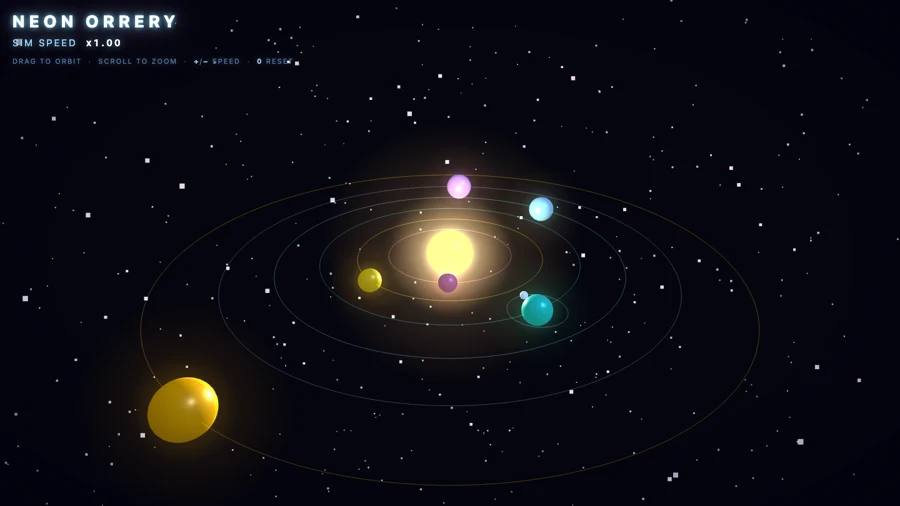
Three builds. One prompt each. All worked first time.
Setup means nothing without proof, so I gave the pairing three jobs — not toy ones — and let Hermes drive.
Each was a single prompt. No follow-ups, no corrections, no fixing anything by hand.
Hermes planned it, called DeepSeek, wrote the file to disk, then opened it in a browser and checked its own work before telling me it was done.
That last part is worth sitting with: the agent verified its own output by taking screenshots a second apart and measuring how many pixels changed, to prove the animation was actually running.
All three rendered clean with zero console errors when I checked them independently.
Three for three, first time, from the cheap tier.
That's the thing worth taking away — not that any one of these is remarkable on its own, but that a model this inexpensive now lands them without a single retry.
Step 4 is the one that surprised me — it screenshotted its own build twice and measured the pixel change to prove the animation was running.
"What's the catch?"
Speed. V4 thinks at length before it writes anything, so each of these took minutes rather than seconds.
If you want an instant draft, this isn't your model.
If you want to hand an agent a real job and come back to finished work, that trade is the right way round.
✦
VI ────── Putting it to work
Then I gave it a real job — and let the board run it.
Three demos are a nice party trick. Here's the part that actually matters for a business.
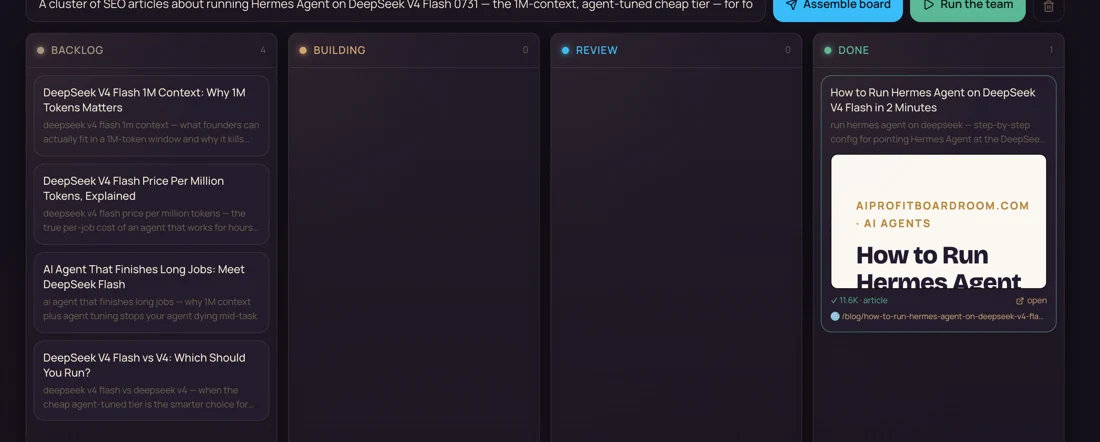
My Agent OS has a Kanban board that agents work: a Planner breaks a goal into cards, a Builder does each card, and finished work lands in the Done column.
I pointed the whole board at DeepSeek and gave it one instruction — a cluster of articles about running Hermes on this model, for founders who want an agent that finishes long jobs.
The Planner filled the board.
Five cards came back, each a real search-intent article: the 1M-context angle, the cost-per-job angle, the setup how-to, the long-jobs angle, and a Flash-versus-V4 comparison.
I didn't write any of those. It found the angles itself.
Then it wrote one, start to finish.
I moved the how-to card into build and the same model wrote the whole article — front matter, headings, keyword-first opening, the lot.
It came back approved, saved straight into the site's posts folder, and it's live now.
The board after one instruction — four cards planned, one written and published, all by the same model. The Done card previews the live article.
That's the difference between a model you chat with and a model doing your work.
One sentence in, a planned content cluster and a published article out — while I was doing something else.
"Did you edit the article afterwards?"
Two things, and I'll be straight about both: I corrected the author name in the front matter, and I swapped one phrase I don't allow in my writing.
The structure, the angles, the argument and every paragraph are the model's.
That's a genuinely publishable draft from one card on a board.
✦
VII ────── And then it wrote the ad
The same agent scripted the video promo.
Last one, and it's my favourite, because it closes the loop.
I asked the same Hermes + DeepSeek pairing for a sixty-second promo script for a talking-head video.
Spoken words only, third-grade language, a bold promise, one open loop, no jargon.
Then that script went straight into my AI avatar — my own face, my own cloned voice — and came back as a finished video.
Model writes the words. Avatar delivers them. Nobody sat in front of a camera.
The finished promo — script by DeepSeek through Hermes, delivered by my AI avatar. No camera, no studio, no takes.
Look at what that chain actually is.
One model planned a content cluster, wrote a publishable article, and scripted the ad that promotes it — from a board, in an afternoon, on the cheap tier.
"Isn't AI-written content going to read like AI-written content?"
Judge the two things above rather than the category.
The reason they don't read like slop is that the instructions were specific — who it's for, what voice, what to avoid, what the reader should feel.
A vague prompt gets you slop from any model. A precise one gets you a draft you'd actually publish.
✦
VIII ────── My story · why this matters
I was you. Then I made the brain a swappable part.
Before
Every model launch used to mean a day of rebuilding.
New tool, new install, new setup, new habits — and by the time I'd finished, something else had launched.
I was permanently behind, and permanently starting over.
Then I stopped rebuilding and started swapping.
After
DeepSeek's upgrade landed and I had it running as a Hermes profile before my coffee went cold.
One folder, one config file, one flag.
Everything I'd already built — my agents, my memory notes, my whole workflow — carried straight across.
Then I pointed it at three jobs and went to do something else while it worked.
You can have this too. Build the system once, and every launch becomes a two-minute upgrade.
IX ────── The receipts
Real people. Real builds. Inside the Boardroom right now.
The members running this stack — agency owners, ecom founders, course creators — swapping in new engines the week they ship.
4,000+ founders inside AIPB
258 real wins documented
400K YouTube subscribers
38 countries · live members
163K X followers
Members post their wins as they happen — first agents shipped, workflows automated, whole businesses run from one dashboard. All collected in one doc you can read right now.
The setup above is four steps and about two minutes.
So here's the deal.
Make the profile today and give it one real job — something you'd normally do yourself.
Not a test question. An actual piece of work.
Then judge it on what comes back.
The people who read launch threads are still reading them next week.
The people who wire it in have three finished things by lunchtime.
Be one of those people. One profile. Today.
✦
X ────── Old way vs new way
Most people pick a model. Operators keep a socket.
The old way: commit to one model, build your habits around it, and start again when something better lands.
Every launch is a threat, because it means your setup is now the wrong setup.
You end up defending your choice instead of upgrading it.
The new way: the agent is permanent, the brain is a socket.
A launch is a folder and a config file. Everything you've already built inherits the upgrade instantly.
You test the new one against the old one on real work, keep the winner, and move on.
That's how a launch day turns from a distraction into a free upgrade.
✦ ✦ ✦
Get the whole operating system
Want this pre-wired, not DIY?
Every engine in one dashboard, swappable, with the profiles already built — that's the Agent OS. Join the AI Profit Boardroom and you get:
The Flash Agent Stack™ pre-wired — Hermes with the DeepSeek profile ready to run
The full Agent OS — every major engine in one dashboard, new ones added the week they ship
Free local models — the everyday 90% of work at $0 on your own machine
Agent Kanban — Planner → Builder → Reviewer teams that ship while you sleep
The memory vault — an Obsidian brain your agents actually read
Model-routing playbooks — which engine for which job, kept current as the field moves
5 live coaching calls a week — get unblocked by people on your exact setup
You're not buying a tool. You're getting the operating system I run a seven-figure business on — and it absorbs launches like this one without breaking stride.
Inside the AI Profit Boardroom · skool.com/ai-profit-lab
Set up in an afternoon · used in 38 countries · new tools added every week
XI ────── Three beliefs to drop
What's actually stopping you isn't technical.
"Setting up an agent with a custom model sounds like developer work."
It's a folder with a text file in it and one command to check it worked.
If you can make a folder and paste four lines, you've already done the hard part.
Everything after that is just talking to your agent.
"A cheap model will produce cheap work."
Look at the three builds above and decide for yourself — one prompt each, no retries, from the budget tier.
Price stopped tracking capability a while ago. What matters now is whether a model was trained for the job you're giving it, and this one was trained for exactly this job.
"There'll be a better model next week, so why bother now?"
There will be — that's precisely the argument for setting this up.
Once your agent treats the brain as a swappable part, next week's model is another two-minute profile, not another rebuild.
You're not betting on DeepSeek. You're building the socket it plugs into.
✦
XII ────── The SOP
Do it properly — five steps.
1 · Get the key from the source. DeepSeek's own platform. This is also what guarantees you're on the shipped build rather than a stale mirror.
2 · Make the profile. A folder under ~/.hermes/profiles/, the config from section III, your key alongside it. Two minutes.
3 · Verify before you trust it.hermes -p deepseek status must show the model and provider you expect. Never assume a label — check. This is the single most valuable habit in this guide.
4 · Give it a real job, not a quiz. The upgrade is about agent loops, so test it there: a whole build, a multi-step task, something with tool calls in it. A one-line question tells you nothing about what changed.
5 · Feed it the context it can now hold. A million tokens means whole codebases and whole research piles fit in one call. Most people never change their habits after a context jump — that's free leverage sitting on the table.
✦
XIII ────── Recap
The whole thing in 30 seconds.
Hermes supplies the hands, DeepSeek V4 Flash supplies the brain — a million-token context window, retrained specifically for agent and coding loops, on the cheap tier.
Setup is a folder, a config file and one flag. Verify with hermes -p deepseek status before you trust any of it.
Watch the version. The upgrade shipped as the dated 0731 build with the same name and size as the preview — use the vendor's own API or the dated ID, or you may be judging yesterday's model.
Three builds, one prompt each, all working first time — a 3D orrery, a generative garden and an ocean simulator, all playable above.
Then I gave it real work: it planned a five-card content cluster on my Kanban board, wrote one of the articles start to finish (published and live), and scripted the video promo my AI avatar delivered.
The real win isn't the model. It's an agent where the brain is a swappable part, so the next launch costs you two minutes instead of a weekend.
The shortcut
Skip the wiring. Run my exact setup.
Hermes, the DeepSeek profile, and every other engine — pre-wired inside the Agent OS. 4,000+ founders, 258 documented wins, 38 countries.
The AI Profit Boardroom is where the actual Agent OS lives — the templates, the prompts, the daily rooms, the weekly walkthroughs. Same builds you read about here, taught hands-on inside.