Running live on 5 sites · numbers pulled 5 August 2026
The Claude AI SEO Skill — one keyword in, five ranking articles out.
You can now hand Claude one keyword and get five finished articles, live on five different websites, before your coffee goes cold.
Not five copies — five genuinely different posts, each with its own click-getting title, its own videos, its own FAQs.
They link to each other across the network, they get pushed to Google the same hour, and a scoreboard tells you exactly what to write next.
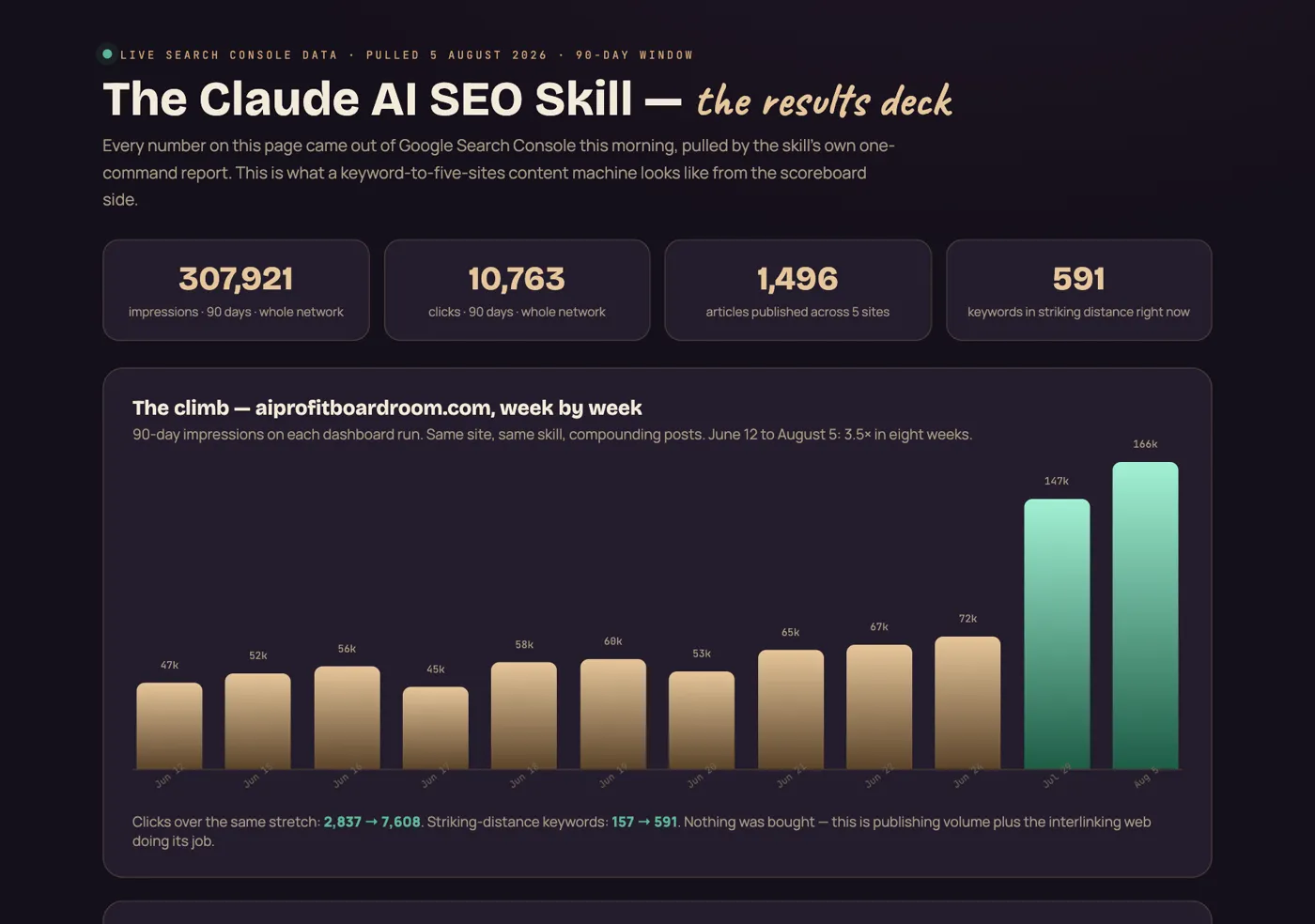
This system took one of my sites from 47,000 impressions to 166,185 in eight weeks — the real dashboard is embedded below so you can check me.
Today: the whole skill, step by step, the pathways inside it, and the one habit that makes it compound. Stick with me to the end. Let's get into it.
Here's the whole idea in one breath.
A "skill" is a written playbook Claude reads before it works — my SEO one is a 13-step operating manual.
It takes one keyword and one video transcript, writes five unique articles in my voice, publishes them across my five-site network, wires the backlinks, triggers indexing, and logs the result.
What used to be a week of content work is now one instruction.
166,185impressions · flagship site · 90 days
1,496articles live across the 5 sites
5unique articles per keyword
591keywords in striking distance today
✦
I ────── The problem
The Invisible Blog Problem.
Imagine writing a really good article.
You research it, you write it, you hit publish.
And then nothing happens.
Google doesn't know it exists, so nobody searches their way to it.
Nothing links to it, so it has no authority.
The title is descriptive but dull, so even when it does show up, nobody clicks.
So you write another one. Same result.
That's the Invisible Blog Problem — the work happens, the traffic doesn't.
Most people quit here and call SEO dead.
The Claude AI SEO Skill breaks that cycle — publishing five angles at once, interlinking them into a web, and forcing Google to look the same day.
THINKING IT?"Five articles per keyword sounds like spam."
It would be, if they were five copies. They're five different articles — different titles, different structures, different examples — on five different sites.
Google sees five relevant results from five domains, and the reader gets a real answer whichever one they click.
✦
II ────── How it works, in simple words
What the skill actually does
Think of it as a content factory with a quality manual bolted to the wall.
You give it two things: a keyword, and the transcript of a video I already made about that topic.
The transcript rule is the heart of it — every fact in every article must come from the transcript, so the AI never invents features or numbers.
Then the factory runs: five writers produce five different takes, each one gets a click-getting title, videos get embedded, links get woven in, and all five ship to five different sites at once.
The moment they're live, Google gets told to come look.
Keyword in, five articles out, Google told, results measured. Then the measurements pick the next keyword.
✦
III ────── Exactly how it works, step by step
The 13-step pathway inside the skill file
This is the actual pathway Claude walks every single run — condensed from the skill file itself.
1 · Get the keyword and the transcript. It asks one question — "what keyword?" — then loads the matching video transcript. The transcript is the source of truth: if there isn't one, it stops and asks rather than making things up.
2 · Plan the video embeds. Every article gets 2–3 of my real YouTube videos — the main one near the top, supporting ones woven into matching sections. More watch time, more proof, more reasons to stay on the page.
3 · Write titles like YouTube headlines. Five different click-getting formulas across the five sites — number + result, curiosity gap, personal story, bold claim, question. Never "A Guide To X".
4 · Write five genuinely different articles. Same keyword, five unique posts — different openings, structures, examples and FAQs, each 2,000–3,000 words in my voice, every sentence on its own line.
5 · Layer the conversion elements. Benefit-led opening lines, a call-to-action in the first third, schema markup for rich results, an author bio for trust, comparison tables where they fit, and every link properly wrapped.
6 · Wire the internal links. Each article links to 2–4 related posts on its own site, plus a "Related reading" block — so every new post strengthens the old ones.
7 · Deploy all five sites in parallel. Five builds, five live URLs, then each one is checked to confirm the videos actually rendered.
8 · Trigger indexing the same hour. All 25 URLs go to the indexing service by API. No waiting weeks for Google to wander past.
9 · Cross-link the network and log everything. Each post links to its four sister posts — 20 instant backlinks per keyword — older related posts get "Latest Updates" links added, the tracker sheet gets its row, and the batch ends with an improvement review that updates the skill itself.
So when someone asks "but what IS it?" — it's a 13-step manual that turns one keyword into five ranking attempts, and gets a little smarter every batch.
The skill inside my Agent OS, and what it publishes
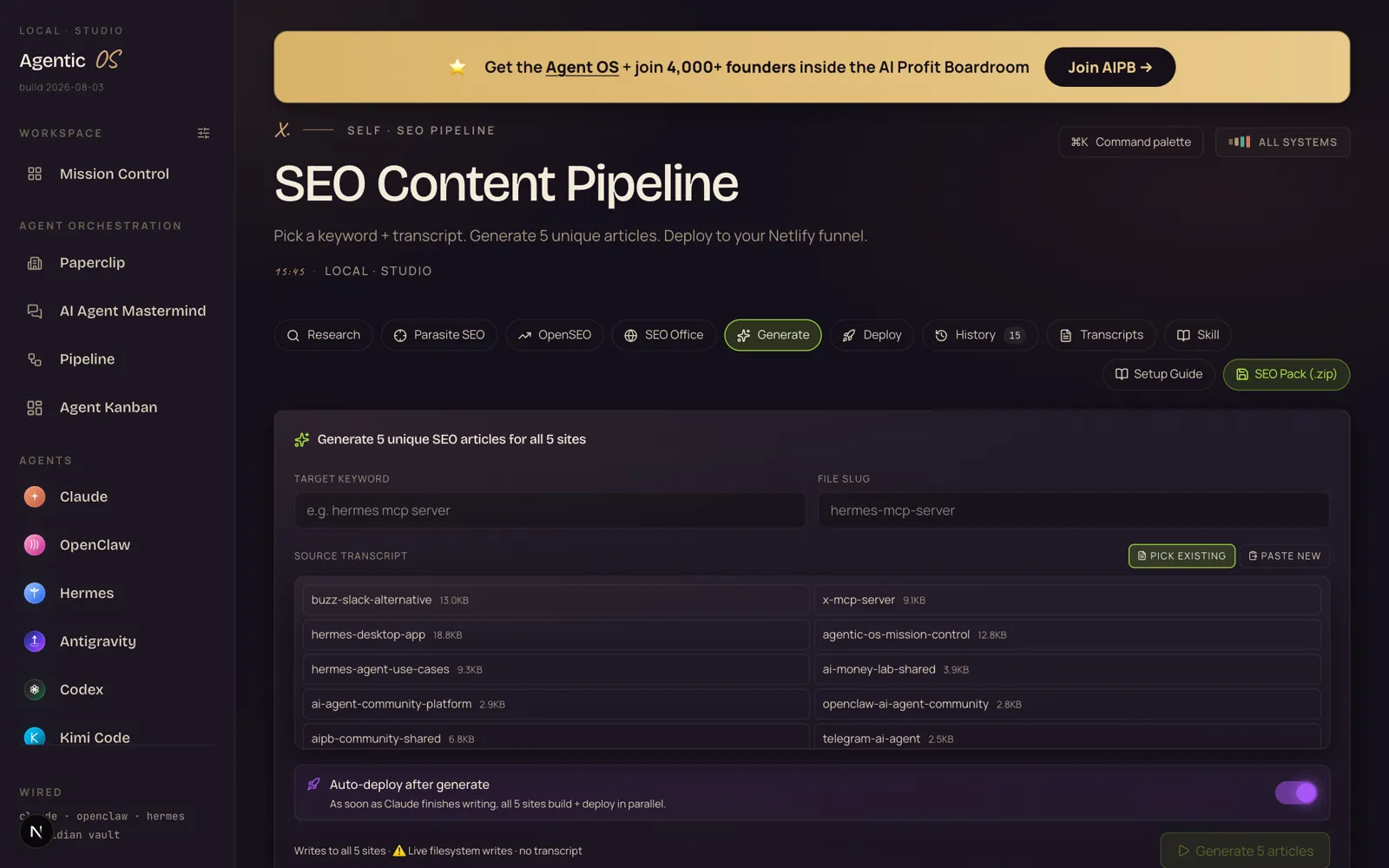
The skill also has a cockpit. Inside my Agent OS there's a whole SEO Content Pipeline tab built around it — keyword box, transcript picker, and an auto-deploy switch.
What you're looking at: the SEO Content Pipeline tab in my Agent OS. Type a keyword, pick a transcript from the library, flip auto-deploy — the skill does the other twelve steps.
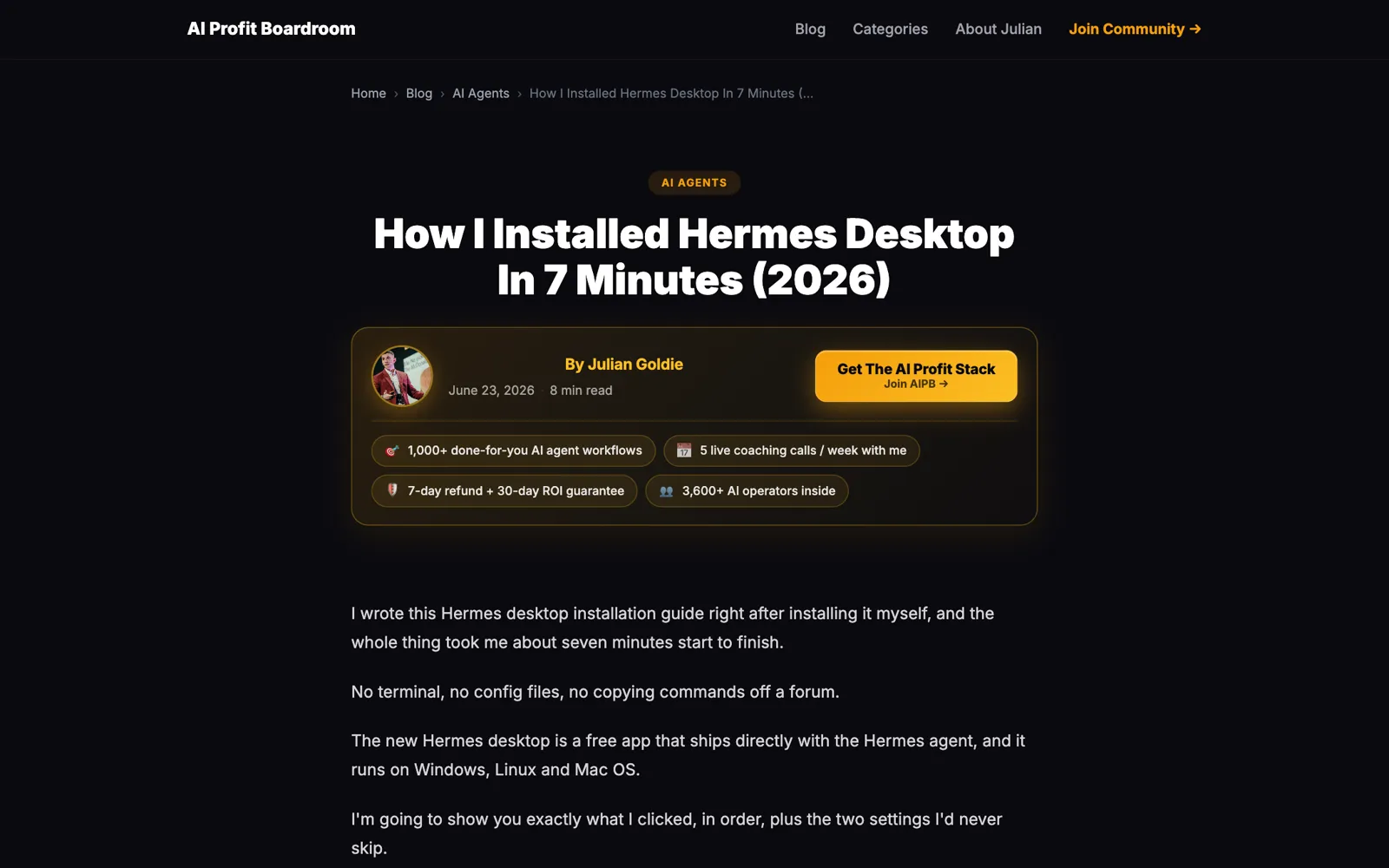
And this is what comes out the other end — a real published article from the network, exactly as readers see it:
What you're looking at: a live post the skill produced — click-getting title, author box for trust, benefit chips, call-to-action before the first scroll. Every element traces back to a numbered step in the pathway.
And the part I'd screen-record: the scoreboard. The skill's report command pulls all six Search Console properties into one deck — the climb, the whole network, and the exact keywords to hit next. This is live data from this morning, interactive:
The scoreboard sorts every keyword into one of these two buckets and hands you the fix.
One keyword used to cost me a week. Now it costs one sentence.
VI ────── My story · why this matters
I ran an SEO agency. This is the machine I wished existed.
I've done SEO the manual way for years — brief a writer, wait a week, edit, publish, forget to build links, wonder why nothing ranked.
One post, one site, one attempt per keyword. If the title flopped, that keyword was gone.
The skill flips the economics. One keyword now gets five attempts, on five domains, each with a different title formula — and the network links every attempt to the other four.
The numbers on this page are what happened when that machine ran for eight weeks. You can have the same system reading your keywords tonight.
✦
VII ────── The receipts
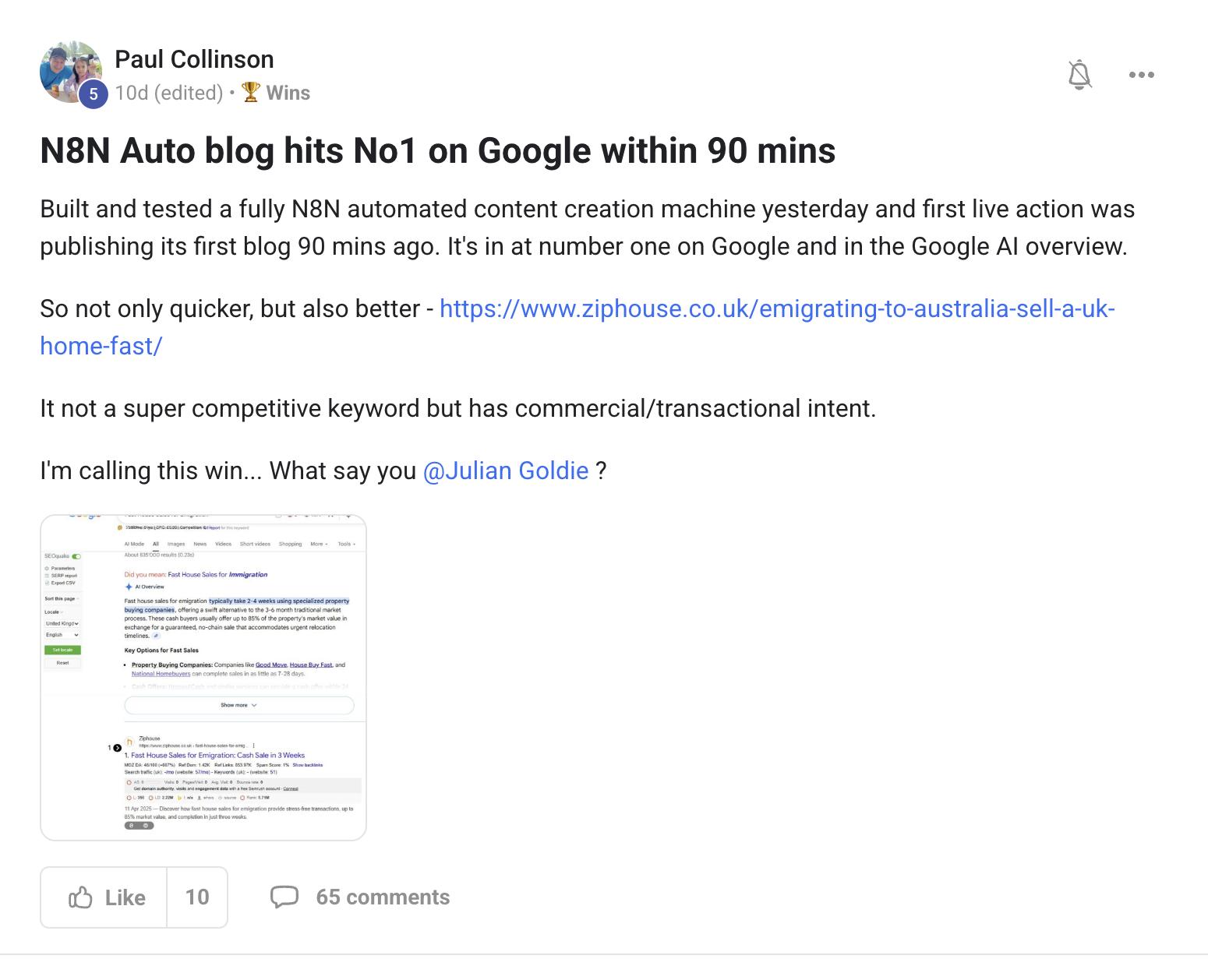
Real people. Real wins. Inside the Boardroom right now.
Members run this same playbook on their own niches — agency owners, ecom founders, course creators.
Thirteen steps sounds like a lot, so here's the shape of it. Six layers, each one a habit the skill never forgets.
i
The Transcript Truth
Every fact comes from a real video transcript. No transcript, no article — so the AI can't invent features, numbers or claims.
ii
The Five Voices
Five unique articles per keyword, five title formulas, five structures — five chances to own the results page instead of one.
iii
The Conversion Layer
Titles written for clicks, a call-to-action before the first scroll, schema for rich results, an author bio for trust. Traffic that actually converts.
iv
The Network Web
Every post links its four sister posts plus 2–4 older posts on its own site — 20 instant backlinks per keyword, and the older content stays fresh.
v
The Index Trigger
All 25 URLs pushed to Google the same hour they go live, by API. Ranking starts this week, not next month.
vi
The Compound Loop
Every batch ends with a review: what worked goes INTO the skill file. The scoreboard picks the next keyword. The machine gets smarter every run.
One keyword becomes a five-node web. Google follows the threads; the smaller sites inherit the flagship's authority.
✦
IX ────── Old way vs new way
What this gives you back.
The old way — by hand
~a week per keyword
Write one article, publish on one site
One title — if it flops, the keyword is dead
Forget the schema, skip the internal links
Wait weeks for Google to maybe crawl it
Never check Search Console again
With the Claude AI SEO Skill
~one instruction
Five unique articles live on five sites
Five title formulas — five shots at the click
Schema, bio, tables and links baked into every post
All 25 URLs pushed to Google the same hour
The scoreboard picks next week's keywords for you
"This probably needs a big site network to work."
The pathway works on ONE site from day one — steps 1 to 8 don't care how many domains you have.
The network layers (steps 9–12) are the amplifier you add when you're ready. I started with one site too.
"AI content can't rank." The deck above is live Search Console data: 166,185 impressions in 90 days on the flagship, 3.5× growth in eight weeks. The trick isn't AI — it's the transcript rule, the unique-five rule, and the indexing trigger. Lazy AI content doesn't rank. Systemised AI content does.
"Google will penalise five articles on one keyword." Five DIFFERENT articles on five different domains is what big publishers have always done. The skill's hard rule — different title, structure, examples and FAQs on every one — is exactly what keeps it clean.
"I'd need to be an SEO expert to run this." The expertise is written INTO the skill file — that's the whole point of a skill. You bring a keyword and a transcript. The 13 steps carry the rest, the same way every time.
Don't take my word for it
158 pages of members who broke through these exact beliefs — real businesses, real wins, written by them.
Google doesn't reward the best writer. It rewards the best system.
XI ────── The SOP
Run it yourself — eight steps.
1 · Record the video first. Talk through the topic for ten minutes. That transcript becomes the source of truth for everything written.
2 · Save the skill file. Put the 13-step playbook where Claude reads skills. From now on "write the articles for [keyword]" runs the whole pathway.
3 · Start with one site. Steps 1–8 on a single domain. Get ten posts live before you think about a network.
4 · Never skip the index trigger. A post Google hasn't seen is a post that doesn't exist. Push every URL the hour it ships.
5 · Pull the scoreboard weekly. One command refreshes every site's numbers. Ten minutes, once a week.
6 · Fix click leaks first. Anything ranking on page 1 with a weak title gets a rewrite before any new post gets written. Fastest win on the board.
7 · Chase striking distance second. Everything at positions 5–20 is one push from page 1 — strengthen those posts, add links to them.
8 · Feed the wins back into the skill. End every batch asking: which titles earned clicks? Write the answer into the skill file. That's the compounding.
Publish → measure → learn → publish sharper. Step 8 is what turns a workflow into a machine.
✦
XII ────── Recap
The whole thing in 30 seconds.
You stop guessing what to write. The scoreboard reads your own Search Console and hands you the list — click leaks first, striking distance second.
You stop publishing invisible posts. Every article ships with five title attempts, 20 backlinks and a same-hour indexing push.
You stop paying for facts. The transcript rule means every claim comes from your own videos — nothing invented, nothing generic.
You stop repeating yourself. The skill file carries the expertise; batch by batch it absorbs what worked and gets sharper.
The numbers are real. 47k → 166k impressions in eight weeks, 1,496 articles live, 591 keywords in striking distance today — all of it in the live deck above.
The AI Profit Boardroom is where the actual Agent OS lives — the templates, the prompts, the daily rooms, the weekly walkthroughs. Same builds you read about here, taught hands-on inside.