Hy3 (Hunyuan 3) dropped as Apache-2.0 open weights at basically-free API prices. I benched it on GoldieBench, watched it crawl from broken builds to an 8.2 DOOM, gave it a live coding tab in my Agent OS — and learned exactly how to prompt cheap models into premium output.
Before
I pointed Hy3 at my bench with one-line prompts, like every other model.
Back came a flat red wall calling itself DOOM. A parachute game that was a black screen. A "promo video" that was a 3D toy you had to drag.
The scores said 3.5. The screenshots looked worse.
Old me would have written the verdict: "cheap model, cheap output."
Then I embedded my 3D game playbook directly into Hy3's prompts.
After
Same model. Same price. New prompts — renderer settings, lighting stacks, multi-part model recipes, HUD zones, spelled out.
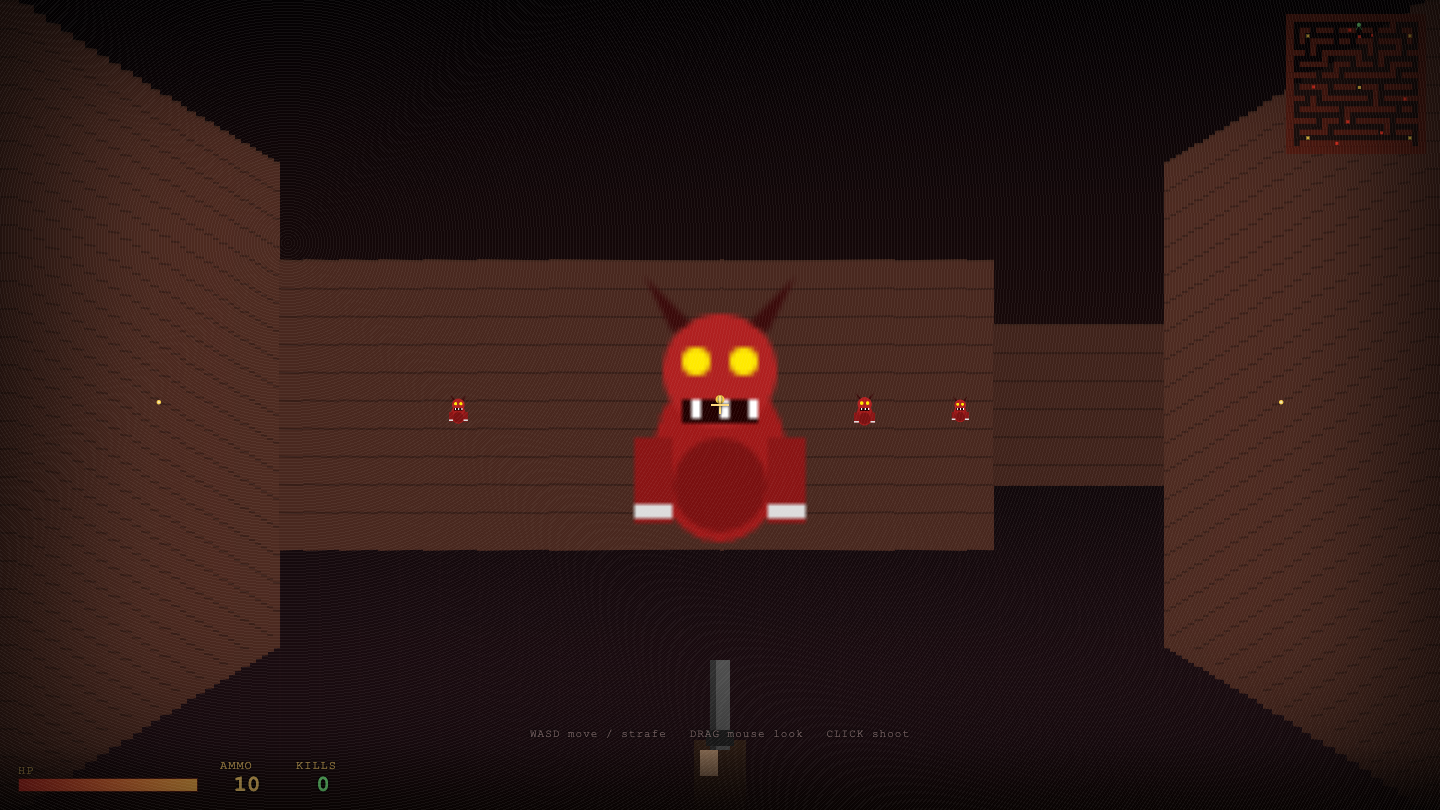
DOOM went 3.5 → 8.2: demons in the corridor, shaded walls, minimap.
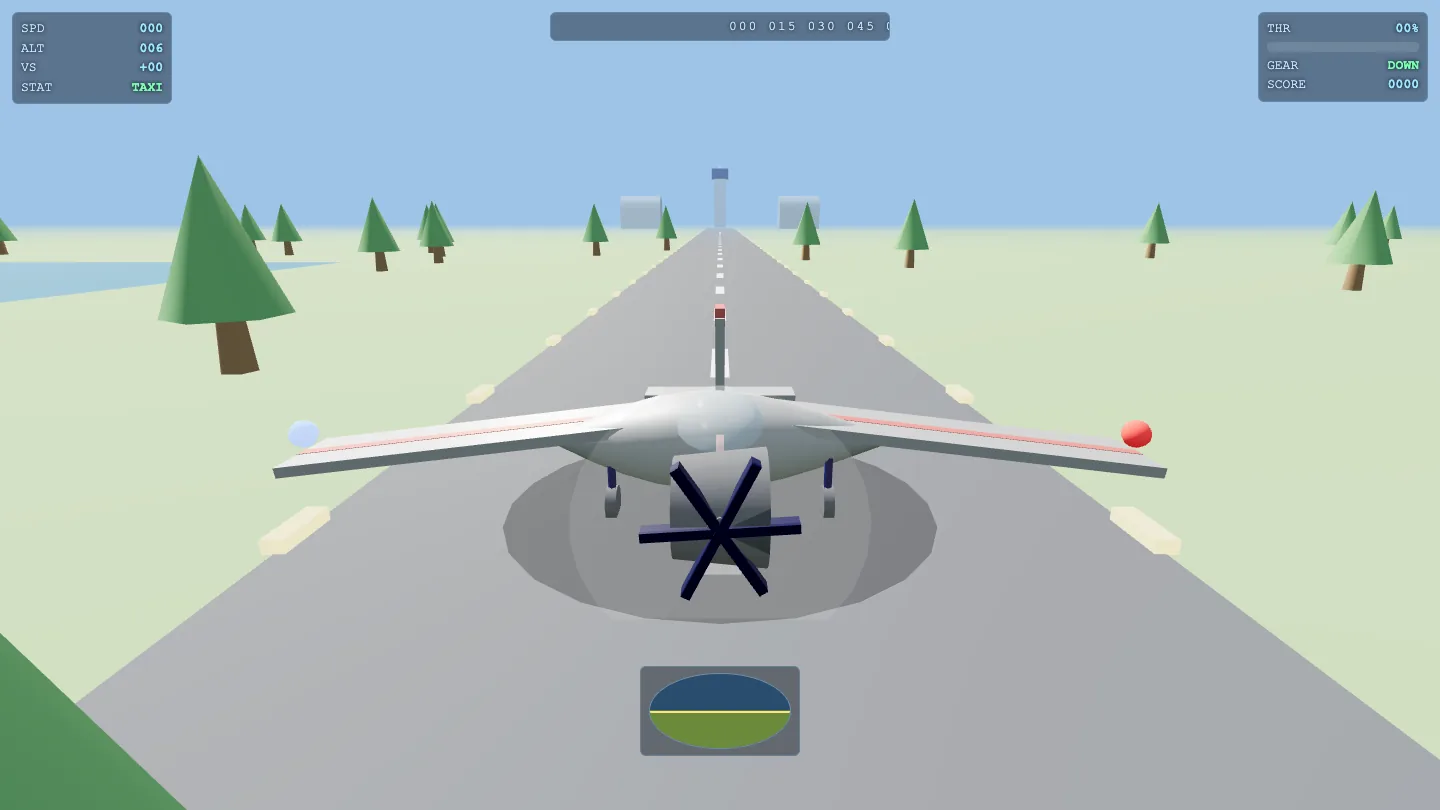
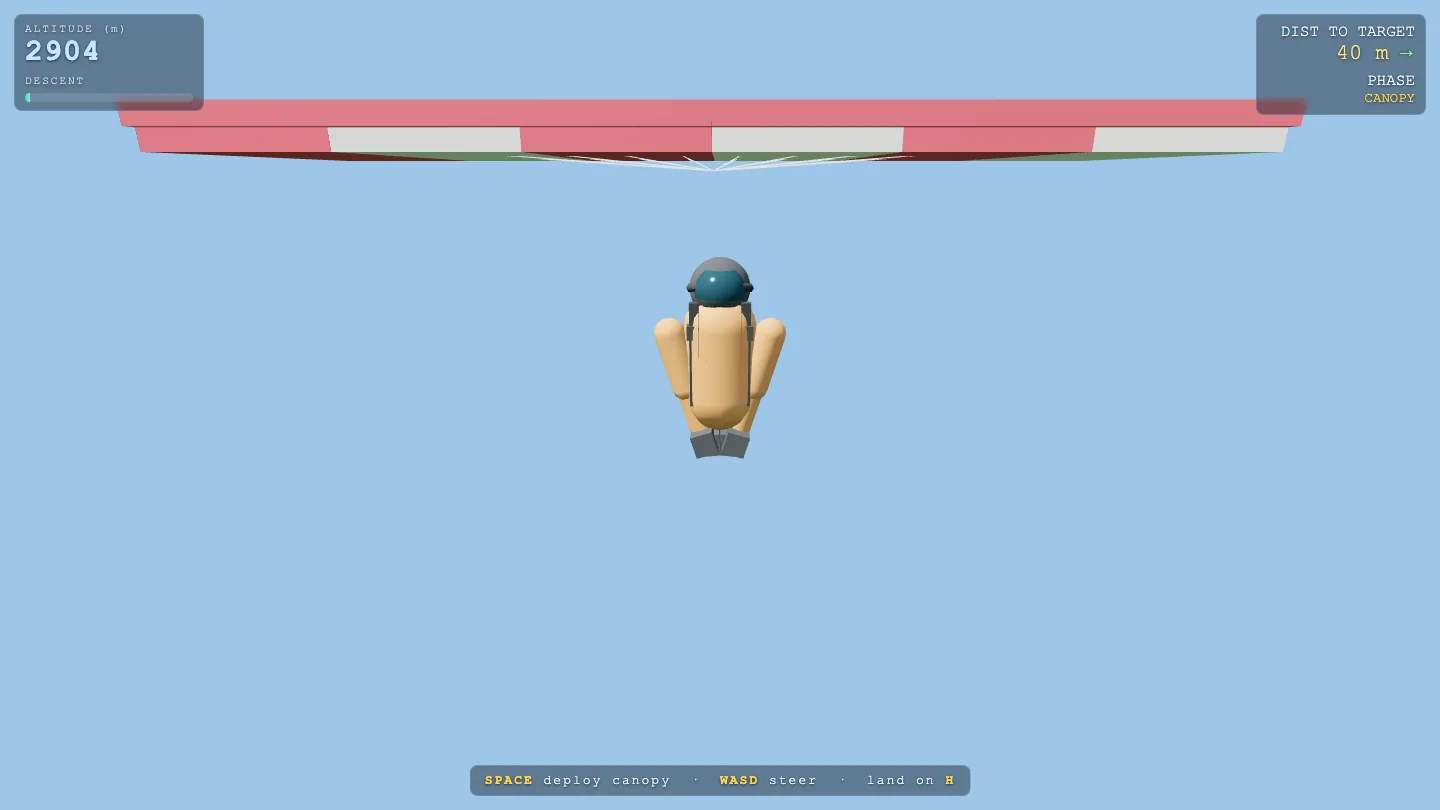
The flight sim grew an artificial horizon. The parachute game grew a canopy. The promo became a real self-playing video.
Every fix was authored by Hy3 itself — I only fed back the exact errors.
The system beats the model. You can run the same system.
No invented quotes here. The wins are written by the members themselves — 158 pages of them — so read them in their own words.
Read the 158-page wins doc →You've seen the receipts. Real operators, real systems.
The next few minutes show you exactly how a $0.14 model produced an 8.2 game — every prompt pattern included.
So make yourself one promise: this week, you take ONE task you'd normally hand to an expensive frontier model, and you run it through a cheap open-weights coder with a proper system prompt instead.
The people who learn to squeeze cheap models compound their margins forever. The people who default to expensive models pay a premium for laziness.
Be the one with the system.
Commit to the experiment — the economics change everything.
Hy3 is Tencent's Hunyuan 3 — released July 6 under Apache-2.0. Clone the weights, self-host it, or hit it on OpenRouter for $0.14/M input and $0.58/M output. That's roughly 1/40th the cost of a frontier model's output tokens.
Tencent's pitch: it beat GLM-5.1 in a 270-expert blind eval (2.67 vs 2.51), cut hallucinations from 12.5% to 5.4%, and holds stable tool-calls across coding scaffolds. Strongest categories: frontend, data work, CI/CD.
Half right, and it matters. Quality is real (my bench agrees with Tencent's eval), but the OpenRouter upstream is slow — 30–180 seconds per build, and one of my batch runs died to upstream flake. That's why my Agent OS panel streams tokens live instead of showing a spinner, and why the bench harness retries. Cheap + slow + good is a fine trade for background build work — it's the wrong model for tight interactive loops.
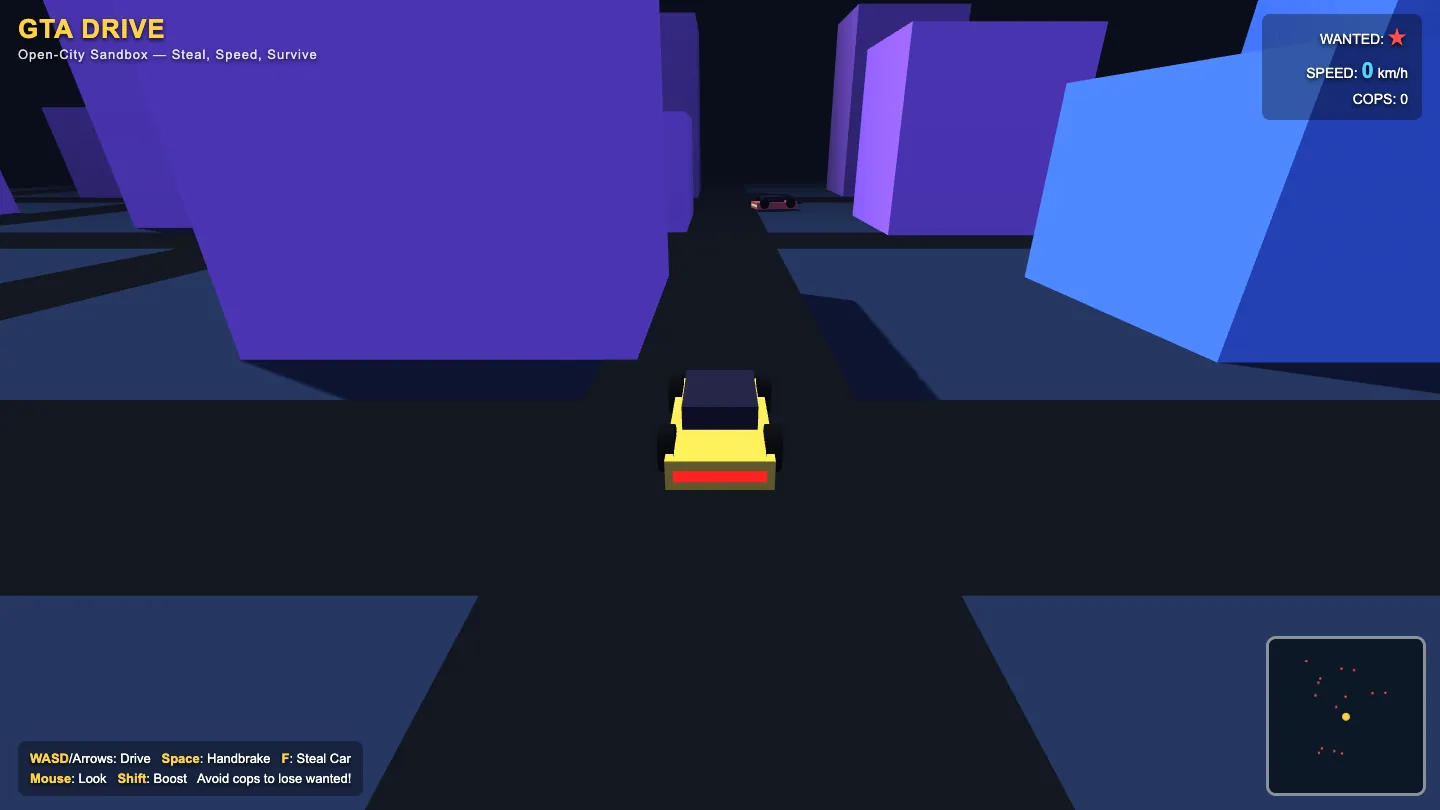
Same model, same price. The prompt carried my three.js game-director playbook — and *every final score comes from a mid-play frame captured while actually driving the controls (DOOM looks great posed at 8.2-quality, but plays wall-huggy — so it scores 5.5).
| Task | Journey | Final |
|---|---|---|
| Flight simulator | 6.3 → 8.0 (12-part plane, artificial horizon) | 8.0 |
| GTA drive | clean first try — multi-part car, minimap | 7.4 |
| AIPB promo | 3D orbit toy → real auto-playing video ad | 7.4 |
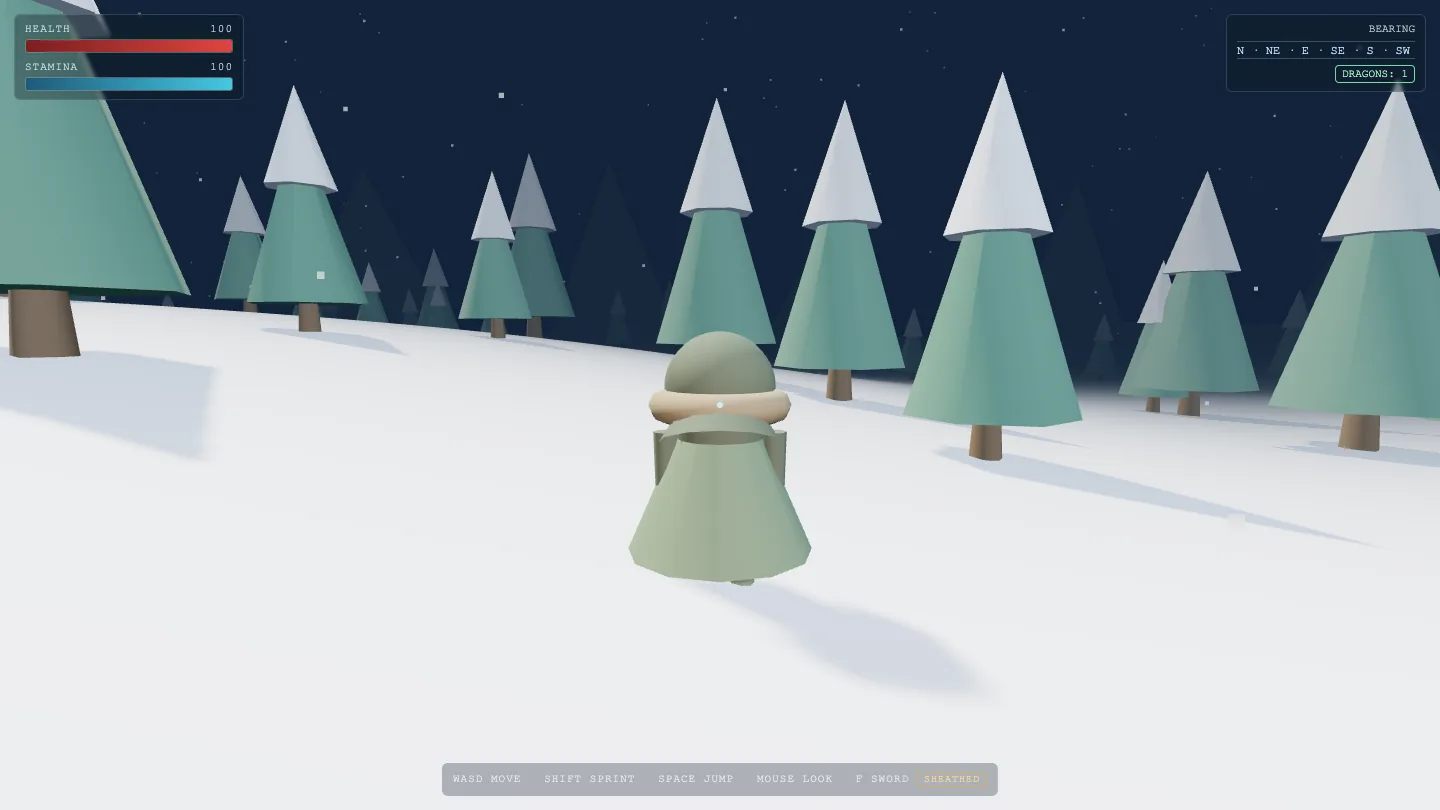
| Dragon Realm | cone-wizard hero → hooded ranger + snow forest | 7.2 |
| Parachute drop | black screen ×4 (incl. a CJK-corrupted identifier!) → plays | 7.2 |
| GTA on-foot | laggy (per-frame allocs) → GC fix + dusk look | 7.2 |
| DOOM raycaster | 8.2 on its best frame — mid-play it hugs walls; scored as played | 5.5 |
Hy3 average: 7.13 across 7 tasks — every score from a real PLAY-TESTED frame, not a posed screenshot — sitting among models that cost 20–40× more per token. Live on goldiebench.com/models/hy3.


Every demo is playable on GoldieBench — click any task on the Hy3 model page and drive it yourself.
The AIPB promo task kept coming back as an interactive 3D toy — pretty, but not an advert. The fix: force 2D motion-graphics with a master-clock timeline in the prompt. Result — a 26-second self-playing ad with six scenes, animated stat counters, and a CTA, that loops like a Remotion export:


Cheap models don't know your quality bar. Mine now carries it: renderer flags (sRGB + ACES tone mapping), a lighting stack (key + fill + rim + fog-for-depth), "silhouette-first multi-part models — REJECT bare boxes", zoned HUD with meter bars, event VFX. Plus a per-game "minimum asset pass" (a 12-part plane, a 9-part skydiver, demons with horns).
The parachute game black-screened three times. The console said: THREE.CapsuleGeometry is not a constructor — an API that doesn't exist in three.js r128. I pasted that exact line back to Hy3; it swapped in r128-safe geometry and the game rendered. I never wrote a line of its code.
Mechanics checks lie. A build can "pass" while rendering a flat red wall. Every demo gets screenshotted and actually looked at before it ships — that's how the 3.5 DOOM got caught and re-briefed.
Hy3 takes 30–180s per build. A frozen spinner looks dead; live-streaming tokens looks like work. The Agent OS panel streams every token as it writes, with an elapsed timer.
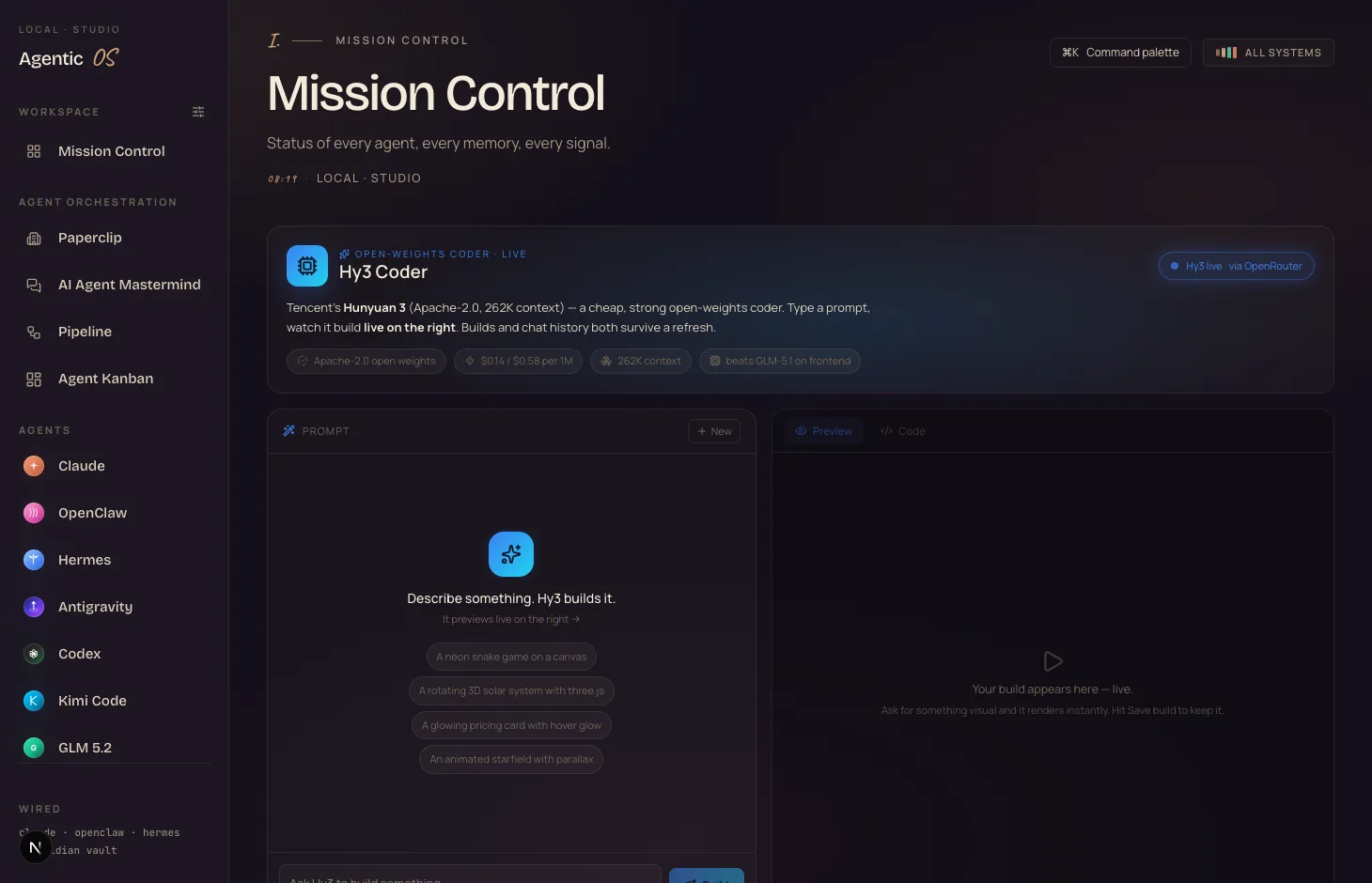
One prompt panel, live preview on the right, conversation history + saved builds on disk — the same pattern as my other coder tabs. Type "a neon snake game", watch Hy3 stream the HTML, see it render instantly, hit Save build. Chats survive refreshes; builds land in ~/.agentic-os/hy3-coder-workspace/.

Real screenshot: the Hy3 Coder tab in my Agent OS — live badge, prompt panel, preview pane, workspace below.
Because of what it costs to keep busy. At $0.14/$0.58 per million, Hy3 is a background builder — fire prompts, let it stream, come back to finished single-file demos. The seven bench games cost pennies in total. Speed matters for chat; for build queues, cost-per-artifact wins.
Hy3 scored 7.41 on my bench. Fugu Ultra scored 7.94 — at ~50× the output price. That gap is the arbitrage.
The opposite — this run is the proof. Seven games + twelve fix iterations on Hy3 cost pennies total at $0.58/M output. The Agent OS runs the everyday 90% on free local models, cheap open-weights like Hy3 for background builds, and saves the expensive CLIs you already pay for (Claude included) for the judgment calls. Inside the AI Profit Boardroom there are full token-optimisation playbooks too.
Hy3 is free weights + a cheap API — anyone can use it. What made it perform was the system around it. Inside the AI Profit Boardroom you get my full build:
You're not buying a tool. You're getting the operating system I run a seven-figure business on.
Get the Agent OS →Wrong: "Model quality is fixed — a 3.5 model is a 3.5 model."
Right: The same weights scored 3.5 and 8.2 on the same task in the same afternoon. The variable wasn't the model — it was whether the prompt carried a quality system. Price the system, not the model.
Wrong: "You need frontier prices for production-grade output."
Right: Hy3 averaged 7.41 at $0.58/M output; the field's leaders average ~7.9 at 40–50× the price. For background builds, briefs and drafts, that last half-point is the most expensive half-point in AI.
Wrong: "Iterating with AI means fixing its code yourself."
Right: I wrote zero lines of these games. The loop feeds the model its own console errors and screenshots — it repairs its own builds. Your job is diagnosis and standards, not typing.
158 pages of members running these systems on real businesses — in their own words.
Read the 158-page testimonials doc →Apache-2.0 open weights, 262K context, 7.41 avg on my bench — at $0.14/$0.58 per million.
Embedding the game-director playbook took DOOM from 3.5 to 8.2. Same model.
Exact console errors fed back — Hy3 repaired its own r128 API crash. Zero hand-written lines.
Screenshots caught what mechanics checks missed — three times.
The Agent OS tab streams Hy3's tokens live — background builder, not chat toy.
Every demo + score is live on goldiebench.com — play them yourself.
You watched a day-old, $0.14 model get benched, coached to an 8.2 game, given a live coding tab, and published to a public leaderboard — in one afternoon, hands off the code. That's what an operating system does: every new model that drops makes it stronger.
Inside the AI Profit Boardroom you get the full Agent OS — the coder tabs, the bench harness pattern, the game-director playbook, the token playbooks — plus 3,600+ founders and me, benching every new model the week it ships.
Set it up in an afternoon. Then let the arbitrage compound.
Get the Agent OS →