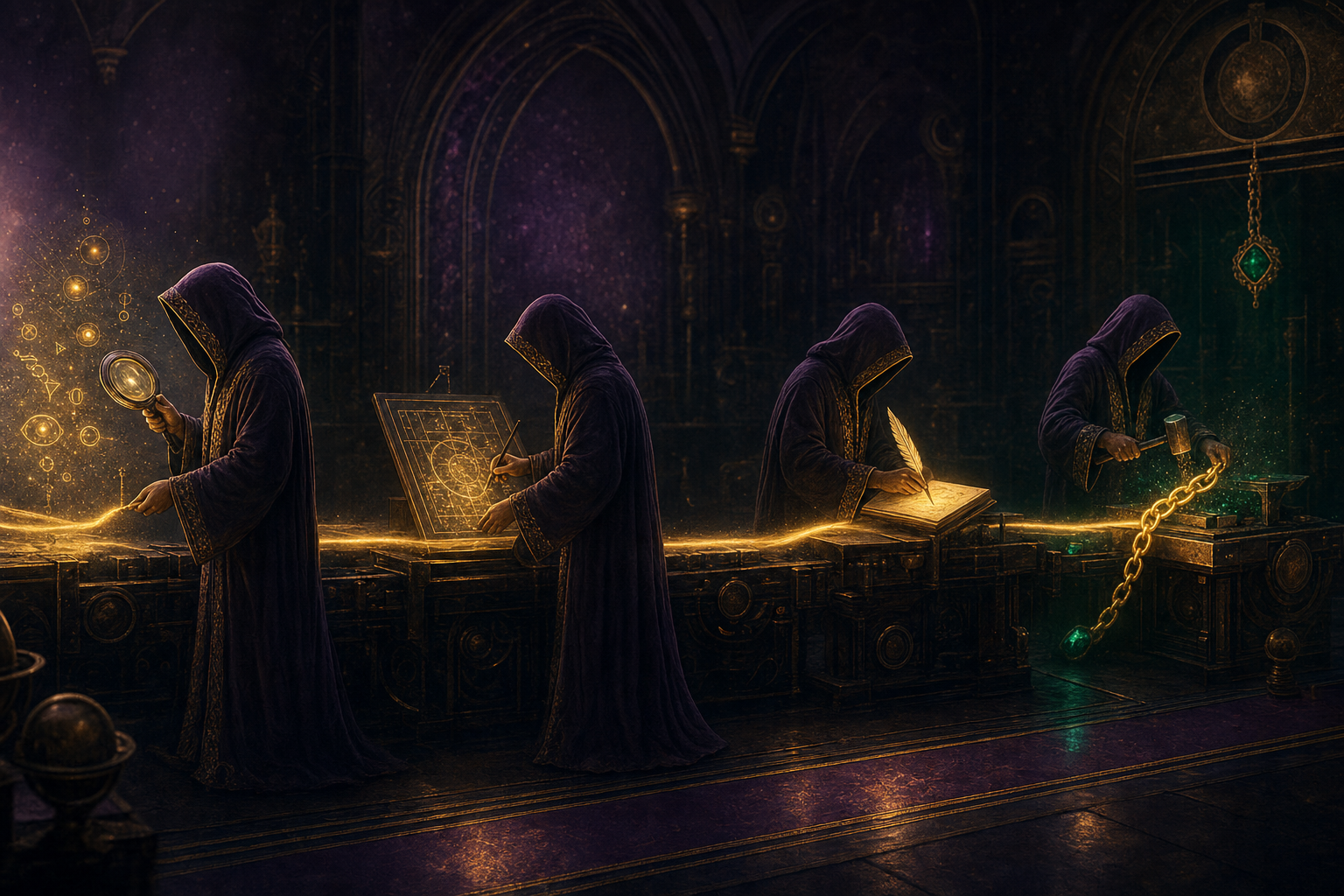
The Goldie SEO Assembly Line™.
4 AI employees. 1 published page.
I hired four AI employees this morning — a keyword researcher, an outline architect, a content writer, and a link builder. Each one is a real Hermes agent profile with its own brain, its own memory, and its own job. They passed work down a kanban board like a factory line. Eleven minutes later, a finished SEO page was live on one of my real sites. This guide shows the whole line — with the receipts.
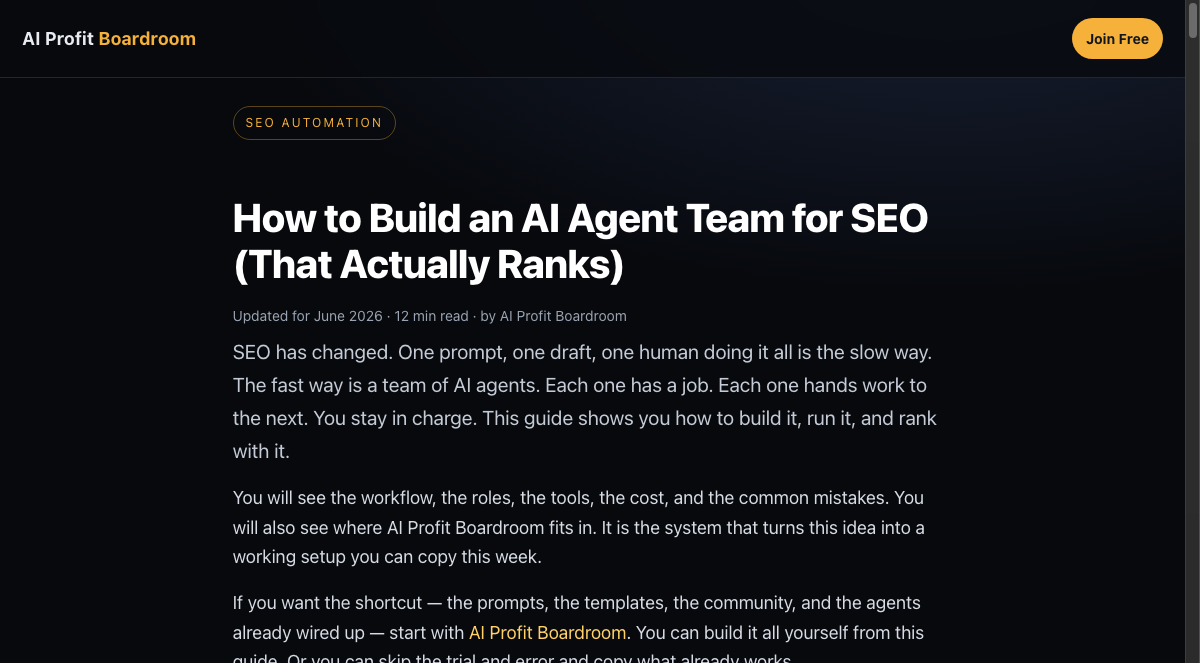
↑ This is the page they shipped — it's live, click it.
I was you. Then I stopped writing pages one prompt at a time.
Before
My SEO content was one long chat session.
Prompt for keywords. Copy. New chat. Prompt for an outline. Copy. New chat. Write. Edit. Forget the internal links.
One page took an afternoon — and I was the project manager, the courier and the editor.
I run an SEO agency. I know what a real content team looks like. This wasn't it.
Then I hired the team instead of doing the job.
After
Now I type one topic into a kanban card.
Four AI employees pass the work down the line — research, outline, draft, links — each one a specialist with its own memory.
This morning the line ran start to finish in about eleven minutes.
The output isn't a draft in a chat window. It's a live URL on one of my real sites — with schema, internal links, and a backlink outreach plan.
You can have this too. Same tools. Same path.
Real people. Real wins. Inside the Boardroom right now.
Here's what's happening for the members already running this stack — agency owners, ecom founders, course creators, solo operators.
158 pages of members documenting real wins with this exact stack — real businesses, real screenshots, real numbers.
Read the 158-page testimonials doc →Commit to transitioning today. Not tomorrow.
You're about to watch four AI employees take a topic and turn it into a live, indexed page — with zero prompts from me after the kickoff.
Every step is reproducible on your machine.
So here's the deal.
Promise yourself one thing right now: you'll finish this guide AND hire your first AI employee before you sleep tonight. Just one.
Because the moment your content runs as an assembly line, you stop being the bottleneck in your own SEO.
The people sitting still are getting passed. The people implementing today are the ones who'll look back in six months and say "that was the moment."
Be one of those people.
Commit to the transition. Commit to taking action today. This changes everything about your workflow.
The Goldie SEO Assembly Line™.
A factory has stations and a conveyor.
Your content line has four stations — and the kanban board is the conveyor that moves work between them.
The Researcher
Turns a raw topic into a keyword brief: one primary keyword with honest ranking odds, supporting keywords, the questions people actually ask, and the slug.
The Architect
Turns the brief into a blueprint: title tag, meta description, full H1–H3 skeleton, word counts per section, FAQ plan, CTA placements.
The Writer
Turns the blueprint into the finished page — in your voice, your design, publish-ready HTML. Not a draft. The page.
The Link Builder
Turns the page into an SEO asset: contextual internal links across your site network, FAQ schema for rich results, and a backlink outreach shortlist.
The Conveyor
The kanban board. Each card is gated by the one before it — finish the brief and the outline card unlocks itself. No manager needed. The board IS the manager.

Four employees. Four SOULs.
Each employee is a Hermes agent profile — a complete, separate agent with its own brain, memory and identity.
Hiring one is two commands: create the profile, then write its SOUL file — the role charter it carries into every job.
The researcher's SOUL says "you find keywords with honest ranking odds." The writer's says "short sentences, UK English, third-grade reading level." They never forget who they are, because it's their identity — not a prompt you re-paste.
All four run on the MiniMax coding plan — so the whole team costs pennies per page, not per-token Claude money.
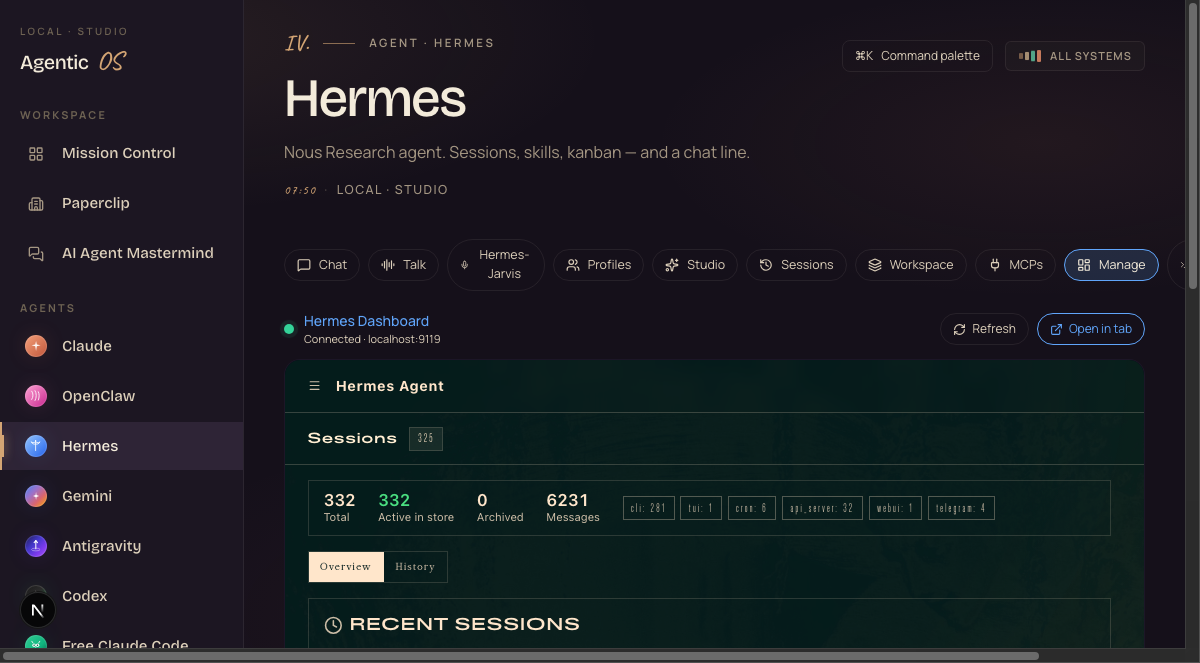
And every employee shows up in the Hermes dashboard inside the Manage section — sessions, runs, token spend, all logged per profile.
→ Hermes → Manage → dashboard — seo-keywords · seo-outline · seo-writer · seo-links
No — each profile is a separate agent install: own config, own memory files, own session history.
The writer literally cannot see the researcher's chats. They only share what's on the board — like real colleagues.
One topic in. Four cards chained.
I gave the board one topic: "an AI agent team that does your SEO."
Then four cards, each assigned to its specialist, each blocked by the one before it:
🔎 Keyword brief → 📐 Page outline → ✍️ Publish-ready HTML → 🔗 Links + schema + outreach.
That dependency chain is the magic. When the researcher finishes, the outline card unlocks itself and the dispatcher wakes the architect. Nobody coordinates. The board coordinates.
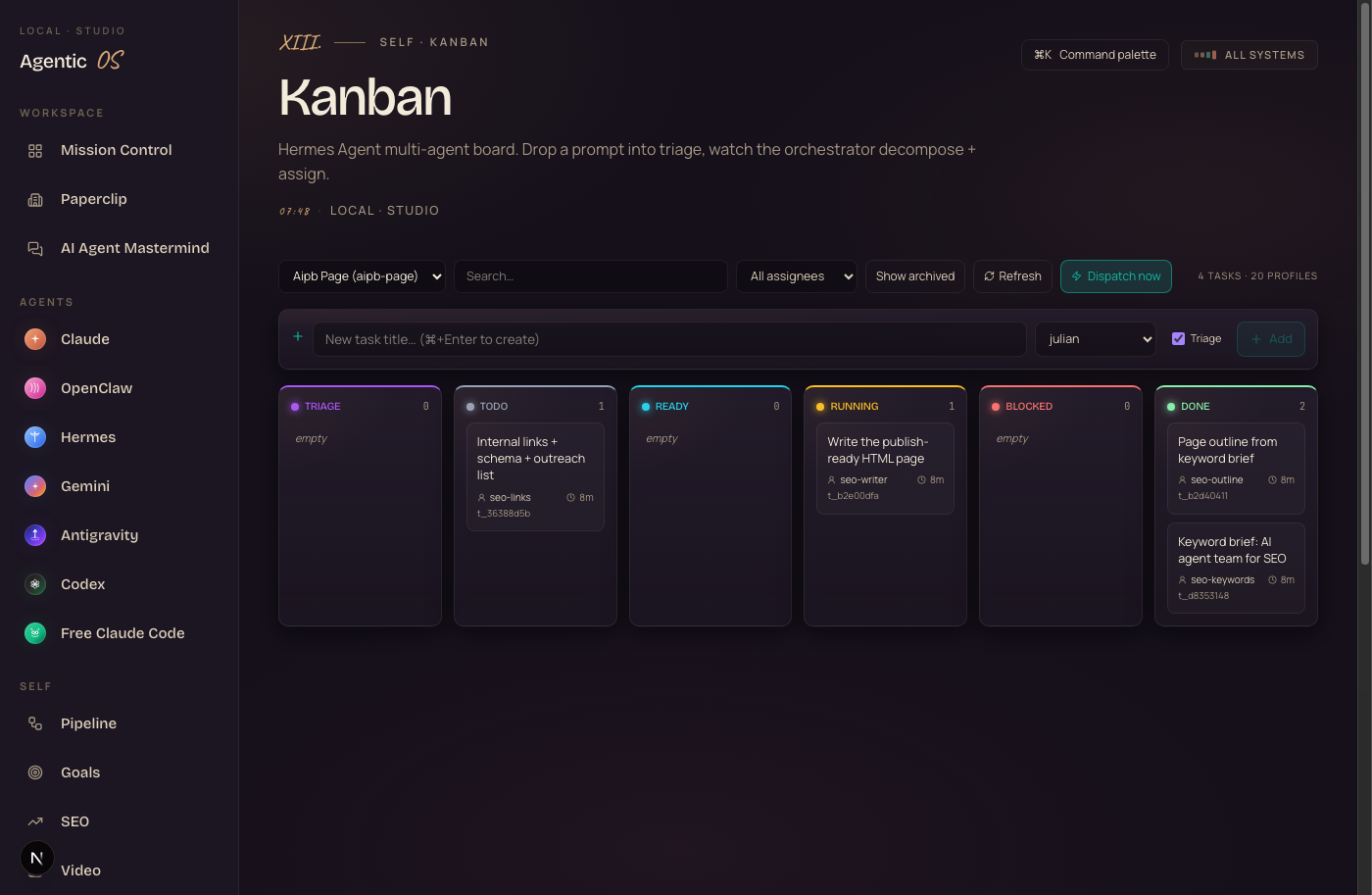
→ Kanban tab → board aipb-page — all four cards, full event history per card
Eleven minutes of hands-off work.
Here's what each station produced — every file saved in the shared workspace:
🔎 07:42 — keyword-brief.md. Primary keyword with honest odds ("top-20 in 3-6 months"), 10 supporting keywords, 8 People-Also-Ask questions.
📐 07:45 — outline.md. 54-character title tag, 151-character meta, full H2/H3 skeleton, word counts, FAQ plan, CTA placements.
✍️ 07:47 — page-draft.html. 3,700+ words, dark premium design, FAQ section, mobile-ready — a complete page, not a wall of text.
🔗 07:51 — final-page.html + outreach.md. Internal links into my site network, valid FAQPage schema for rich results, and a 5-target backlink pitch list.
Four employees. Four handoffs. Zero prompts from me after the kickoff.
You can watch it live in the Manage tab too — every session, every token, every run logged in the Hermes dashboard.
→ Hermes → Workspace → workspace/aipb-page/ — all five files, timestamped
→ Hermes → Manage — sessions + analytics for every employee
▶ See the deliverables · new tabGeneric comes from generic prompts. This line has a specialist brief at every station — honest keyword odds, a real outline, voice rules in the writer's SOUL, schema and internal links at the end.
That's more process than most human content teams run. And you review the final card before it ships — you're the editor-in-chief, not the typist.

Run the Assembly Line on your business.
Everything you just saw — the employees, the SOULs, the board, the dispatcher — ships as one system: the Agent Operating System inside the AI Profit Boardroom.
Your team shares one memory. They know your sites. They know your voice. So the pages they ship are YOUR pages — not generic demos.
- The full Agent OS zip — the exact system in every screenshot above
- A 30-day roadmap — hire your team, wire the board, ship your first page
- Every prompt + every SOUL file — copy the exact team
- Coaching calls — we set it up together, step by step
- 3,100+ founders building with this stack · someone's online 24/7
Not a draft. A live URL.
Most AI content dies in a Google Doc.
This one went straight to production: the final page deployed to bestaiagentcommunity.com — one of my real AIPB funnel sites — with the sitemap updated in the same deploy.
The deploy was additive: every existing file untouched, one new page added. Live in seconds.
Title tag, meta, FAQ schema, internal links — everything the line built is now in front of Google.
→ bestaiagentcommunity.com/blog/ai-agent-team-for-seo/ — the page, live on the internet
→ sitemap.xml — already includes the new URL
▶ Open the live page · the team's work, publishedNeither did this page. The deploy is one command against Netlify's free tier — and the Agent OS wraps it so the line can ship without you touching a terminal.
One afternoon vs eleven minutes.
- Prompt for keywords in one chat, copy the output by hand
- New chat for the outline — re-explain everything
- Write or pay a contractor $100-200 per article
- Forget the internal links, skip the schema
- Draft dies in a Google Doc awaiting "publishing day"
- You are the project manager, courier and editor
- One topic typed into one kanban card
- Four specialists pass work down the line automatically
- Voice + quality rules live in each employee's SOUL
- Internal links + FAQ schema + outreach list built in
- Output is a live URL with the sitemap already updated
- You review the final card — editor-in-chief, not typist
Start with two employees.
Honest advice: don't build all four stations tonight.
Hire the researcher and the writer first. Run one page through a two-card chain. Feel the handoff work.
Then add the architect and the link builder next week — each one makes the output measurably better.
And review every page before it ships while you tune the SOULs. The line gets sharper every run, because the SOULs are files you edit — not prompts you lose.
The people who figure out AI agents now, while the tools are evolving fast, are going to be way ahead when everything settles. Every workflow you build compounds.
The whole team runs on the MiniMax coding plan — this entire page cost pennies.
Thirty pages a month on this line costs less than one human-written article.
What you just gained.
You hired a team, not a tool.
Four real agent profiles with separate brains, memories and SOULs — all visible in the Hermes dashboard.
You stopped managing.
The kanban dependency chain promotes and dispatches work itself. The board is the manager.
You got specialist quality.
Honest keyword odds, real outlines, voice rules, schema and links — process at every station.
You shipped, not drafted.
The output is a live URL with an updated sitemap — in front of Google the same morning.
You can trace everything.
Kanban events, workspace files, Manage dashboard analytics, the live page — all clickable above.
You pay pennies.
The whole line runs on the MiniMax plan. Thirty pages costs less than one freelancer article.
"Stop writing pages. Start running the line."
Build your own Assembly Line.
If you want this exact system — the four employees, the SOUL files, the kanban conveyor, the deploy step — grab the Agent Operating System inside the AI Profit Boardroom.
You get the zip file. Every prompt and SOUL. The Obsidian memory setup. Coaching calls where we hire your team together, step by step.
3,100+ members. Daily tutorials. A 30-day roadmap. A member map to find builders near you.
Get the Agent OS → Inside the AI Profit Boardroom · aiprofitboardroom.com link in the description ↓Hire two employees tonight. Run one page through the line this week.
I'll see you in the next one.