● CLAUDE AI SEO · 1 KEYWORD → 5 RANKINGS · 0 → 305 CLICKS A DAY
This Claude AI SEO skill took a website from zero to 305 clicks a day. You give Claude one keyword and one case study. It writes five completely different articles, publishes them on five different websites, and gets them indexed in Google within the hour. Five articles. Five sites. One keyword. Before your coffee goes cold.
305clicks a day — site one, from zero
5unique articles per keyword
13steps Claude walks, every run
<1hour from publish to indexing ping
The whole engine in one picture: one keyword in, five rankings out.
My story · why this matters
I used to spend a day per article. Now I spend a click.
Before.
If you've ever tried to rank a website, you know the pain.
I'd research a keyword for an hour. Write one article — a full day if I was fast.
Format it. Add the links. Upload it to WordPress. Write the meta description. Hit publish.
Then wait weeks for Google to even notice it existed.
One keyword. One article. One site. Days of work. Or real money per article to a writer — and I'd still check, fix and publish it all myself.
Then I wrote the whole process into a Claude skill — once.
After.
Now I type a keyword, paste a case study, and click one button.
Five articles get written, published across five sites, and pushed to Google's index in the same hour.
One of those sites went from zero to 305 clicks a day. Another hit 284. All free traffic — no ads, just people typing questions into Google and AI search engines.
SEO has changed more in the last year than in the last ten. This page shows you exactly how the engine works.
✦
I · What a skill is
A recipe card Claude never forgets.
If you've never heard of skills, here's the simple version.
A skill is a file that trains Claude on exactly how to do one job, step by step.
Think of it like a recipe card. You write down every step once — and Claude follows it perfectly, every single time, forever.
My SEO skill is a 13-step pathway. Claude walks through all 13 steps on every single run. No skipping. No shortcuts.
And here's why that beats any human process: a human writer would struggle to follow 40 formatting rules. They'd forget half of them by article three. An AI is literally built to follow instructions. Give it 40 rules and it follows all 40, every time, without complaining.
THINKING IT?"I'm not technical. I could never set something like this up."
You don't need to be — that's the entire point of a skill. All the SEO expertise — the title formulas, the meta rules, the linking logic, the formatting — is already written into the file. Claude carries the expertise.
You supply the keyword and the case study — the two things only you can supply, because they're about your business. If you can write a couple of paragraphs about a job you did for a customer, you can write a case study. The setup happens once, following a video tutorial. After that, it's a couple of clicks.
II · The heart of the engine
The case study — the ingredient that stops the AI making things up.
This is the part I need you to really hear, because this is what separates content that ranks from content that flops.
The case study is the heart of the whole engine.
Every fact in every article comes from your own real experience or from real references. Your actual results. Your actual screenshots. Your actual numbers.
The AI never invents anything, because it's pulling from your source of truth.
This is why the content doesn't read like generic AI fluff. You've seen that stuff — vague, empty, says nothing. Google's gotten very good at ignoring it.
But content built on a real case study has what SEOs call information gain. It adds something new to the internet. Google rewards that.
So think of the whole thing as a content factory with quality control bolted to the wall. The factory runs fast — but every product coming off the line is built from real materials.
Day to day it's this simple: say you run a cleaning business and want to rank for "how much does deep cleaning cost". You plug in that keyword, paste a short case study about a real job you did, and the engine handles the rest.
III · The writing
Five articles. Five genuinely different posts.
These aren't five copies of the same post.
The skill enforces five different headline formulas across the five sites. The keyword goes at the front of the title. Numbers and results. Sometimes a bold claim, sometimes a question. A curiosity gap built in so people actually click.
There are rules for the meta descriptions. Rules for grammar style. Rules for which titles to avoid.
Then it writes the five articles — same keyword, different openings, different structures, different examples, different FAQs.
Each one is 2,000-3,000 words, written in my voice, with every sentence on a new line so it's easy to scan. Easy for readers. Easy for Google. Easy for AI search engines to pull answers from.
Google sees five unique pages from five different sites, all going after the same keyword.
An article that just sits there doesn't make you money — so the skill wires the selling into every page.
Then the links. The skill wires internal links between your articles and adds external links to trusted sources — because without links connecting your pages, Google sometimes ignores pages completely. A smart web means Google crawls everything, values everything, indexes everything faster. And when it makes sense, articles link across to the other sites in the portfolio, so the five sites feed each other strength.
IV · Deploy + index
Live on five sites — indexed the same hour.
All five articles go live on all five sites at the same time.
On WordPress, you give the system your login and API token once, and it publishes directly. On Netlify, an access token. Either way — after setup, publishing means clicking a button.
And the same hour they go live, indexing gets triggered: the system pings Indexceptional through an API, which tells Google — new pages, come look at these now.
Instead of waiting weeks for Google to stumble across your content, you're waving a flag the moment it's published.
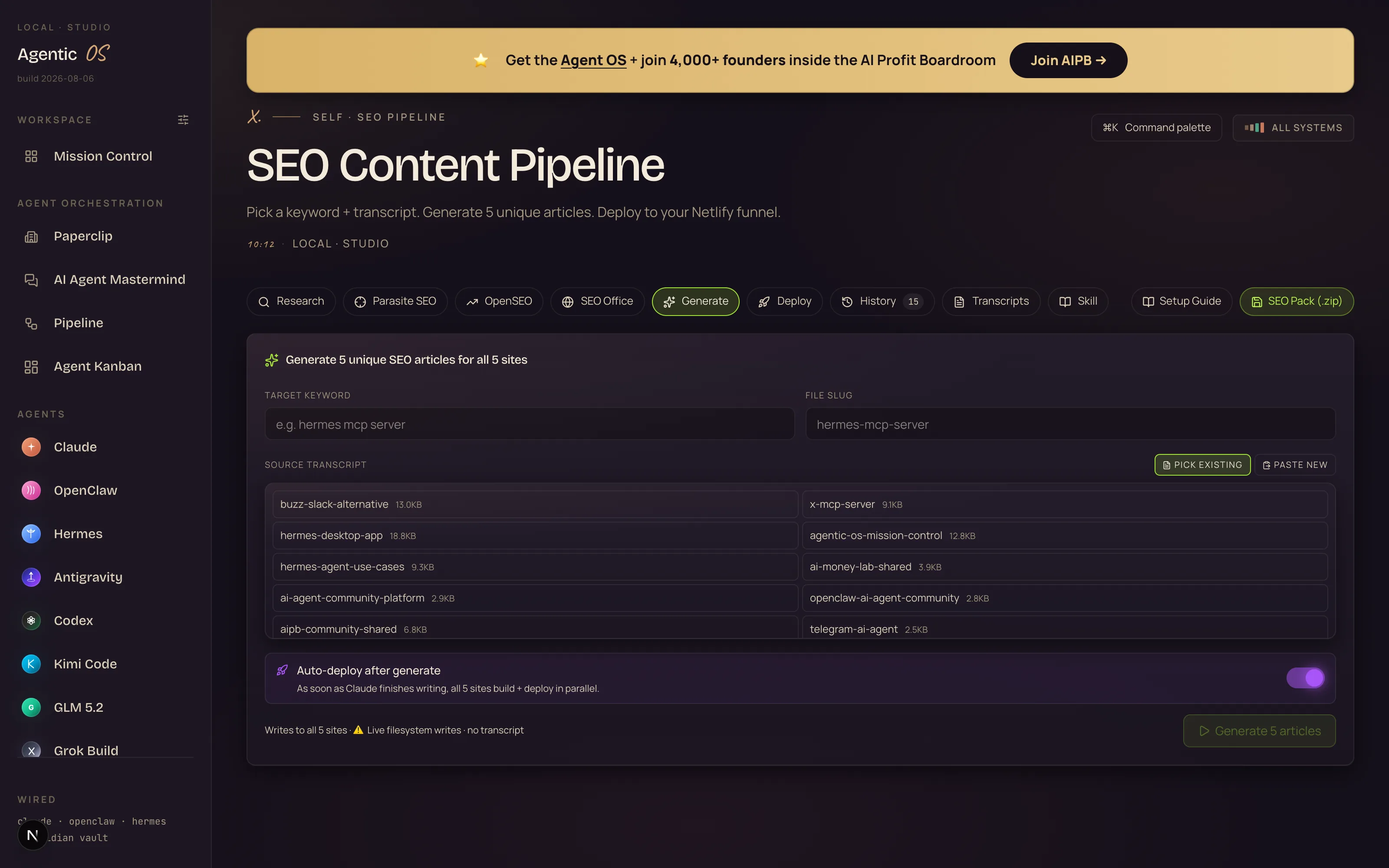
What you're looking at: the engine's cockpit in my Agent OS — the SEO tab's Generate view. Target keyword, the case-study source, an auto-deploy toggle ("as soon as Claude finishes writing, all 5 sites build + deploy in parallel") and one button: Generate 5 articles. That button is the whole old way, automated.
✦
V · Where keywords come from
The golden signal: impressions, no clicks.
People always ask — where do the keywords come from?
From your own Google Search Console, pulled in automatically through the API.
And here's the trick: you look for keywords where you're getting impressions but no clicks.
Plain English: impressions mean Google is already showing your site for that keyword — people are seeing you in the results. No clicks means you don't have a dedicated page good enough to win the spot.
That's a golden signal. Google is basically telling you: I'd rank you higher if you gave me a proper page for this.
So you take that keyword, feed it into the engine, and five dedicated articles appear across five sites.
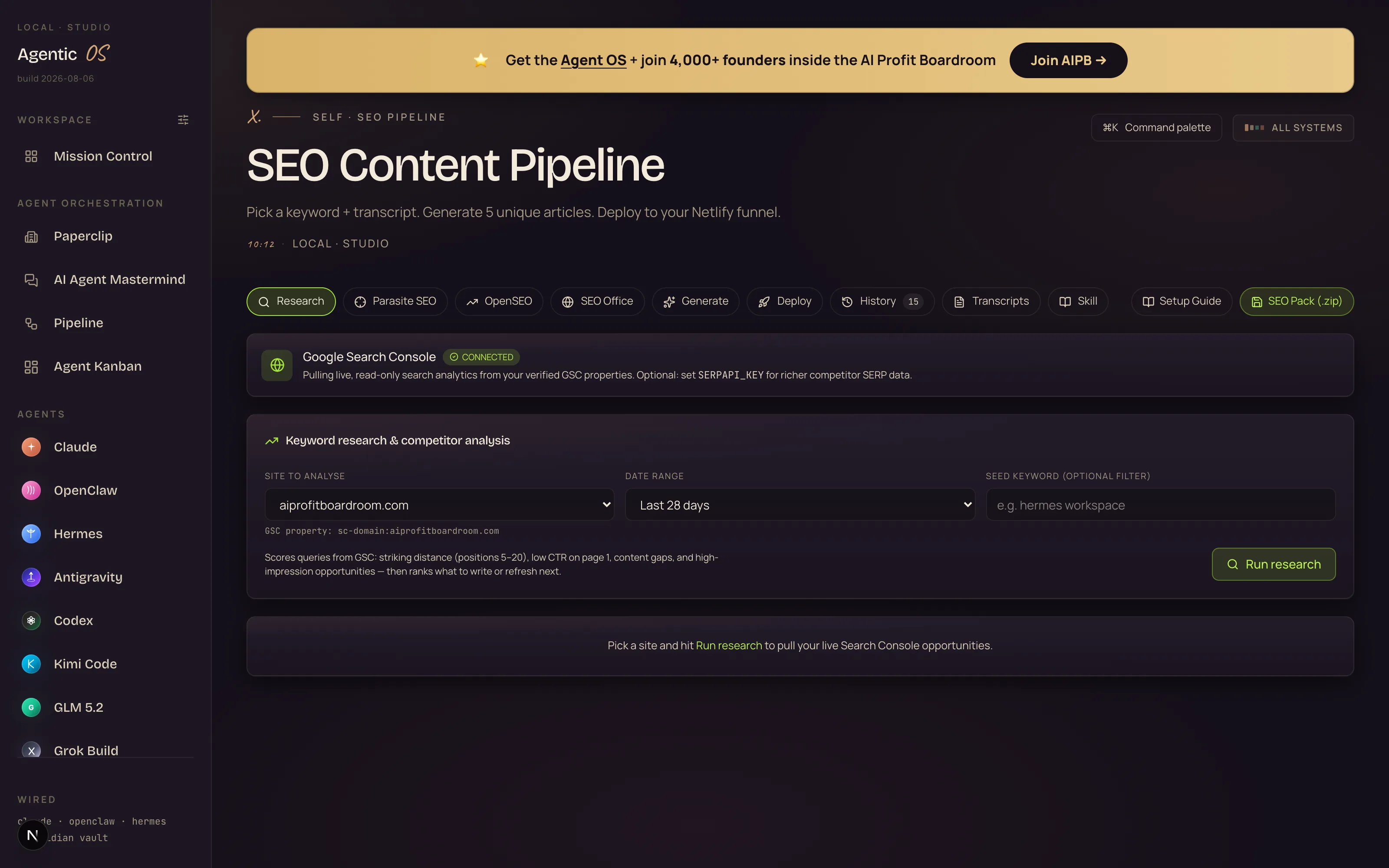
The Research tab in the same SEO section — live Search Console data, with filters for exactly that golden signal: keywords with impressions where nobody clicks yet. Every row is a gap Google has already told you it wants filled.
The flywheel: it compounds, round and round, getting stronger every cycle.
VI · The results
Same niche. Same chart. Up and to the right.
The results speak for themselves — six sites, all in the same niche, all following the same shape:
Free traffic — people typing questions into Google and AI search engines and landing on these sites every single day.
Now let me be straight with you about timelines, because I refuse to hype this.
SEO takes time. Three to six months to real results, especially on a new site. One of these websites was completely flat from April all the way to November — months of publishing with barely any clicks. Google simply doesn't trust brand-new websites at first. SEOs call this the sandbox.
Most people quit right there. They publish ten pages, see nothing for two months, and walk away. That's exactly why they never win at SEO.
We kept feeding the engine. When that site came out of the sandbox, it popped — and it's been climbing ever since, straight through multiple Google updates. The pattern held across the whole portfolio: flat, flat, flat, then up.
The difference with this system is what those waiting months cost you. The old way, six months of waiting meant six months of grinding out articles by hand. Now the machine publishes daily while you run your actual business. The waiting doesn't hurt because it isn't eating your time.
THINKING IT?"AI content doesn't rank. Google will punish it."
Look at the charts: 305 clicks a day, 284 clicks a day, growing through core updates. And think about what Google's actually doing — they're pushing AI Overviews harder than ever. Google is using AI to write answers at the top of its own results. They believe in AI content.
What Google punishes is bad content — thin content, content that adds nothing. Content built on real case studies, with real information gain, real formatting and real linking? That ranks. And honestly, it's better than what I could write by hand — it follows every SEO rule perfectly, every time. I can't.
VII · The part nobody talks about
The skill improves itself.
Here's the part I promised — the part that honestly blows my mind a little.
Built into the skill file is an end-of-batch SEO improvement evaluation.
Every time it finishes a batch of articles, it loops back around. It looks at the content it made. What worked. What didn't. And then it proposes updates to its own skill file.
So the system that writes your content is also studying its own work and upgrading its own instructions. You don't have to prompt it. You don't have to remember to do it.
Most tools stay the same forever. This one gets sharper with every batch.
The loop almost nobody builds: the engine that writes the content also upgrades the engine.
VIII · Old way vs new way
What changes in your week.
OLD WAYone keyword, one article, days of work
An hour of keyword research per keyword
A full day to write one article — if you're fast
Format, link, upload, meta description, publish
Wait weeks for Google to notice it exists
Or pay a writer real money — then fix their work anyway
One site carrying all the risk of every update
NEW WAYwith the One Keyword Engine
Keywords pulled from your own Search Console data
One keyword + one case study + one click
Five unique, conversion-ready articles in one run
Published to five sites, indexing pinged the same hour
The skill reviews its own batch and sharpens itself
Five sites spread the risk — one update can't wipe you out
One more thing I love about running five sites instead of one: safety. Any website can dip — Google updates shake things around. But when one of your five sites has a rough month, the other four keep ranking and keep sending traffic. You've spread the risk.
That's how I think about SEO now: rank everywhere. Multiple sites — and multiple formats, because the same Agent OS has a video agent sitting right next to the SEO tab. Your keyword shows up in the articles and in the videos, across five sites. You start owning the whole results page instead of fighting for one spot on it.
IX · The framework
The One Keyword Engine, end to end.
i.
The Fuel
One keyword with impressions but no clicks — pulled from your own Search Console — plus one short case study from your real experience. The two things only you can supply.
ii.
The 13-Step Skill
The recipe card Claude follows perfectly every run: title formulas, meta rules, grammar rules, five genuinely different 2,000-3,000-word articles in your voice.
iii.
The Conversion Layer
Benefit-led openings, a CTA in the first third, author bios, repeated CTAs and exit-intent popups — every reader gets a path to the thing you sell.
iv.
The Launch
Internal + external + cross-site links wired in, all five sites deployed in parallel, and Indexceptional pinging Google the same hour.
v.
The Sharpening Loop
The end-of-batch evaluation: the skill studies its own output and upgrades its own file. Every batch runs on better instructions than the last.
Wrong: "AI content doesn't rank — Google will punish it."
Right: Google punishes thin content that adds nothing. Content built on real case studies with real information gain ranks — 305 clicks a day, growing through core updates, is the receipt.
Wrong: "I've missed it. Everyone's already doing this."
Right: Most business owners still haven't figured out Claude can do this — they're still paying for ads or paying writers per article. Every keyword in your Search Console with impressions and no clicks is a gap nobody has filled yet. The people who feel late are usually standing closest to the easiest wins.
Wrong: "If it doesn't work in month one, it doesn't work."
Right: The sandbox is real — flat, flat, flat, then up. The winners are the ones still feeding the engine when the pop comes, and this engine makes the waiting cost you nothing.
Don't take my word for it
Members post their wins every day — agency owners, ecom founders, course creators, solo operators across 38 countries. Real businesses, real numbers, in their own words.
Find the golden keywords. Open the Agent OS SEO tab → Research. It pulls your Search Console through the API and surfaces queries with impressions but no clicks — demand Google already shows you for.
Write one short case study. A couple of paragraphs about a real job you did for a real customer — your numbers, your results. This is the source of truth every article draws from.
Feed the engine. Generate tab → keyword in, case study in, one click. Claude walks the 13 steps: titles, rules, five unique articles, conversion layer, links.
Deploy + index. With auto-deploy on, all five sites build and publish in parallel the moment Claude finishes — and Indexceptional pings Google the same hour.
Let it sharpen itself. The end-of-batch evaluation reviews the run and proposes upgrades to its own skill file. Accept the good ones; every batch gets better.
Repeat weekly. More content → more rankings → more impression data → more golden keywords. The flywheel compounds while you run your actual business.
Want it done with you?
Book a free SEO strategy session with our team.
One to one. We'll look at your actual website together and build you a custom game plan to rank it and pull in customers from Google and AI search engines — your free SEO domination plan, the best link building strategy for your specific site, and how to outrank your competitors inside AI search too.
One keyword + one case study + one click replaces days of writing.
You got five doors.
Five unique articles on five sites, all after the same keyword.
You got real content.
Every fact from your case study — information gain, not AI fluff.
You got the funnel.
CTAs, bios and exit-intent wired into every page. Readers become leads.
You got same-hour indexing.
Indexceptional waves the flag the moment you publish.
You got a sharpening engine.
It reviews its own batches and upgrades its own instructions.
4,000+ founders inside AIPB
400K YouTube subscribers
38 countries · live members
163K X followers
Members post their wins every day — agency owners, ecom founders, course creators, solo operators across 38 countries. Real businesses, real numbers, in their own words.