● GSC PLATFORM PROPERTIES — GLOBAL 29 JUL 2026 · X · INSTAGRAM · TIKTOK · YOUTUBE
Imagine opening Google Search Console and seeing every keyword your Instagram, TikTok, X and YouTube posts already rank for — that's the new update The One-Keyword Empire is built on.
Google just switched this on for everyone, free.
This means you stop guessing what to post.
You find keywords Google already sends you traffic for — proven winners, straight from Google's own data.
Then you take those winners and spread them across every platform you post on.
Your content stops dying in 24 hours and starts paying you for months.
Later I'll show you the new Agent OS tab that finds these plays for you automatically.
4platforms now in Search Console
112live plays my scan found today
1keyword → four doors
~48hfor new platform data to land
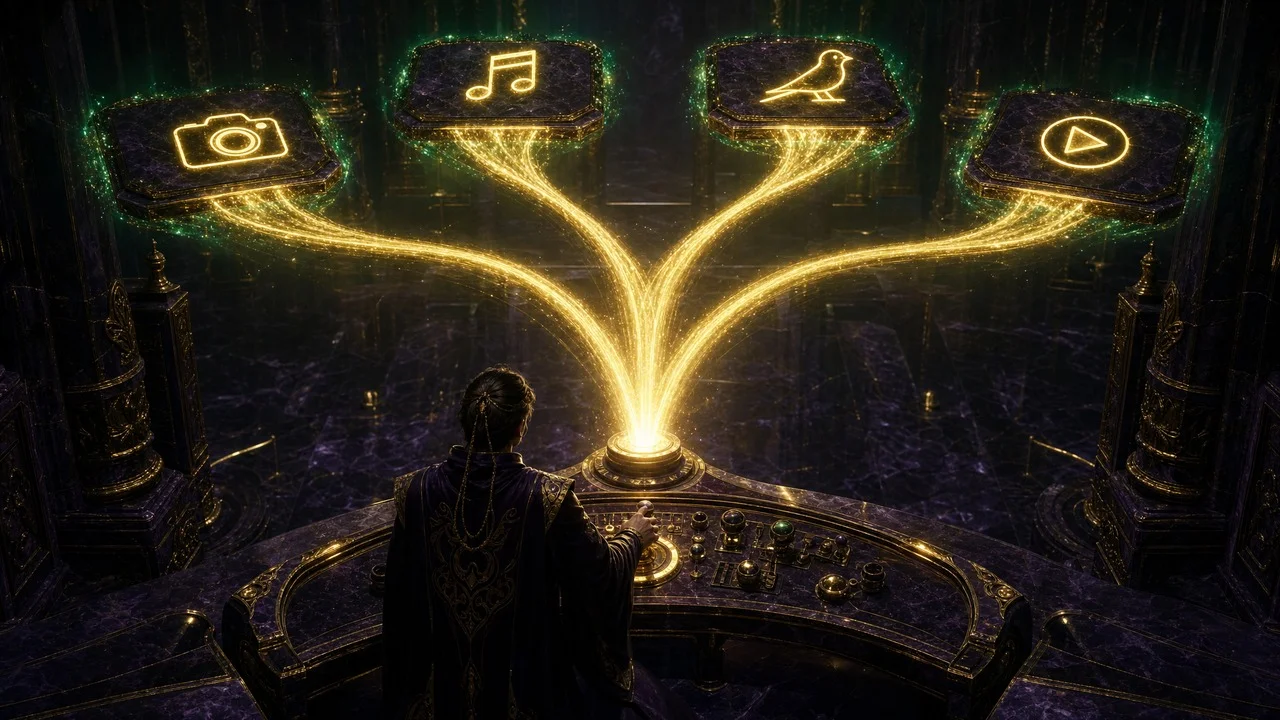
The empire in one picture: one keyword you already rank for, remade platform-native four ways — each one a new door to the same search demand.
My story · why this matters
I was guessing what to post. Now Google tells me.
Before.
Every platform was its own guessing game.
I'd post daily on YouTube and X — and have no idea which posts Google was quietly ranking.
Keyword research lived in one world (my websites). Social lived in another (vibes and view counts).
A post would die in 24 hours and take its lesson with it.
And when something DID rank on one platform, I never knew — so I never repeated the win anywhere else.
Then Search Console started tracking social platforms — and I wired it into the Agent OS.
After.
Now Search Console shows the exact queries sending Google traffic to my posts — per platform.
The Agent OS Parasite SEO tab scans that demand and hands the play straight to Claude: this query wants a thread, that one wants a Reel script, that one wants a video.
One proven keyword becomes four pieces of platform-native content — every one of them written by Claude inside the Agent OS.
My first scan surfaced 112 plays from queries I already rank for. Zero new research.
✦
I · The Problem
The 24-hour content death.
Here's the trap every creator is stuck in.
You make a post. It gets its day in the feed. Then it dies.
Tomorrow you start from zero again — new post, new guess, new roll of the dice.
Meanwhile search is the opposite: one page that ranks keeps paying you for months.
What almost nobody noticed: your social posts already rank on Google. Instagram Reels, TikToks, X threads, YouTube videos — they show up in Search, Discover and Google News.
You just had zero visibility into which ones, for which queries. So the compounding channel hiding inside your social content stayed invisible.
That blindness just ended — and the Claude AI SEO Keyword Empire is built on what it revealed.
THINKING IT?"My social content is for the feed, not for Google."
That was true five years ago. Today Google fills its results with Reels, TikToks, threads and Shorts — search demand flows through social posts whether you plan for it or not.
The only question is whether you can see it and steer it. As of July 29, you can.
II · What just changed
Search Console now watches your platforms.
On July 29, 2026, Google rolled out platform properties in Search Console — globally, for everyone.
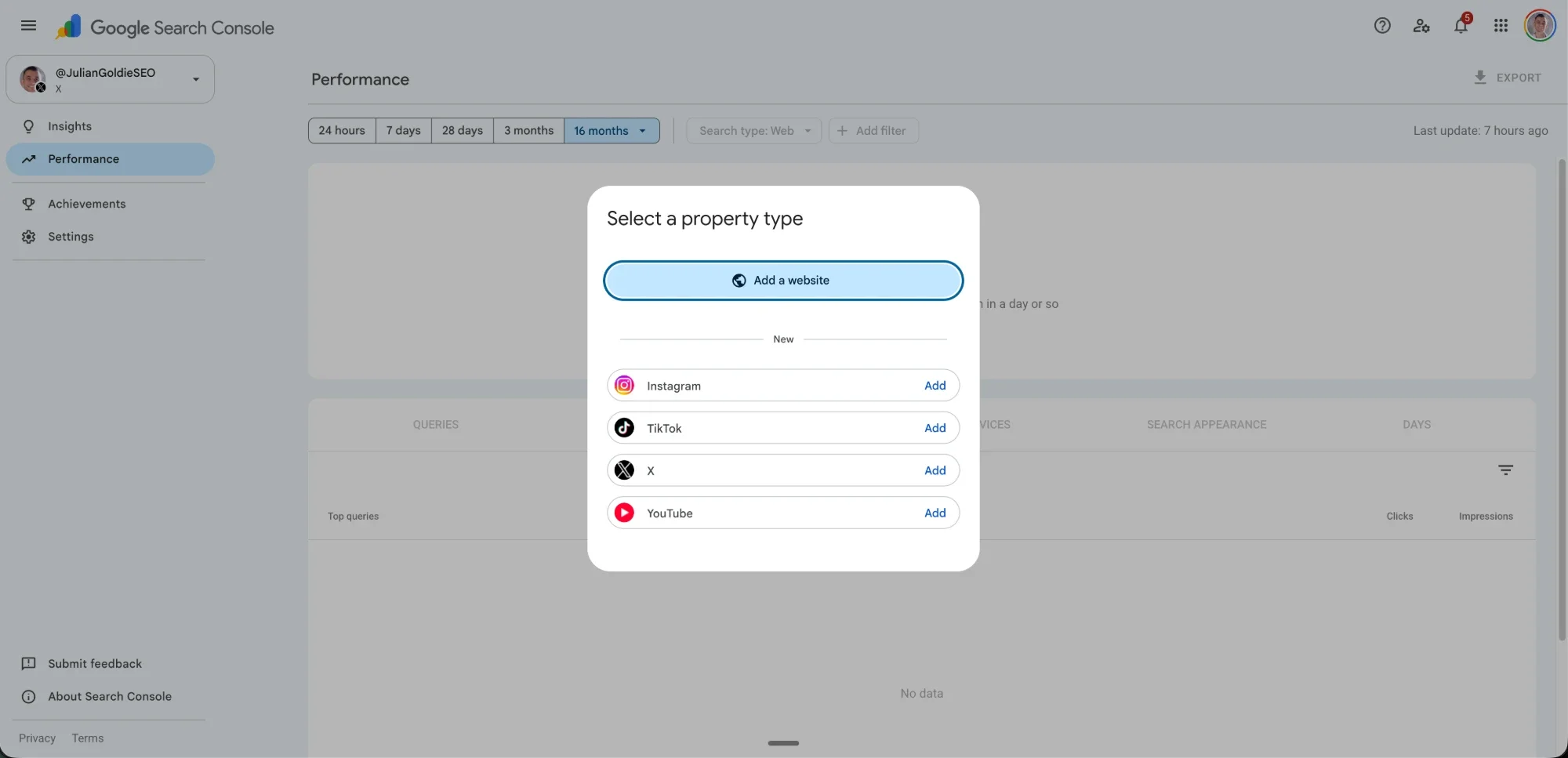
You can now add Instagram, TikTok, X and YouTube as properties, exactly like you'd add a website.
What you're looking at: my own Search Console, the new "Select a property type" dialog. Website as always — and under New: Instagram, TikTok, X and YouTube, each one an Add button away from becoming a measurable search channel.
Once connected, Search Console shows how your posts on that platform perform on Google Search, Discover and Google News — queries, clicks, impressions, the lot.
Google also shipped a companion guide on analysing social and video performance. The highlights:
Query groups in Insights. See the top, trending-up and trending-down search themes sending Google traffic to your social content — data-driven inspiration for your next topic, caption or hashtag.
The 24-hour filter. Spot a sudden search spike on a recent post while it's still hot — then cross-promote it on your other platforms the same day.
Cross-platform comparison. Export several properties into one spreadsheet and see how the same content performs on YouTube vs Instagram vs X vs TikTok, side by side.
Revive old winners. Find older videos regaining search traction — pin them, or expand them into a part two.
Annotations. Rewrite a YouTube title or TikTok caption, drop an annotation, and watch whether search performance moves. Optimisation with receipts.
"Track how your social and video posts on Instagram, TikTok, X, and YouTube perform on Google Search, Discover, and Google News."
— Google Search Central Blog, July 29, 2026
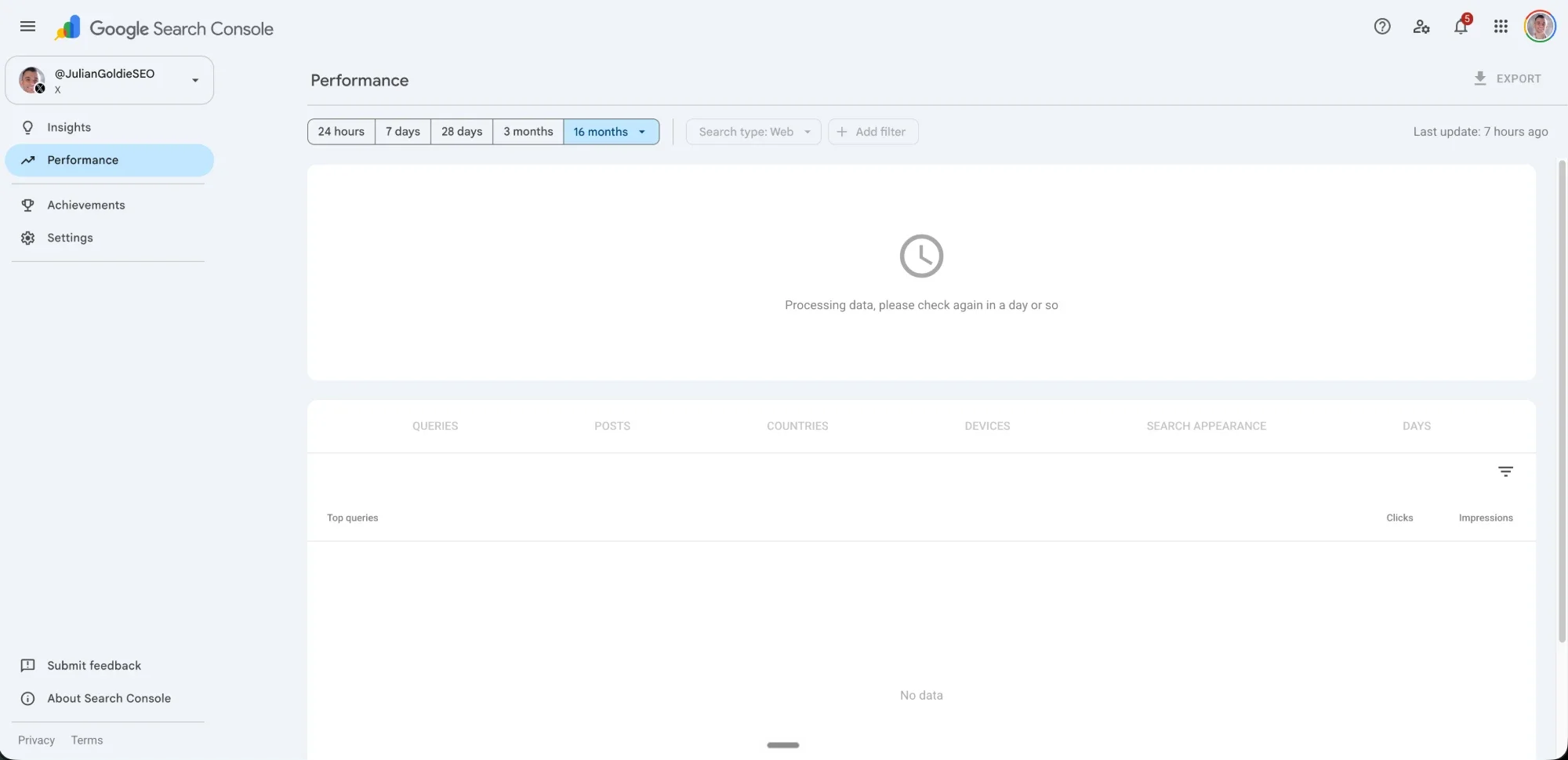
The honest timeline — my own X property sat on "Processing data" day one. The empire starts on your website queries while you wait.
And here's exactly what day one looks like: my @JulianGoldieSEO · X property, freshly connected — "Processing data, please check again in a day or so." Note the report already has a POSTS tab waiting next to Queries and Countries. This is the ~48-hour window where you scan your website demand instead of staring at the spinner.
III · The play
Rank once. Harvest everywhere.
Here's the move this data unlocks — the whole empire in three sentences.
Find a query one platform already ranks for. Say your X thread ranks for "hermes workspace".
Remake it platform-native everywhere else. Not a repost — a translation. The same keyword becomes an Instagram Reel, a TikTok Short, a YouTube video. Same demand, four doors.
Let Search Console referee. Each platform property tells you which doors opened, and the queries they opened for feed the next round.
The format adapts to the platform. The keyword doesn't have to.
The loop that builds the empire: every platform win gets translated, every translation gets measured, every measurement feeds the next win.
THINKING IT?"Isn't reposting the same thing everywhere just spam?"
Reposting is spam. Translating isn't. A Reel is not a thread read aloud — it's the same answer rebuilt for how that platform's audience consumes it.
Google's own guide encourages exactly this: spot trending content with the 24-hour filter, then cross-promote it on other platforms. You're serving the same demand in four native formats.
Reading dashboards is not a system. So I built the loop into the Agent OS.
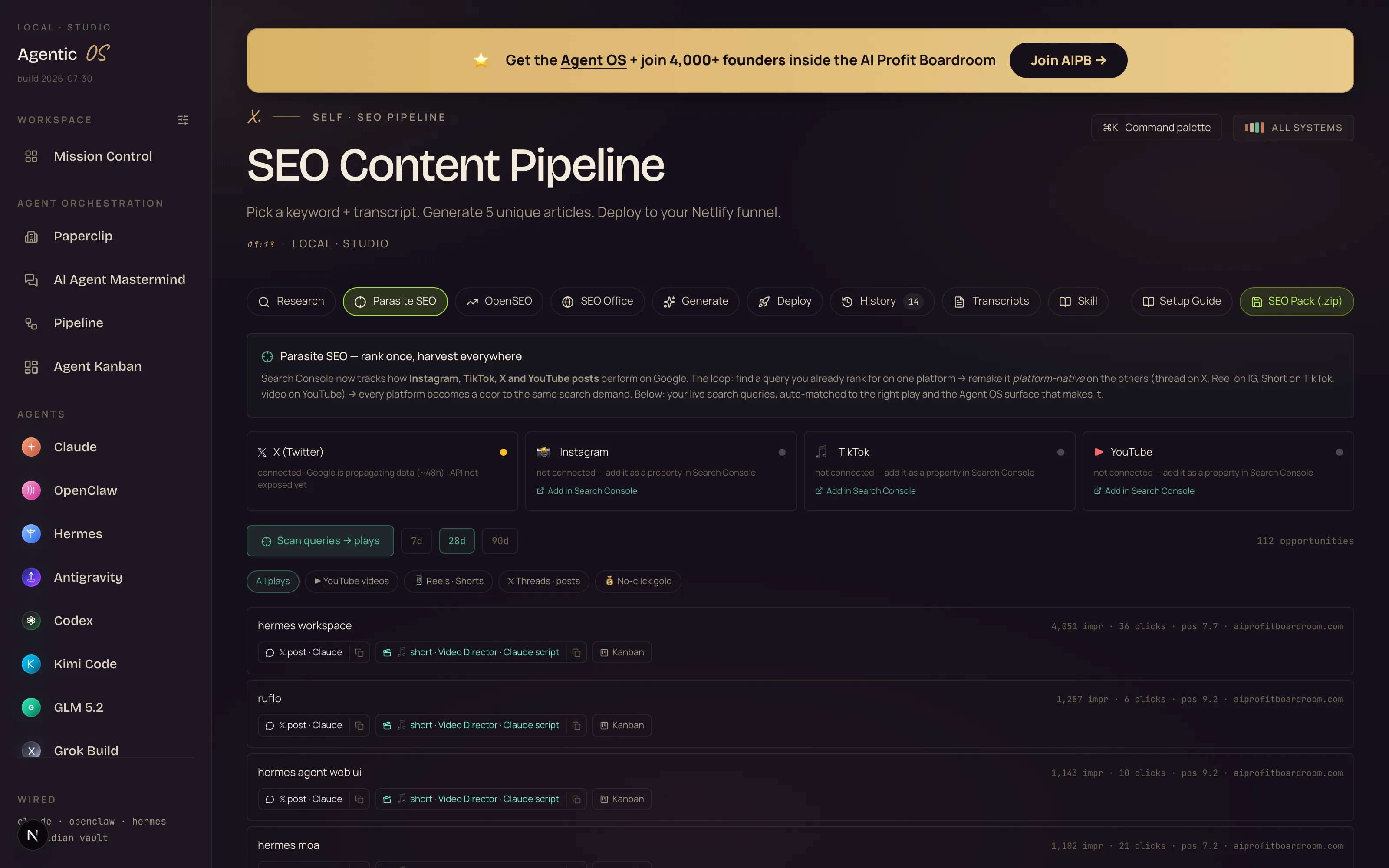
The SEO section has a new tab: Parasite SEO. Here it is, live:
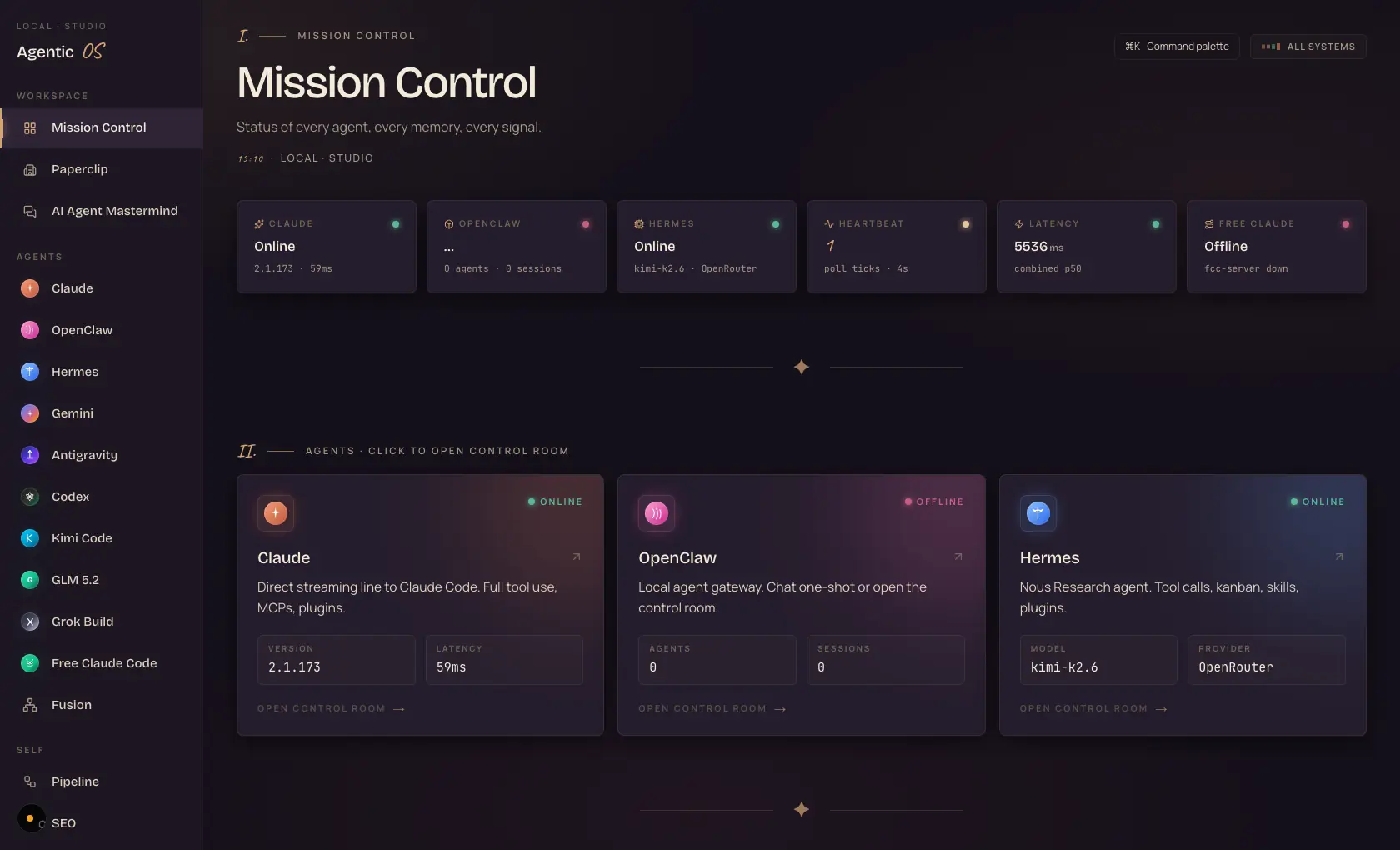
What you're looking at: my Agent OS, SEO section, Parasite SEO tab. Top row — the four platform properties with live status dots (X is connected and propagating; the others link straight to Search Console to add). Below — a real scan: 112 opportunities from 6 sites, my actual queries ("hermes workspace", 4,051 impressions) each matched to plays with one-click buttons — 𝕏 post · Claude straight into the Claude tab, Video Director · Claude script for the video formats.
Three things it does:
Watches the platforms honestly. Each platform card shows its true state. One honest detail: Google hasn't exposed platform-property data through the Search Console API yet (I verified — the API returns website properties only). The moment they ship it, the tab auto-detects and the platform queries flow in. Until then it says "propagating" instead of faking numbers.
Scans your real search demand today. One click pulls every query Google already shows your sites for — live from Search Console — and sorts them by opportunity, including the gold: queries shown 50+ times with zero clicks.
Matches every query to its play — and hands it to Claude. A how-to query becomes a YouTube video + TikTok Short. A "vs / best" query becomes an X thread. A "what is" query becomes a thread + Reel. Every play carries a ready-to-paste, platform-adapted prompt, and the button drops it in front of Claude — the same Claude that runs the whole OS.
Deterministic, not vibes: the query's intent picks the format, the format picks the play — and Claude writes it.
VI · The workforce
Claude is the workforce.
This is where the empire stops being a spreadsheet and starts being a machine — and why this is Claude AI SEO, not another dashboard: the finding AND the making run on the same brain.
Each play button routes into the Agent OS surface that produces that format:
𝕏 plays → the Claude tab. One click and the play lands in front of Claude — the same Claude that runs the whole Agent OS, with your vault memory behind it, so it writes the thread knowing your business: hook, steps, receipts, soft CTA. The copy button gives you the exact prompt, pre-filled with your keyword.
Video plays → the Video Director, scripted by Claude. Reels, Shorts and full YouTube videos: Claude writes the script, then the pipeline handles voiceover → b-roll → assembled render. The prompt arrives platform-shaped: 30-45s vertical with big captions for TikTok/IG, hook-first landscape for YouTube.
Everything → the Kanban. One click drops a play into the Agent Kanban pipeline, so the empire's production line is visible — planned, in progress, shipped.
The flywheel: Search Console finds demand, the tab picks plays, agents ship content, the rankings feed the next scan.
THINKING IT?"I don't have time to make four pieces of content per keyword."
You don't make them. The agents do. The thread is an Oracle draft, the video is a Video Director pipeline run — your job is picking which keyword deserves the empire treatment and pressing the buttons.
That's the entire point of running this inside an Agent OS instead of a spreadsheet.
VII · Old way vs new way
What changes in your week.
OLD WAYposting blind, platform by platform
Guess what to post; watch it die in 24 hours
No idea which posts Google is quietly ranking
Keyword research locked to websites only
A win on one platform stays on that platform
Repurposing = lazy reposts that flop
Title/caption changes are pure superstition
NEW WAYwith the Claude AI SEO Keyword Empire
Search Console names the queries per platform
The Parasite tab turns them into ranked plays
One proven keyword → thread, Reel, Short, video
Each format made platform-native by an agent
24-hour filter catches spikes while they're hot
Annotations turn optimisation into an experiment
VIII · The framework
The Claude AI SEO Keyword Empire.
Five parts. Set up once, run weekly.
i.
The Throne
One proven keyword — a query Search Console shows you're already ranking for, anywhere. The empire is built on demand you've already earned, never on guesses.
ii.
The Scouts
The four platform properties — X, Instagram, TikTok, YouTube — each reporting which territory the keyword holds and which queries are trending up or down.
iii.
The Mint
The Parasite SEO tab — turns raw queries into plays: the right format, a ready-to-paste Claude prompt, one click to the writer. 112 plays from my first scan.
iv.
The Claude Workforce
Claude writes the threads in its own tab, scripts every Reel, Short and video inside the Video Director, and the Kanban keeps the production line visible.
v.
The Ledger
Search Console closes the loop — annotations mark every change, the 24-hour filter catches spikes, and each weekly scan starts from a richer map than the last.
IX · Three beliefs to drop
What's actually holding you back.
Wrong: "Social media and SEO are separate games."
Right: Google ranks your Reels, threads and Shorts in Search, Discover and News — and now measures them in Search Console. It's one game with four boards.
Wrong: "Each platform needs its own keyword research."
Right: Demand doesn't care where it's served. One proven query travels across all four platforms — only the format changes.
Wrong: "I'll wait until the platform data finishes propagating."
Right: Your website queries already fund the empire today — my first scan found 112 plays before any platform data landed. The social layer just makes the map richer in ~48 hours.
Don't take my word for it
Members post their wins every day — agency owners, ecom founders, course creators, solo operators across 38 countries. Real businesses, real numbers, in their own words.
Add your platform properties. Open Search Console → Add property — alongside "website" you'll now see Instagram, TikTok, X and YouTube. Add every platform you post on. If you've already set up your Google Search profile with those accounts linked, the data connects automatically.
Expect the ~48-hour wait. New platform properties show "Processing data, please check again in a day or so" — that's normal propagation, not an error. Mine said exactly that on day one.
Scan your existing demand today. Agent OS → SEO → Parasite SEO → "Scan queries → plays". Your website queries return instantly — sorted plays, each with its agent and prompt. Start with the No-click gold filter: queries Google shows you for 50+ times where nobody clicks. Free demand, zero content serving it.
Run the play. Click the play button — the Oracle for threads, the Video Director for Reels/Shorts/videos — or hit copy and paste the pre-filled prompt anywhere. One keyword, four pieces, platform-native.
Mark your moves. When you rewrite a title or caption, drop a Search Console annotation. In two weeks you'll know if it moved search traffic — measurement instead of superstition.
Re-scan weekly. Once platform data lands, the same scan shows which platforms rank for what — and every win becomes the seed for the next translation. The empire compounds.
THINKING IT?"My platform property still shows no data — is it broken?"
No — propagation genuinely takes about 48 hours, and the Search Console API doesn't expose platform data at all yet (the Agent OS tab tells you this honestly instead of showing fake zeros).
Meanwhile the website scan works right now. You'll have your first plays shipped before the social data even arrives.
XI · Should you bother?
If you post anywhere — yes.
You're already paying the cost: the daily grind of making content that dies in a day.
This is what Claude AI SEO actually looks like in practice: the posts you were going to make anyway, pointed at demand Google has already confirmed, written by Claude instead of eating your evenings.
Same effort. Four doors instead of one. And a referee that tells you which doors opened.
The creators who wire this in now get a head start on every keyword their competitors are still guessing at.
XII · What you walk away with
The recap.
You stopped guessing.
Search Console names the queries — per platform, per post.
You got four doors.
One proven keyword becomes a thread, a Reel, a Short and a video.
You got the Mint.
The Parasite SEO tab: 112 plays from my first scan, each with its prompt.
You got the writer.
Claude drafts every thread and scripts every video — one brain, four formats.
You got honest data.
Real propagation states, no faked numbers, API auto-detect when Google ships it.
You got compounding.
Annotations + weekly scans — every cycle starts from a richer map.
4,000+ founders inside AIPB
400K YouTube subscribers
38 countries · live members
163K X followers
Members post their wins every day — agency owners, ecom founders, course creators, solo operators across 38 countries. Real businesses, real numbers, in their own words.