§4 · Example Onepew research · 900 people, 69,000 searches
The AI answer halves your clicks.
Pew tracked 900 real people making almost 69,000 real Google searches.
With an AI summary on the page, people clicked a result 8% of the time. Without one, 15%.
And the source links inside the summary? One percent. That is the number that should scare you.
§5 · Example Twoahrefs · 300,000 keywords, real search console data
Position one lost 58% of its clicks.
Ahrefs ran the same study twice.
In April 2025 the drop was 34.5%. By the December re-run it was 58% — the damage went from a third of your clicks to more than half in about eight months.
The trend line only points one way. Being number one is worth less every quarter.
§6 · Example Threesparktoro + similarweb · the big one
For every 1,000 searches, 276 clicks reach the open web.
In the first four months of 2026, 68.01% of US Google searches ended without a click. In 2024 it was 60.45%.
Break it down by search type and you can see exactly where the pain sits.
The questions get eaten by AI. The buyers still click. Remember that — it matters later.
§7 · Example Fourhabits are moving faster than the tools
More than a third of people start with an AI.
ChatGPT passed 900 million weekly users, handling around 2.5 billion prompts a day. Google's AI Mode passed a billion monthly users.
And 37% of consumers now open an AI tool first instead of a search engine.
More than a third of your future customers open an AI first. Not Google. An AI.
§8 · Add It Upthat is what changed
Four numbers. One conclusion.
AI answers cover half of Google, they cut clicks in half where they appear, two-thirds of searches end with nothing, and a billion-plus people are asking AI directly.
48%of queries carry an AI Overview
8% vs 15%clicks with an AI answer vs without
68.01%of US searches end with no click
1B+people asking an AI instead
That is why “is SEO worth it” is even a question.
§9 · Example Fiveseer interactive · the number that should give you hope
The click didn't disappear. It moved.
Brands cited inside the AI answer earn about 35% more organic clicks than brands sitting right below it without a citation.
AI Overviews aren't only reducing clicks — they're redistributing them to whoever gets named.
Whoever gets named gets everything now. Whoever doesn't gets skipped.
§10 · The Real Questionthe framework
How do you become the name the AI trusts?
I call the system the Everywhere Engine, and I've tested it across five websites, a subreddit and video content.
Four pieces — and the fourth matters more than your own website.
i.
The five-site flywheel
One keyword goes in, five different articles go out the same day, and every article creates fresh data that finds the next keyword.
ii.
Your own Google data
Search Console shows you keywords nobody else can see, because they're yours — including, since June 2026, how visible you are inside AI answers.
iii.
The rules file
A written set of rules the AI follows every single time, so article 400 is as good as article one.
iv.
The mention web
What the rest of the internet says about you moves the AI more than your own website does.
Stick with me for the free Google data trick, and the 82-factor study whose number two shocked me.
Book a free SEO strategy session with my team. We look at your actual site, check your AI visibility in Search Console together, and find your gaps and your leaks.
Instead of one website publishing one article and hoping, you run five small websites.
One keyword and one real case study go in, the AI writes five different articles — different titles, different angles, different examples — and Google gets pinged the same hour.
What you're watching: my real SEO Content Pipeline. I pick the source transcript, type the keyword, and auto-deploy is on — so all five sites build and publish in parallel. The second half is the deploy log: real posts, real domains, real timestamps.
A flywheel is hard to push at first. Every push adds to the last one, until it spins on its own.
§12b · The Gapold way vs new way
The gap between these two is the whole video.
Old way~1 post a day
One website, one article a day if you're fast
Keywords guessed from a tool everyone else uses
Same numbers your competitor is staring at
Write it yourself or pay $200 an article
Wait months for Google to maybe notice
One shot at one ranking on one page
New way~5 posts a day
Five small sites publishing the same day
Keywords pulled from your own Search Console
Data nobody else on earth can see
The AI writes; you supply the real story
Google pinged the same hour, indexed fast
Five shots, plus Reddit, plus video, plus AI answers
§13 · Piece Twothe fuel · your own search console
The only keyword tool showing data nobody else can see.
Search Console is free, and most people never open it.
Since June 2026 it also has AI performance reports — Google itself telling you how visible you are inside AI answers.
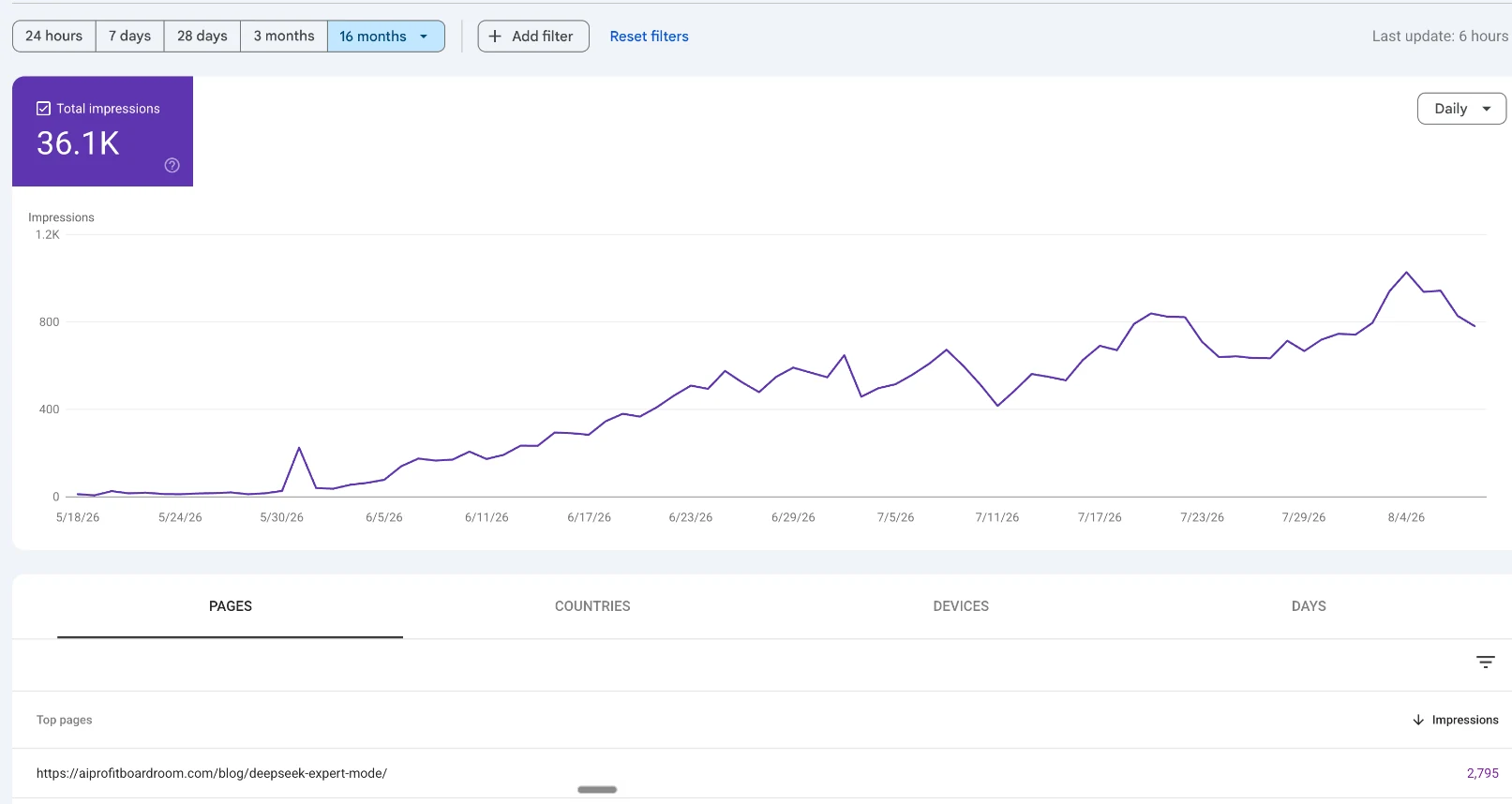
This is the new Generative AI report on aiprofitboardroom.com — 36.1K impressions inside AI Overviews and AI Mode, climbing since May. Google is handing you your AI visibility for free, and almost nobody checks it.
aiprofitboardroom.com
36.1K
AI impressions · 16 months
aisuccesslabjuliangoldie.com
12K
AI impressions
aimoneylabjuliangoldie.com
6.55K
AI impressions
juliangoldieaiautomation.com
1.9K
AI impressions
Four of the five sites, all now showing up inside AI answers. Every one of those curves points up.
§14 · Gaps & Leakstwo patterns to hunt
Gaps and leaks. Fix the leaks first.
A gap is a keyword getting impressions with no proper page — Google saying "give me a real page and I'll rank it".
A leak is a page ranking fine that nobody clicks. Same data, completely different fix.
What you're watching: I hit Run research and the pipeline pulls live Search Console data across all five sites — 5,000 queries analysed, 84,592 impressions, 2,840 clicks, scored into 25 opportunities. 8 striking distance, 16 low CTR, 3 content gaps. This is the gaps-and-leaks pass, running for real.
Leaks pay out fastest, because Google already trusts those pages.
Thinking it?"I've opened Search Console before and it just looked like noise."
You only need two columns: impressions and clicks. High impressions with no clicks is a leak. Impressions with no page is a gap.
That's the whole method — the tool above just sorts and scores it for you.
§15 · Piece Threequality control
Google isn't against AI content. It's against bad AI content.
The way you avoid bad AI content is a written set of rules the AI follows every single time it writes — mine is 13 steps.
Real case studies as the source of truth. Five unique articles per keyword. Titles under 60 characters. A case study near the top. A clear call to action. And a self-improvement step at the end.
What you're watching: the actual rules file the pipeline runs, scrolling top to bottom. Step 1 makes the transcript the source of truth — specifics must come from what really happened, not invented. It keeps going for thousands of lines.
Anyone can ask an AI to write one blog post. The rules file means article number 400 follows every rule as perfectly as article number one.
You and me? We'd forget the rules by article 12. That's just being human. The system doesn't forget.
Your own experience is the ingredient nobody can copy — because it only happened to you.
Thinking it?"I don't have anything special to say — I'm not an expert."
You don't need to be. Real tests you've run, real client work, real results good and bad — that's information gain, and it's yours alone.
If you can describe what you do for your customers, you can feed this engine. That's the entire skill requirement.
§16 · Piece Fourthe one that changes everything
Your own website matters less than what the internet says about you.
NP Digital studied 82 factors behind whether ChatGPT recommends a brand.
Number one was relevance. Number two — above your own site's authority — was brand mentions across the rest of the web.
For twenty years SEO was about pages you control. Now the thing deciding your fate lives on pages you don't.
§16b · The Mention Webpublish beyond your own site
So we built a subreddit. 244,000 views in 30 days.
When the AI engines crawl the web they see our brand next to our key terms — on Reddit, on the five sites, in videos, everywhere.
Several places connect your name to your topic, and the AI learns the connection.
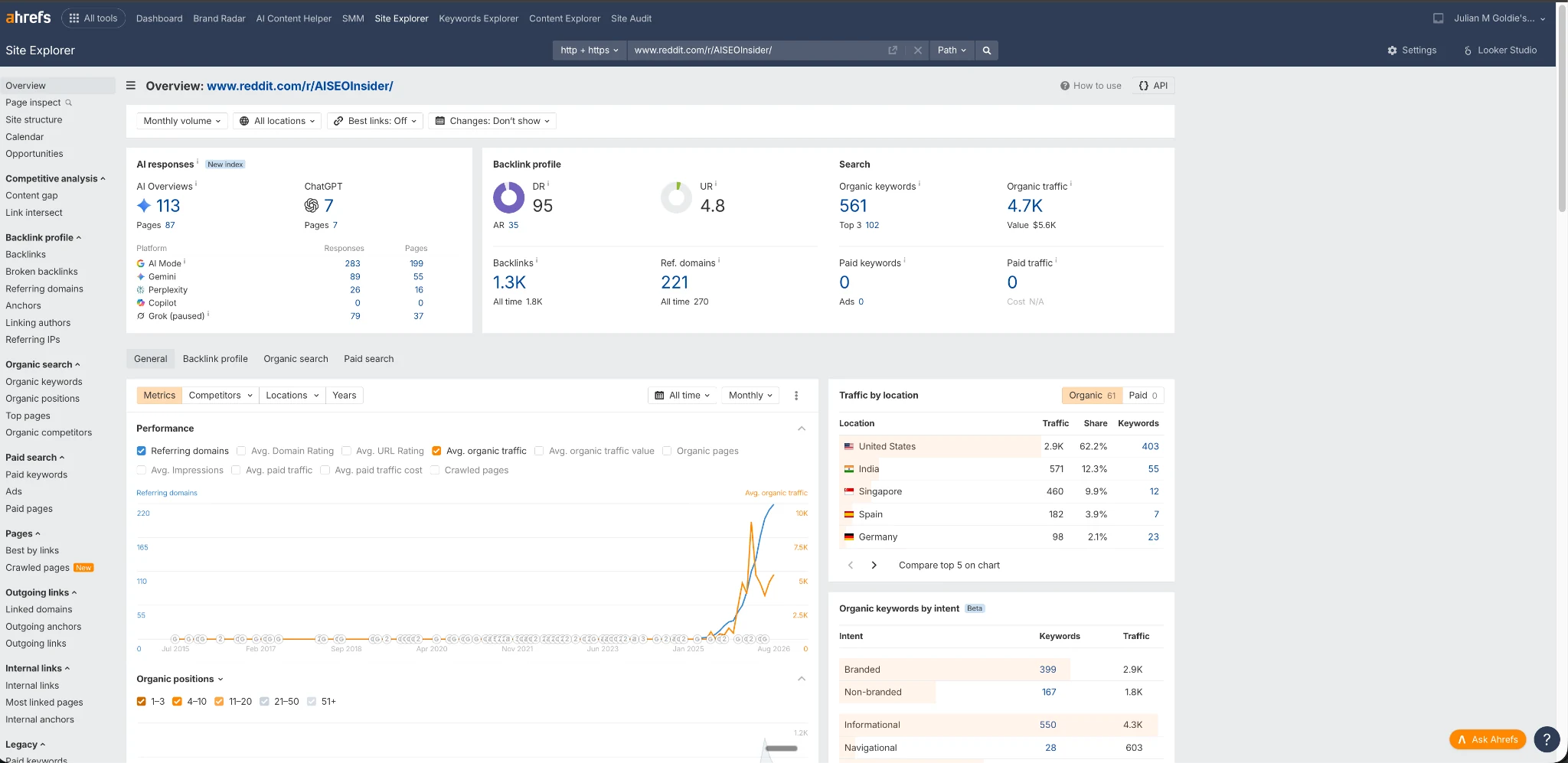
The subreddit in Ahrefs: 113 AI Overview citations and 283 AI Mode responses pointing at it, plus Gemini, Perplexity and Grok. That's a free platform teaching the AI engines who we are.
Thinking it?"Isn't posting on Reddit and other platforms a waste if it doesn't send traffic?"
The mention is the point, not the click. Brand mentions ranked second out of 82 factors — above your own site's authority.
Every genuine mention is a vote that shows up later inside an AI answer.
§17 · Freshnessthe door is wide open
AI doesn't care how big you used to be.
NP Digital asked 100 content marketers what actually gets you cited by AI. Freshness won by a mile at 91%. Being an old, established, authoritative source came last at 17%.
A small sharp brand that keeps showing up can get quoted right over a sleepy giant.
Ten years ago you couldn't outrank the big sites no matter what you did. Now most of the giants haven't noticed the door opened.
§18 · The Promised Numberthe most underreported stat in marketing
Fewer visitors. Each one worth far more.
Everyone panics about losing clicks. Almost nobody checks the quality of the clicks that remain.
Adobe analysed more than a trillion visits to US retail sites: AI-driven traffic converted 42% better, and those shoppers spent 48% longer on site.
A study of 312 B2B companies found AI-referred visitors converting roughly five times better than Google organic. Ahrefs got 12.1% of all sign-ups from 0.5% of sessions.
Why? The AI already did the comparing for them. Microsoft Clarity describes it as a pre-qualification layer — the casual browsers get filtered out before they ever reach you.
Losing junk traffic and gaining ready-to-buy traffic isn’t a loss.
§19 · Three Doubtsthe thoughts running through your head
"Google doesn't rank AI content."
We have nearly 1,500 AI-written posts across these websites, and traffic has grown the whole way through.
Google penalises lazy AI content and rewards useful content — and it genuinely doesn't care who typed it.
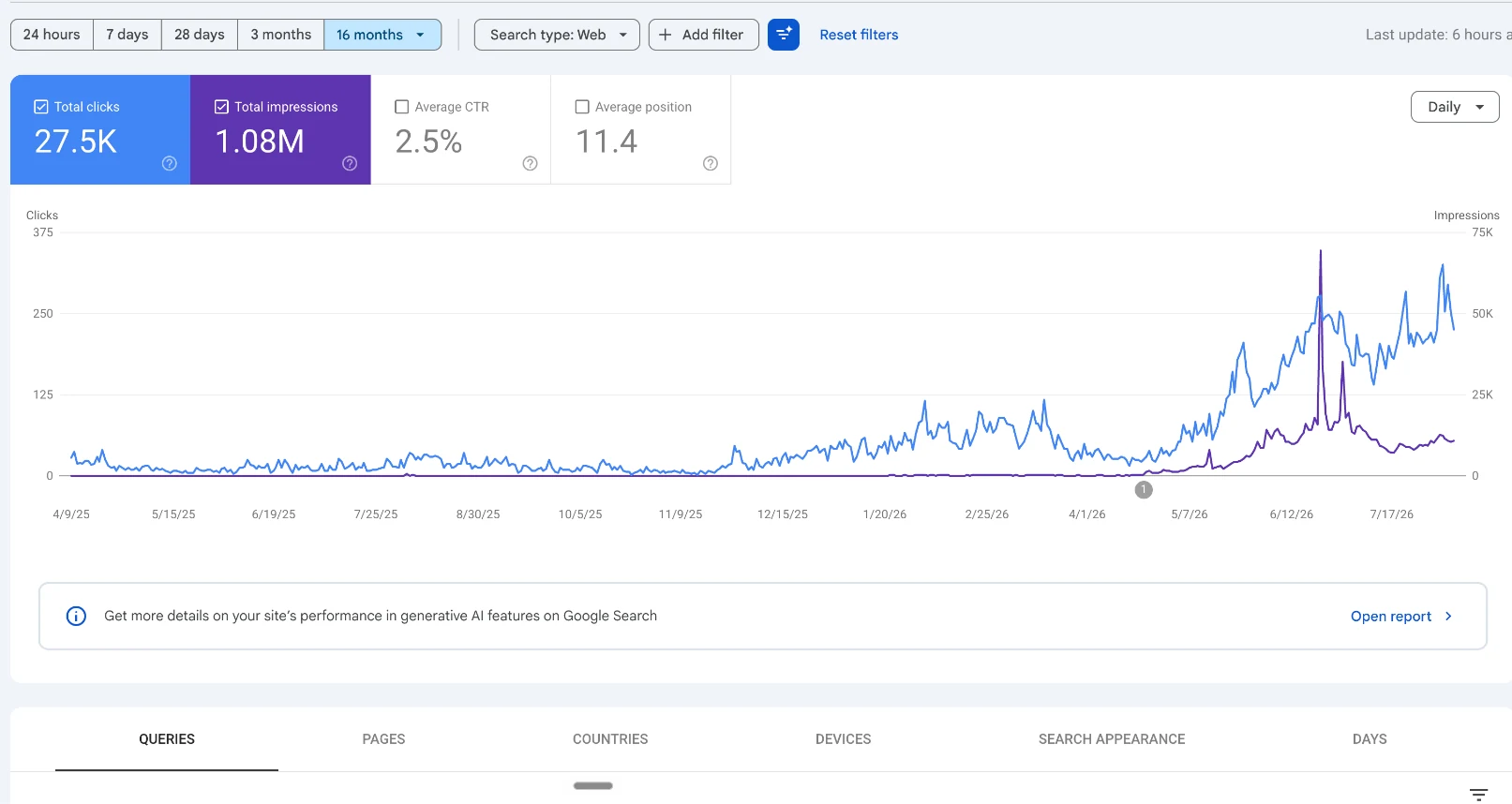
Sixteen months on aiprofitboardroom.com: 27.5K clicks and 1.08M impressions, and look at the shape of that curve on the right-hand side. That's the AI-written content compounding.
The proof? Google now shows AI-generated answers above every human-written result, on nearly half of all searches. It made its position on AI content pretty clear when it did that.
§19b · The Receiptsall five sites, last 28 days
Five sites. 9,770 clicks in 28 days.
Same engine on every one of them. The two big ones carry most of it; the small ones are three months behind on the same curve.
aiprofitboardroom.com
6.23K clicks
269K impressions · pos 8.9
aisuccesslabjuliangoldie.com
2.13K clicks
125K impressions · pos 9.2
aimoneylabjuliangoldie.com
664 clicks
49.1K impressions · pos 9.8
juliangoldieaiautomation.com
504 clicks
28.3K impressions · pos 13
bestaiagentcommunity.com
242 clicks
11.4K impressions · pos 15.6
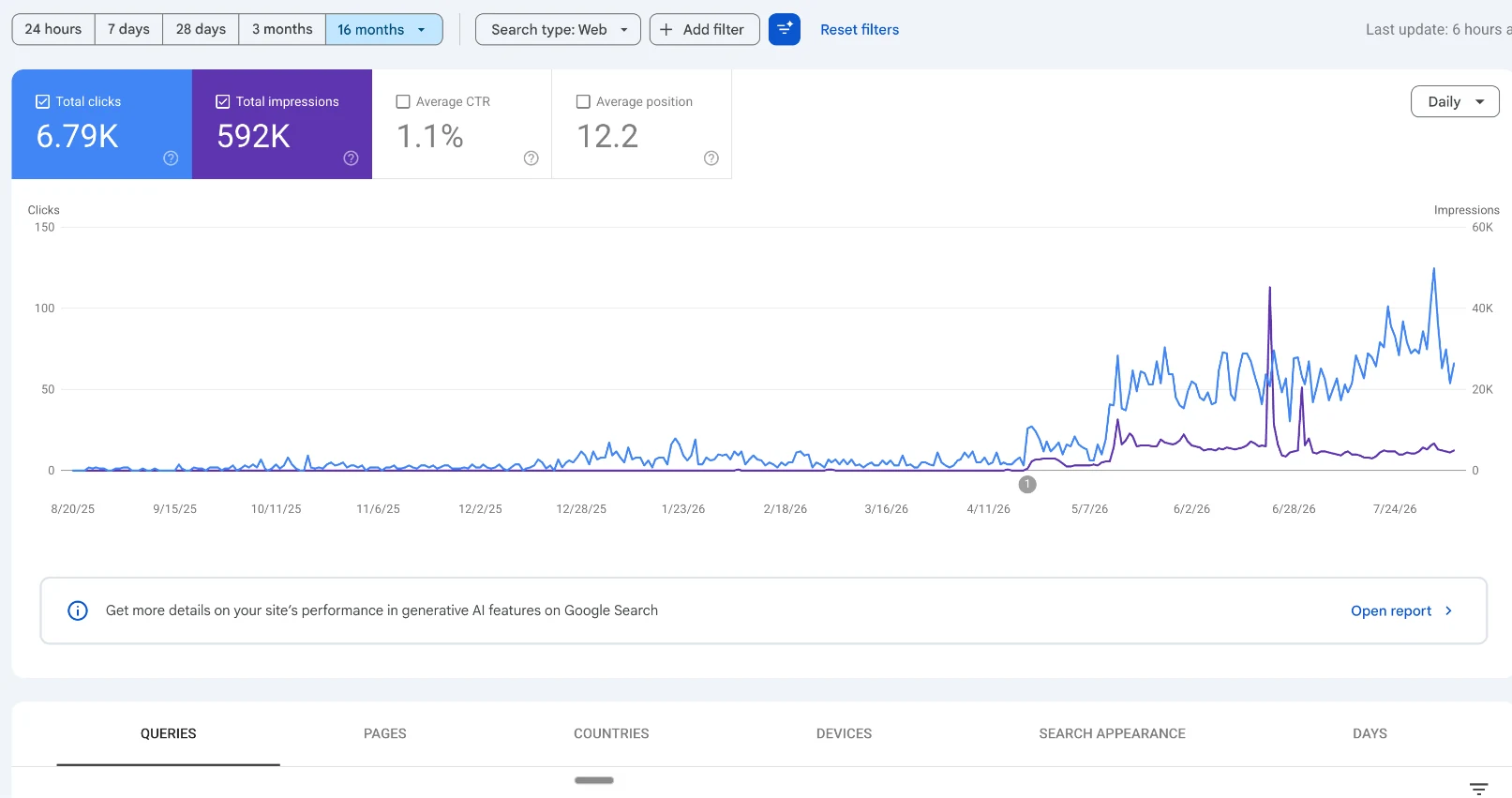
Site two over 16 months — 6.79K clicks, 592K impressions. Flat for a year, then the engine started and the line went vertical.
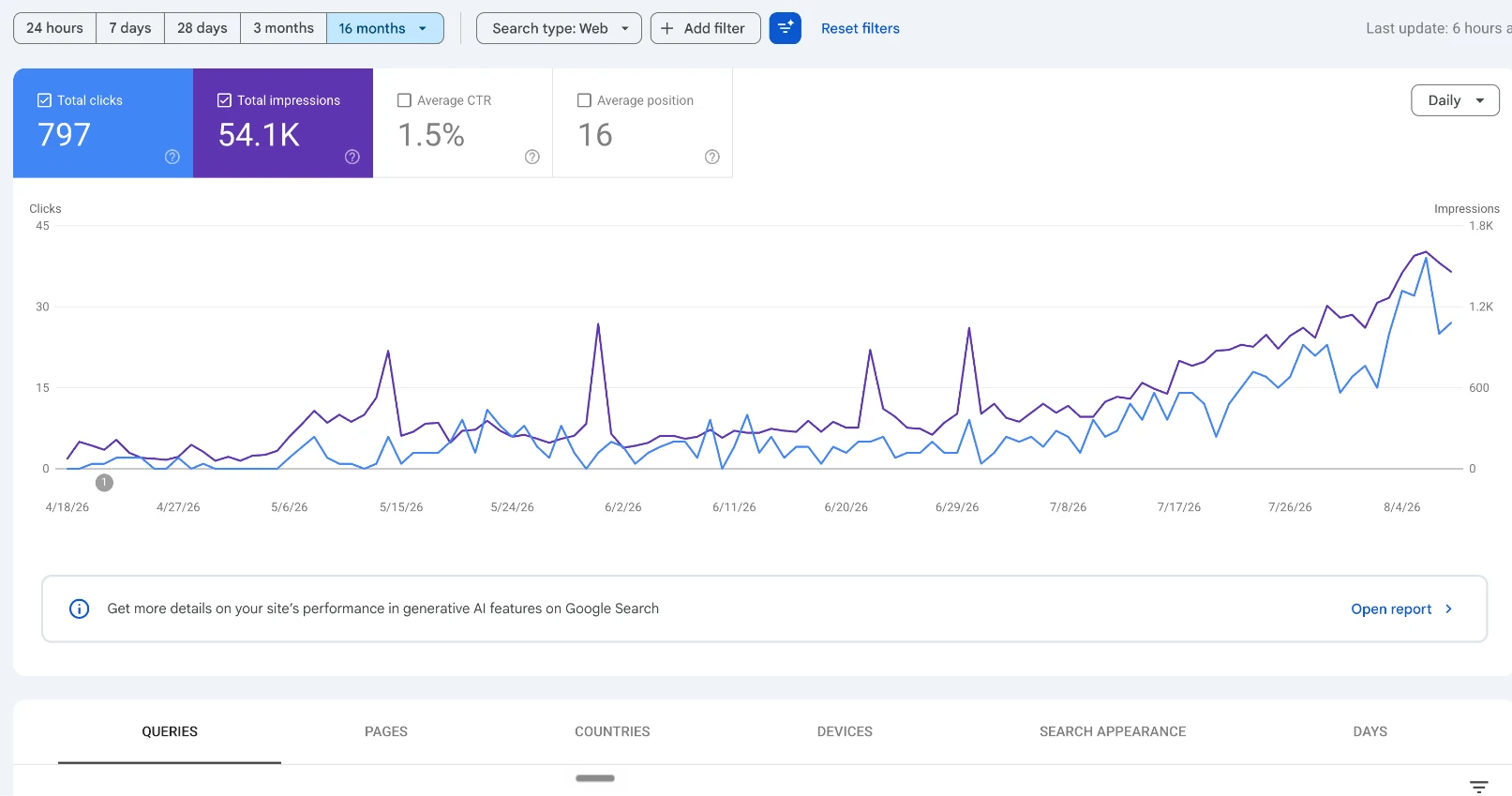
And the newest one: 797 clicks, 54.1K impressions, still early — this is what month four looks like before the curve kicks.
§19c · Doubt Two"I'm not technical enough for this"
I can't even log into most of these websites.
No WordPress, no plugins, no dashboard. The agents handle publishing, formatting and indexing.
My only job is supplying a keyword and a real example from my own work.
What you're watching: the deploy log. Every row is a real article that went live on one of the five domains, with the build time next to it. I didn't touch a CMS for any of them.
Thinking it?"Doesn't running an engine like this burn a fortune in tokens?"
No — that's the biggest myth about it. The everyday 90% runs on a free local model on your own machine, free APIs slot in for more, and the frontier work drives the CLIs you already pay for — your Claude subscription already includes the Claude CLI.
It's a layer on top of what you already own, not a new meter. And there are full token-efficiency tutorials inside the Boardroom.
§19d · Doubt Three"this takes too long"
Flat from January to April. Then 81 → 293 → 405.
One of my sites sat completely flat for four months. Publishing constantly, 30 to 60 clicks a week, chart doing nothing.
New sites sit flat while Google learns to trust them. That's exactly where most people quit — ten posts in, nothing back, walk away.
The ones who quit never find out the curve was three weeks ahead of them.
The 90 days pass either way. Same 90 days, very different ending.
§19e · Beliefsthree things to drop before you start
What's actually holding you back.
Wrong: SEO is dead, so there's no point starting now.
Right: One version of SEO died. Cited brands earn 35% more clicks and AI visitors convert up to five times better — the prize got smaller and much more valuable.
Wrong: I can't compete with the big established sites.
Right: Freshness beat authority 91% to 17% as a citation driver. Staying current beats being old, and most giants haven't noticed.
Wrong: AI content gets penalised, so I have to write everything myself.
Right: Lazy AI content gets penalised. 1,500 posts and a curve that keeps climbing says useful content wins, whoever typed it.
Don't take my word for it
Members post their wins every day — agency owners, ecom founders, course creators, solo operators across 38 countries. Real businesses, real numbers, in their own words.
Five moves. Start today, and the 90 days start counting today.
Start with what you know.
Write down three to five real results from your business. A client you helped. A test you ran. A before and after. These become the case studies nobody can copy.
Open Google Search Console.
Check the new AI performance report to see whether you show up in AI answers at all.
Hunt the gaps and the leaks.
Gaps are keywords getting impressions with no page built for them. Leaks are pages ranking fine that nobody clicks. Fix the leaks first — Google already trusts those pages.
Set a rhythm.
One keyword a day. Thirty a month, compounding, with fresh content going out daily. That's the 91% freshness factor working for you while the big players sit on their 17%.
Publish beyond your own site.
Answer questions in the communities where your customers already are. Every genuine mention is a vote.
§21 · The New Number Onewhat happens if you do it
Somewhere, someone asks an AI a question in your category.
Instead of describing a brand the web pieced together by accident, it describes the one you built on purpose. It says your name.
That's the new number one ranking — and the visitor who arrives after that recommendation converts up to five times better than the old Google click ever did.
The old versionburied
Chasing one ranking on one site
Guessing keywords from a shared tool
Writing everything by hand
68% of searches end with no click
58% fewer clicks at position one
Half of Google covered by AI answers
The new versionunderpriced
Becoming the trusted answer everywhere people ask
Keywords from data only you can see
AI systems doing the heavy lifting daily
A smaller flow of far better visitors
35% more clicks when you're the cited brand
Freshness beating authority, 91% to 17%
It's the most underpriced opportunity in marketing right now, precisely because everyone keeps saying it's over.
The AI Profit Boardroom is where the Everywhere Engine lives — the five-site pipeline, the rules file, the Search Console gap-and-leak process, all pre-wired.