The Goldie Fable Five™.
Five real builds. One day. One brain.
Claude Fable 5 launched on June 9, 2026. The next morning, I pointed it at my Agent OS and gave it one day. It built a website, shipped a pipeline idea, led a five-agent design meeting, ran an AI company, and cut its own show reel. Every artefact is real. Every one is traceable inside the OS. This guide walks through all five — with the receipts.
This model is a generation jump. Here's the proof.
Before the use cases — the receipts on the engine behind them.
1.It's a new model class, not a version bump
Claude used to come in three sizes: Haiku, Sonnet, Opus.
Fable 5 is the first public model from a fourth class that sits above Opus: Mythos.
Its unrestricted twin, Mythos 5, is reserved for government cyber-defence partners and vetted researchers.
You and I get the same brain — with safety rails.
2.The coding numbers behind these builds
📊 SWE-bench Verified: 95.0% versus Opus 4.8's 88.6%.
📊 SWE-bench Pro: 80.0% versus Opus 4.8's 69.2% — and GPT-5.5's 58.6%.
📊 On Cognition's FrontierCode eval it scored more than double Opus 4.8.
📊 1M token context. Effort dial from low to xhigh. Fewer turns per finished job.
The analysts' one-liner: "the lead widens as tasks get longer and more complex."
That's exactly what a day of real builds needs.
"Fable 5's capabilities exceed those of any model we've ever made generally available."
— Anthropic, official announcement, June 9, 2026
"Compressed months of engineering into days."
— Stripe's CEO, on using it across a 50-million-line codebase, June 2026
3.Why this matters for the Fable Five
Every use case below leans on a different strength:
🏗️ The website → frontier code generation in one pass.
🏭 The pipeline → code review sharp enough to finish another model's work.
🧠 The agent room → synthesis across five competing opinions.
🏢 The company → long-horizon agentic work with real tools and real files.
🎬 The show reel → following a complex spec (a whole video framework) first try.
I was you. Then I gave Claude 5 the keys for a day.
Before
Every time a big model dropped, I'd watch the benchmark charts and feel nothing.
Numbers on a slide don't ship anything.
I'd test it in a chat tab, get one nice answer, and go back to work.
The power was real but it never touched my business.
Then Fable 5 dropped — and this time I had an Agent OS to plug it into.
After
One config line and every Claude surface in my OS ran the new model.
By the end of the day: a website, a shipped pipeline build, a game designed by five agents, a real job run by an AI company, and a show reel.
Not demos. Files I can open, history I can show you, work I can use.
That's what a frontier model does when it has a system to live in.
You can have this too. Same tools. Same path.
Commit to transitioning today. Not tomorrow.
You're about to see five things a frontier model did in one day inside one system.
Every single one is reproducible by you.
So here's the deal.
Promise yourself one thing right now: you'll finish this guide AND run ONE of these five use cases before you sleep tonight. Just one.
Because the moment you make this transition, AI stops being a chat tab and becomes a workforce.
The people sitting still are getting passed. The people implementing today are the ones who'll look back in six months and say "that was the moment."
Be one of those people.
Commit to the transition. Commit to taking action today. This changes everything about your workflow.
The Goldie Fable Five™.
Five fables. Five proofs. One brain.
Each "fable" is a story your AI tells with real work — and each one runs a different muscle of the system. Master all five and you've got a complete AI operation.
The Builder
One brain builds alone. You describe it once — it ships a finished, polished artefact in a single pass. No template, no team.
The Factory
Ideas ship themselves. You drop a thought in the Pipeline; it gets shaped, planned, built and verified — while you do something else.
The Boardroom
Five minds beat one. Different real models debate your brief, and the brain synthesizes the best of everyone into one spec.
The Company
Agents with job titles. A real org chart, real issues, real completions — your AI staff runs work end-to-end and reports back.
The Showreel
The system documents itself. Everything built becomes proof — rendered into video you can post the same day.
It built a website about itself. One pass.
Let me start with the simplest one.
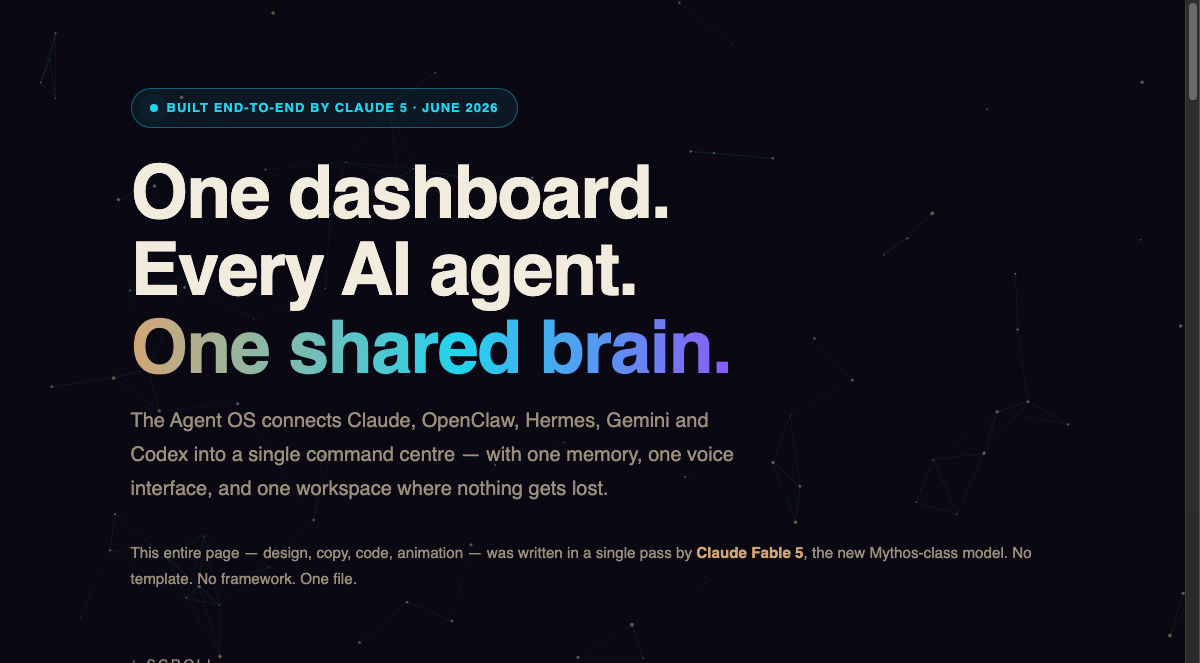
I asked Claude 5 for a website about the Agent OS — design, copy, code, animation.
One pass. One file. No template, no framework, no external resources.
It came back with an animated constellation background, live counters, a seven-agent roster, and copy sharper than most agency landing pages.
You could do this for your own offer today: "build me a single-file landing page for [your product]" — and watch it appear in your workspace.
→ Free Claude Code → Workspace tab
→ file: claude-agent-os-built-by-claude-5.html
I dropped one idea in the Pipeline. It shipped itself.
Next one runs without me.
I typed one idea into the Idea Pipeline: "an AI agent command center simulator — a living mission-control screen."
The Pipeline classified it, drafted a build plan, built it, and marked it shipped. I watched the stages change on the board.
Then Claude 5 did a code review on the output and finished the simulation loop — the free local model laid the bricks, the frontier brain did the finishing.
The result is a live screen where Claude 5 delegates tasks to orbiting agents in real time, with a telemetry stream and a clickable inspector.
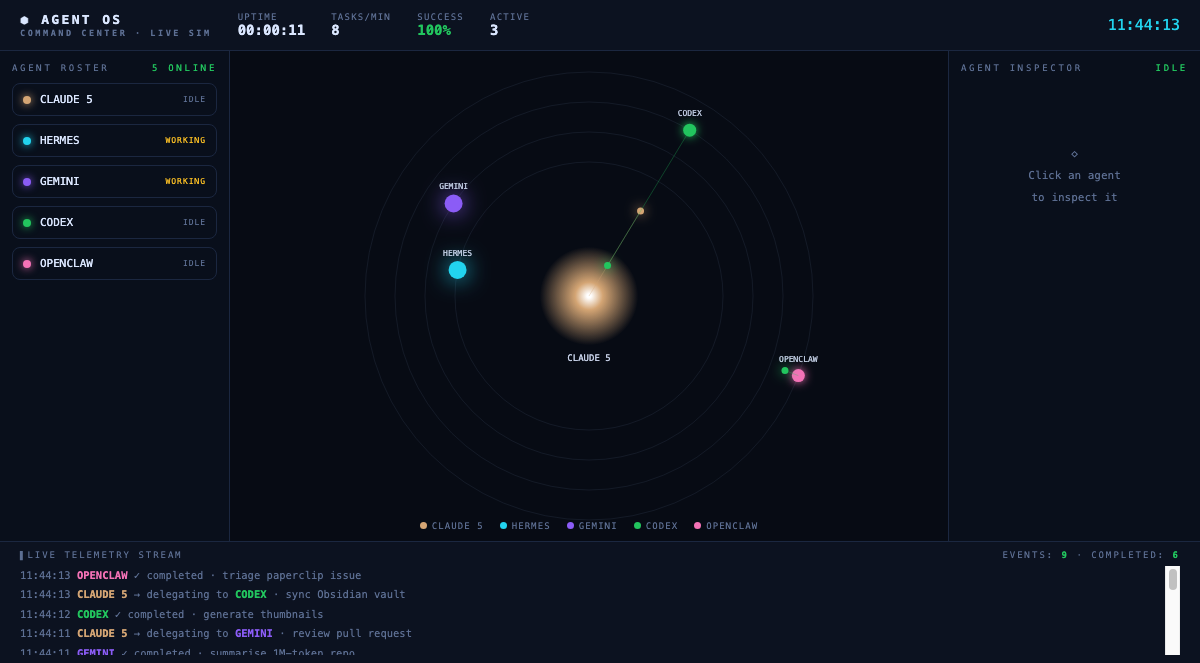
→ Pipeline tab → "AI Agent Command Center Simulator" — stage: shipped
→ Workspace → ai-agent-command-center-simulator.html
The entire input was one sentence typed into a box.
Capture → shape → build are buttons. If you can post a tweet, you can ship an idea.
Five AI agents designed a game. Then it shipped.
This is my favourite one.
I opened the agent group chat — five different real models in one room: Claude 5, Hermes, Gemini, Codex, OpenClaw.
One brief: design a 60-second browser game that teaches what AI agents are.
Every agent pitched a different mechanic. Then Claude 5 synthesized the best of all five into one spec: Agent Rush.
Drag falling tasks onto your agents. Do them yourself and you're slow. Micromanage a working agent and they stop. The lesson, in Claude's words: "You don't scale by working faster — you scale by handing off."
And here's the kicker — Claude saved the game concept to my Pipeline on its own, mid-conversation.
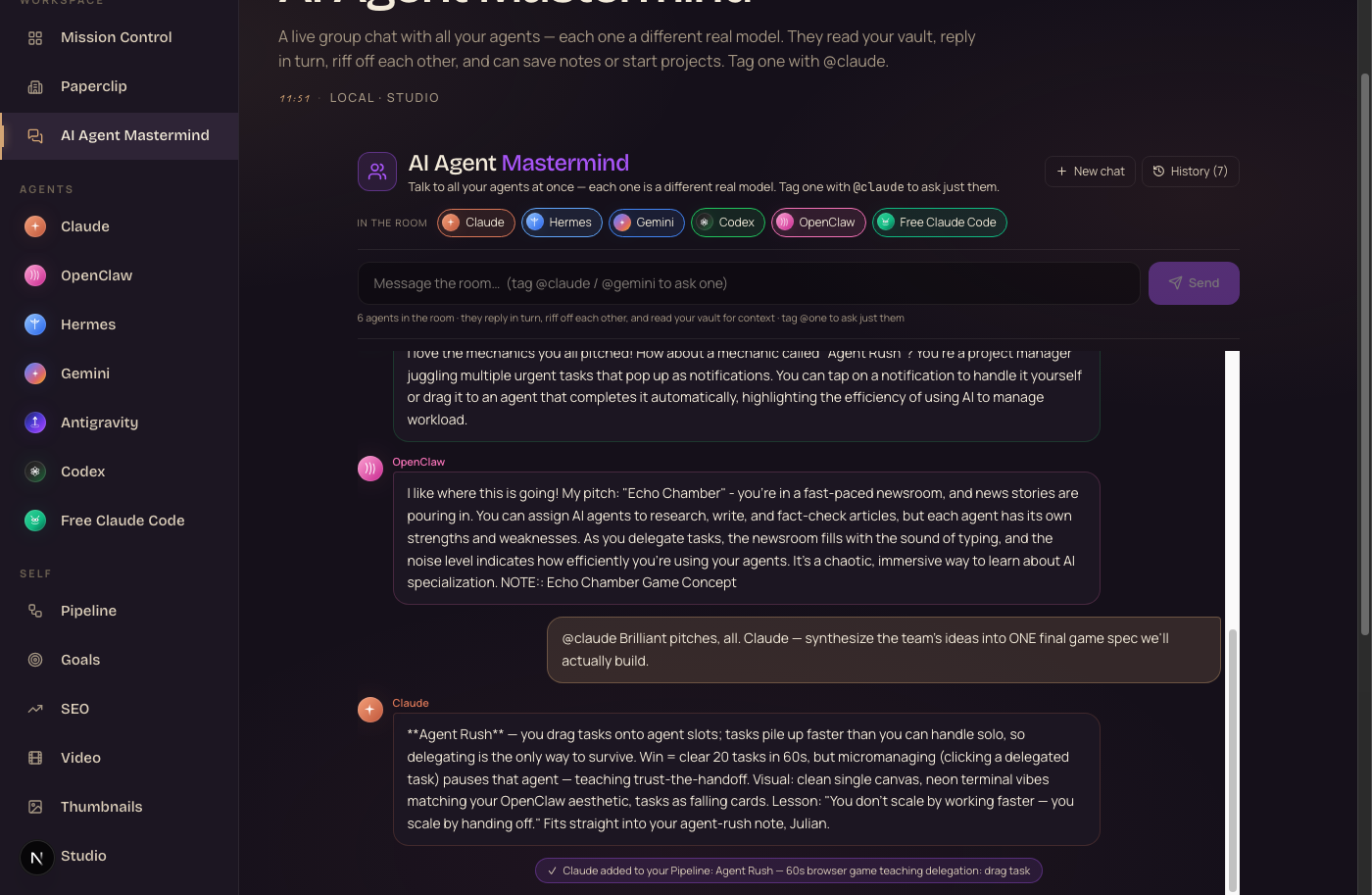
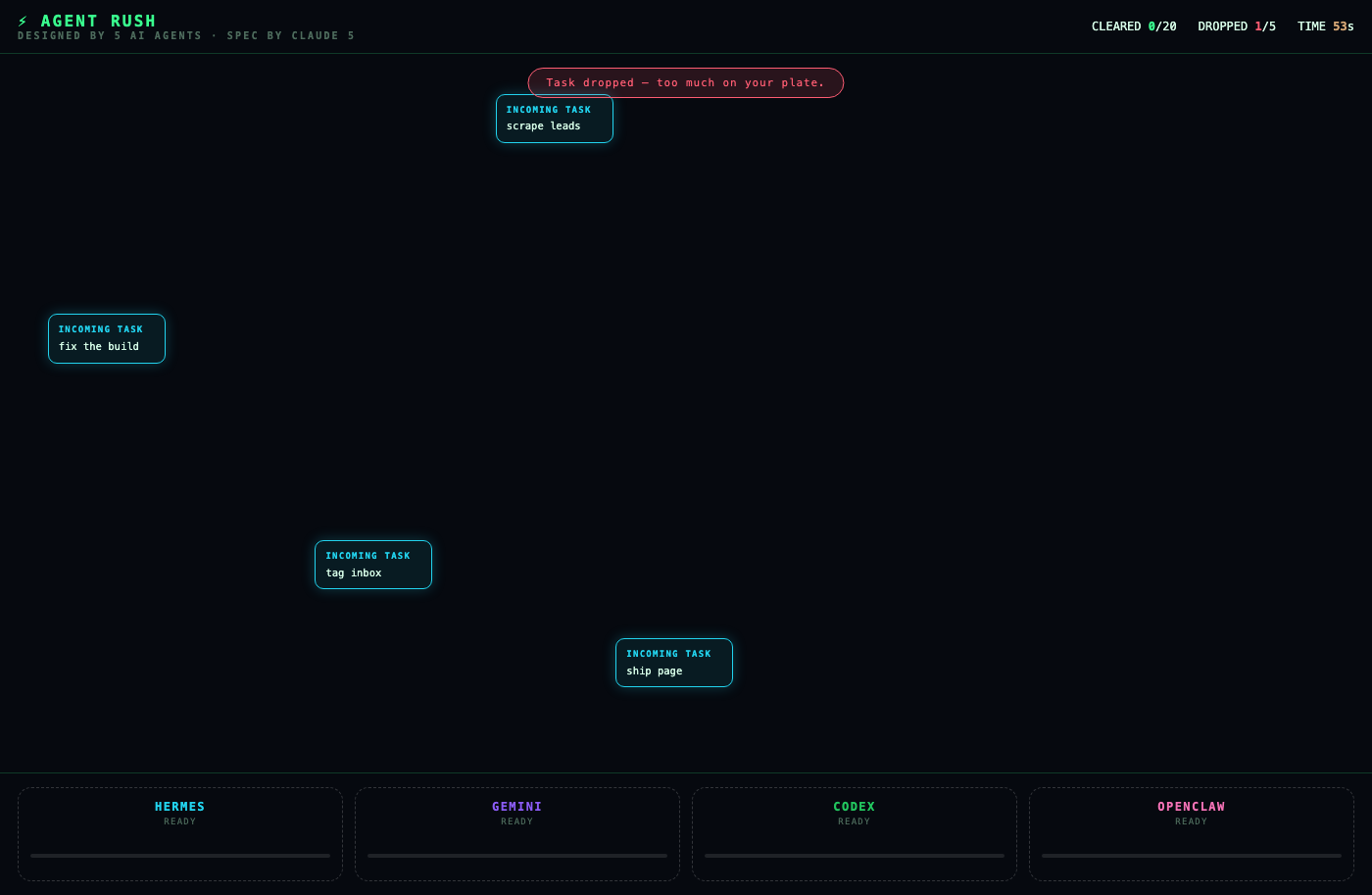
→ AI Agent Mastermind → History → "Claude 5 leads: design the Agent Rush game"
→ Workspace → agent-rush-the-game.html
No — each seat is a different real model from a different company, called by its own API.
Claude 5, Hermes 4, Gemini, GPT, Llama. Different training, different opinions. That's why the synthesis is worth having.
An AI company ran a real job. CEO: Claude 5.
Now the heavyweight.
Inside my OS there's Paperclip — a full AI company called Goldie Labs. Ten agents with job titles: a CEO, a CTO, engineers, a copywriter, a CMO.
I gave the CEO — Ada — a Claude 5 brain, and one issue: write the launch memo for everything shipped today, and assign each product an owner from her team.
Seventy seconds later: issue done, exit code 0.
Her memo assigned the website to Ogilvy ("a showcase is an ad, and nobody sharpens a value proposition like Ogilvy"), the simulator to Carmack, the game to Hopper — and set three priorities for next week.
She signed it: "Momentum is the moat. Keep shipping. — Ada, Chief Executive."
That's an AI delegating to other AIs, with reasons, in writing.
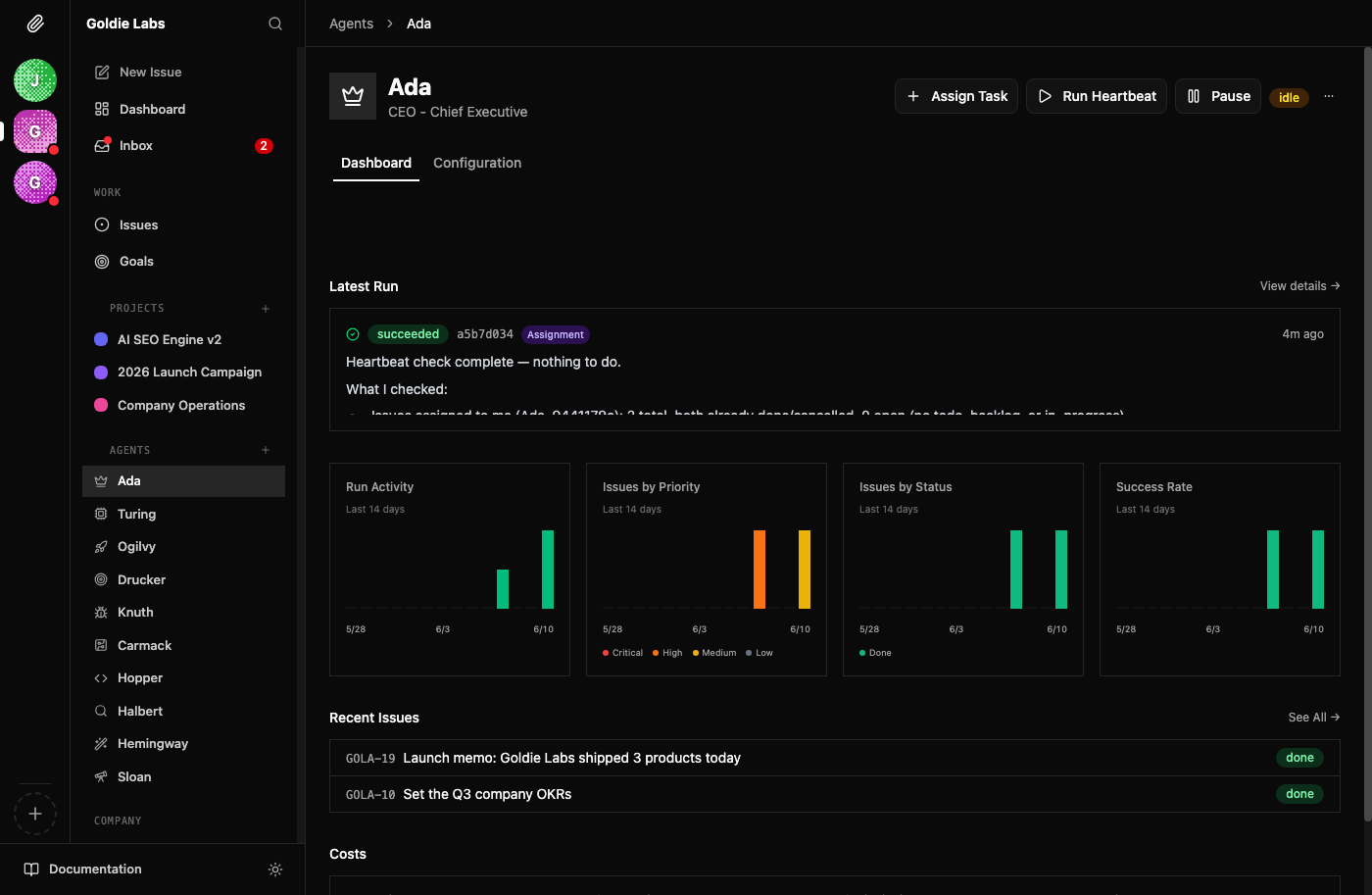
→ Paperclip → Goldie Labs dashboard — Ada's latest run: succeeded
→ issue GOLA-19 — status: done · memo: LAUNCH-MEMO.md
The whole CEO job cost pennies — one short run on the API.
And until June 22, Fable 5 is included free in every paid Claude plan. The cheapest day to try this is today.

Run the Fable Five on your business.
Everything you just saw — the Builder, the Factory, the Boardroom, the Company — ships as one system: the Agent Operating System inside the AI Profit Boardroom.
Your agents share one memory. They know your goals. They know your business. So when Claude 5 builds for you, it builds YOUR thing — not a generic demo.
- The full Agent OS zip — the exact system in every screenshot above
- A 30-day Claude 5 roadmap — install, wire the memory, run all five use cases
- Every prompt + the Obsidian memory setup
- Coaching calls — we set it up together, step by step
- 3,100+ founders building with this stack · someone's online 24/7
Then it cut its own show reel.
Last one — the system documenting itself.
Claude 5 took screenshots of everything above and authored a full video composition in HyperFrames — title card, push-slide transitions, Ken Burns moves on every screenshot, a zoom-through climax, an outro.
Then it rendered the whole thing to a real mp4 on my Mac.
A 33-second launch video for a day's work, made by the thing that did the work.
That's the loop most people miss: your AI shouldn't just produce — it should package the proof for you.
→ Hermes → Workspace → Videos → fable5-showreel.mp4
→ source composition: ~/fable5-showreel/index.html (renderer source — looks blank in a browser; the mp4 is the video)
Most people will use Claude 5 in a chat tab. Here's the split.
- Open a chat tab, ask, copy the answer out by hand
- Re-explain your business every single session
- One conversation at a time, you babysitting it
- Outputs scattered and lost — no history, no proof
- The model's power never touches your actual systems
- Result: "cool demo" — nothing shipped
- One brain wired into builder, pipeline, room, and company
- Shared memory — it already knows your business
- Work runs in parallel while you film, sell, sleep
- Every artefact saved, every step traceable in the OS
- Agents delegate to agents — with names and reasons
- Result: a website, a simulator, a game, a memo, a video — in one day
Honest answer: start with one fable.
Don't try to build all five tonight.
Pick the one that touches money for you fastest.
Selling something? Run the Builder on a landing page. Drowning in ideas? Run the Factory. Making content decisions? Run the Boardroom on your next title.
Then stack the next one each week.
And do it while the window's open — Fable 5 is free on every paid Claude plan until June 22. After that, the same experiments cost usage credits.
The people who figure out AI agents now, while the tools are evolving fast, are going to be way ahead when everything settles. Every workflow you build compounds.
Six months from now this is normal — and everyone has it.
The advantage is the gap between now and then. The free window literally closes June 22.
What you just gained.
You saw the proof, not the pitch.
Five real artefacts, every one traceable inside the OS with file names and run IDs.
You got a builder.
One pass from Claude 5 = a finished website. Works for your offer too.
You got a factory.
One sentence in the Pipeline → shaped, built, shipped while you're elsewhere.
You got a boardroom.
Five real models debate your brief; the brain synthesizes the winner.
You got a company.
An AI CEO that completes issues and delegates to named staff — in writing.
You got a show reel.
The system renders its own proof video. Content from work, automatically.
You know why it works.
95% SWE-bench, 1M context, a Mythos-class brain — verified numbers, not vibes.
You have a deadline.
Free on paid Claude plans until June 22. Run one fable tonight.
"Don't watch the model. Put it to work."
Build your own Fable Five.
If you want Claude 5 actually working for your business — not just impressing you in a tab — grab the Agent Operating System inside the AI Profit Boardroom.
It turns Claude, OpenClaw, and Hermes into one system with shared memory, shared context, and one dashboard you control.
You get the zip file. Every prompt. The Obsidian memory setup. Coaching calls where we wire it in together, step by step.
3,100+ members. Daily tutorials. A 30-day Claude 5 roadmap. A member map to find builders near you.
Get the Agent OS → Inside the AI Profit Boardroom · aiprofitboardroom.com link in the description ↓Run one fable tonight. Stack the rest weekly.
I'll see you in the next one.