The Production Brain™ — an Agent OS for a real factory.
Today I'm turning the Agent OS into a production planner for a real boat factory.
A Boardroom member asked if agents could plan the cutting schedule for six boat models and two hundred parts — so we built it.
Imagine typing "re-plan the quarter" and getting back batch sizes, a cutting calendar, and the cash value of every change.
The working demo is on this page — press one button and watch the agent plan a factory in six seconds.
Then I'll show you the pilot path that needs no access to company servers at all.
And the one number that wins the management meeting — stick with me to the end.

"Could an Agentic OS plan our factory?"
This one came straight from the Boardroom.
A member works for a boat manufacturer. Six models. Demand that shifts every quarter.
Around a hundred plastic parts and a hundred metal parts get cut to feed those boats.
His questions were exactly the right ones.
Could agents organize the data? Could they spot the patterns? Could they recommend batch sizes and cutting frequencies that cut waste and free up inventory?
And the hard one: how do you build the business case when you'd need company data to prove it?
The answer to all four is on this page — including the working demo.
Every business runs a factory. Most just can't see it.
My factory doesn't cut plastic. It cuts content, benchmarks and builds.
But the shape is identical: limited machine time, shifting demand, and a queue of jobs fighting for it.
Before the Agent OS, I planned that queue by feel — and my "inventory" piled up as half-finished projects.
Then I gave the planning job to agents.
Now demand data goes in, and a schedule comes out — what to make, how much, when.
So when a member asked whether the same pattern fits a literal factory, I didn't want to answer with theory.
We built the demo instead. It took an afternoon.
That's the point of this guide: the pattern transfers, and you can pilot it this week.
Real people. Real wins. Across real businesses.
The Boardroom is agency owners, ecom founders, manufacturers and operators wiring agents into actual work.
Every win is collected in one doc — read the 158-page member wins doc →
The Guessing-Batch Problem — where factories quietly bleed.
Here's how part cutting actually gets planned in most small manufacturers.
Somebody looks at last month. Somebody adds a safety margin "to be safe". Somebody rounds up to a nice number.
Nobody recalculates when demand shifts — because recalculating two hundred parts by hand is a week of spreadsheet pain.
So the batches stay fixed while the demand moves.
The cost hides in three places: cash sleeping as excess inventory, material scrapped on oversized runs, and the panic cuts when a part runs out mid-build.
It's not a people problem. It's an arithmetic problem — two hundred small optimizations nobody has time to redo every quarter.
Which is exactly the job agents never get tired of. That's the Production Brain™.
The Production Brain™
Three layers, same as every Agent OS system — just pointed at a factory.
Layer 1 · The Memory
Sales history, the bill of materials, inventory counts and costs — exported to files the agents can read. No live systems touched.
Layer 2 · The Planner
Agents forecast demand per model, explode it into part demand, size batches against setup and holding costs, and build the cutting calendar.
Layer 3 · The Case
Every recommendation carries its dollar impact — so the output IS the business case for management.
Planning by habit vs planning by agent.
Spreadsheets and gut feel.
- Last quarter's batches, rounded up "to be safe".
- 200 parts recalculated never — too much manual work.
- Cash sleeping in overstocked bins.
- Scrap from oversized runs nobody prices.
- Panic cuts when a part runs dry mid-build.
The Production Brain™.
- Export sales, BOM and stock counts to files.
- Agents forecast every model, then every part.
- Batches sized against setup and holding cost — per part.
- A cutting calendar with dollars attached to every change.
- Demand shifts? Re-run the plan in one command.
Don't imagine it. Run it.
We built the member's exact scenario as a live demo: six boat models with two years of shifting demand, one hundred plastic parts, one hundred metal parts, real bills of materials.
The data is synthetic. The planning math is real — forecasting, batch sizing against setup costs, cutting cadence, stockout detection, and the cash value of every recommendation.
▶ Open the live demo — run the planning agent →
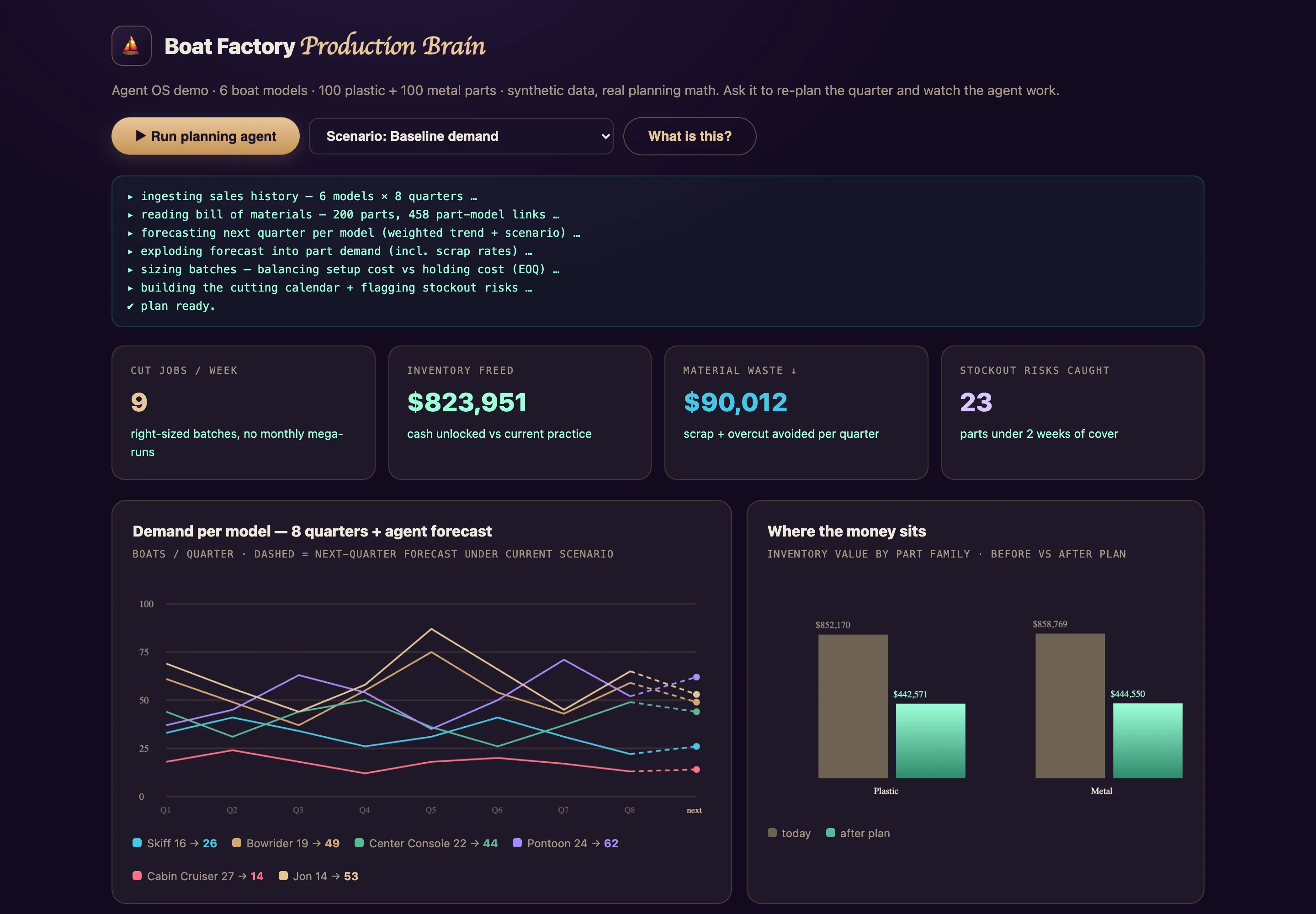
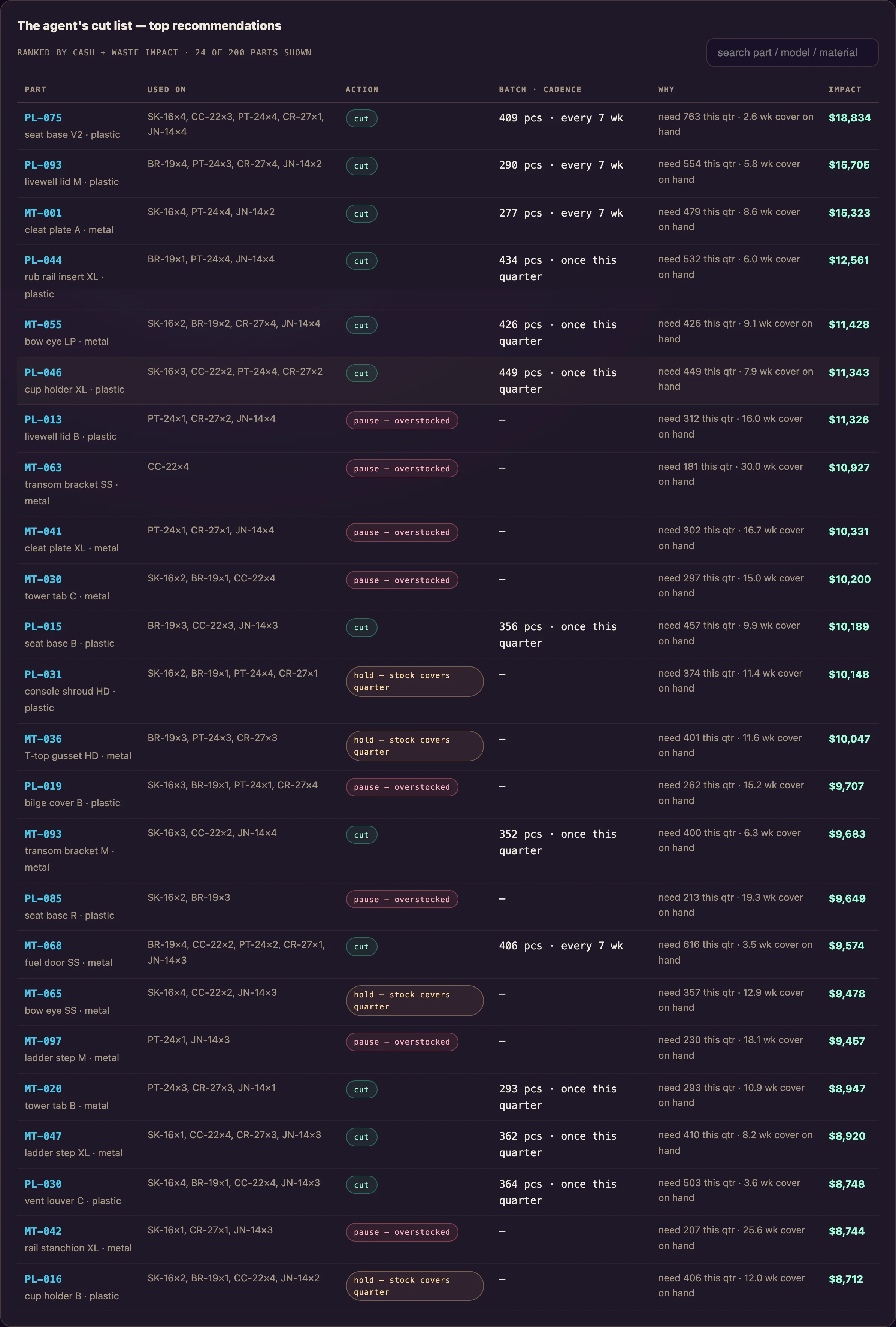
And the number that wins the meeting: on this synthetic factory, right-sizing batches frees roughly $800k of working capital and avoids about $90k of waste per quarter — while catching two dozen stockout risks before they stop a build. Your real numbers will differ. That's the point: the pilot computes YOUR numbers, and that's the business case.
How you'd actually do this — no server access needed.
The member's blocker was real: "I'd need company data and server access before I can prove anything."
No. You need three spreadsheet exports. Every ERP and accounting system can produce them, and management barely blinks at a read-only export.
Pilot on exports — prove it offline
Ask for three CSV exports: sales by model by quarter (2 years), the bill of materials (part → model → quantity), and current inventory with unit costs. Drop them in a folder; your Agent OS reads files natively.
Then have the agents rebuild what the demo above does — forecast, batch sizes, cutting calendar — on YOUR real parts.
Show the delta, not the tech
Management doesn't buy "agents". They buy freed cash and fewer line stops. Present three numbers from the pilot: working capital freed, waste avoided per quarter, stockout risks caught.
Bring the cut list for the top ten parts — concrete part numbers with concrete batch changes reads as engineering, not magic.
Wire it for real
Only now do you ask for the recurring data feed — a scheduled export or a read-only view. The agents re-plan every week, flag drift, and the plan lands in the same dashboard the pilot used.
Scope stays tiny: read data, recommend plans. Humans still press the cut button.
The same brain fits any make-to-stock shop.
Boat & RV plants
The exact demo scenario — models, BOMs, cut parts, seasonal demand.
Furniture & cabinetry
Panels and hardware batched against setup time on the CNC.
Print & packaging
Plate changes are setup cost; run lengths are the batch decision.
Food production
Shelf life turns holding cost real — the same math, sharper penalties.
Machine shops
Job-mix forecasting decides which fixtures stay loaded this week.
Ecom kitting
Bundle demand explodes into component reorder points automatically.
If you want this in one place.
The Agent OS behind this demo — the agents, the dashboards, the file-reading memory — is the system I run my business on. Inside the AI Profit Boardroom you get it pre-wired, plus the people to help when something doesn't work first try.
- The Production Brain™ pattern, ready to point at your exports
- The complete Agent OS — every agent and dashboard in one place
- 5 live coaching calls a week — bring your factory's actual data questions
- 1,000+ prebuilt agents and the automation playbooks
- 4,000+ members in 38 countries — including operators who've pitched exactly this to management
The three beliefs holding you back.
What this costs, straight up.
The demo on this page is a free webpage — open it, play with it, steal its structure for your pitch deck.
The pilot needs an Agent OS pointed at three exported files. Build your own following the guides on this site, or take the shortcut with the pre-wired version inside the Boardroom.
Either way, the pilot costs you a week of curiosity — not a software budget.
Eight steps from question to management yes.
Play the demo
Run the planning agent above. Switch scenarios. This is the artifact you're about to rebuild with real data.
Request three exports
Sales by model by quarter, bill of materials, inventory with costs. Read-only CSVs — the least scary ask in corporate history.
Add setup and holding costs
Ask the floor: what does a changeover cost per part family, roughly? Estimates are fine — the math is robust to rough inputs.
Let agents forecast demand
Per model, next quarter, from the sales history. Sanity-check against what sales expects — agreement builds trust.
Explode into part demand
Forecast × BOM × scrap rate = what each part actually needs this quarter.
Size the batches
Balance setup cost against holding cost per part. Cap batches at real demand — no more "round up to be safe".
Price every change
Inventory freed, waste avoided, stockouts caught. Dollars per recommendation — this is your slide.
Pitch the pilot's own numbers
Ten minutes, three numbers, one cut list. Ask only for a recurring export. You'll get it.
Thirty days from idea to pilot in production.
Week 1 — The data
Days 1–7Goal: three exports in a folder, agents reading them, first demand forecast checked against sales' gut.
Week 2 — The plan
Days 8–14Goal: full cut list for every part, priced. Compare against current practice and total the delta.
Week 3 — The pitch
Days 15–21Goal: ten-minute presentation — three numbers, top-ten cut list, ask for a recurring export.
Week 4 — The loop
Days 22–30Goal: weekly re-plan running on the recurring export, drift alerts on, humans approving cuts from the dashboard.
Everything you just learned, in one glance.
The question
Can agents plan a 6-model, 200-part factory? Yes — demo's live above.
The problem
Fixed batches + shifting demand = sleeping cash, scrap, panic cuts.
The loop
Ingest → Forecast → Optimize → Schedule, re-run any time.
The pilot
Three read-only CSV exports. Zero server access. One week.
The case
Cash freed + waste avoided + stockouts caught — dollars per decision.
The pitch
Three numbers and a top-ten cut list. Ask only for a recurring export.
The guardrail
Agents recommend; humans press the cut button.
The transfer
Boats today — cabinets, print runs, bakeries, machine shops tomorrow.
Run the demo. Then run your factory's numbers.
The demo takes one click. The pilot takes three exports and a week. And if you want the Agent OS behind it pre-wired — with people who've pitched this exact thing to management — that's the Boardroom.
- The Production Brain™ + the full Agent OS, ready to point at your data
- 5 live coaching calls a week — bring your pilot, leave unblocked
- 258 documented member wins — read all of them here