15 new questions. 2 wins. One community.
Second drop from inside the AI Profit Boardroom. Members brought the questions — Hermes, Agent OS, Obsidian, Antigravity, backlinks, speed-to-lead, the remote/cloud setup. I'm answering every one, in order, with the links to the original threads. One person asks. Everyone learns.

Last drop we did 13 questions. This drop's 15 — and the questions are getting sharper.
People aren't asking "what's Hermes" anymore. They're asking how to move it to the cloud, how to structure their Obsidian vault so agents don't pollute it, whether Antigravity replaces it, and how to handle context across systems that span months of work.
That's the Socratic Society doing its job. Nobody's the guru. We're all just further down the road on different parts.
— JulianJerry Polson: "Hermes pulls in my voice notes every 4 hours. No manual exporting."
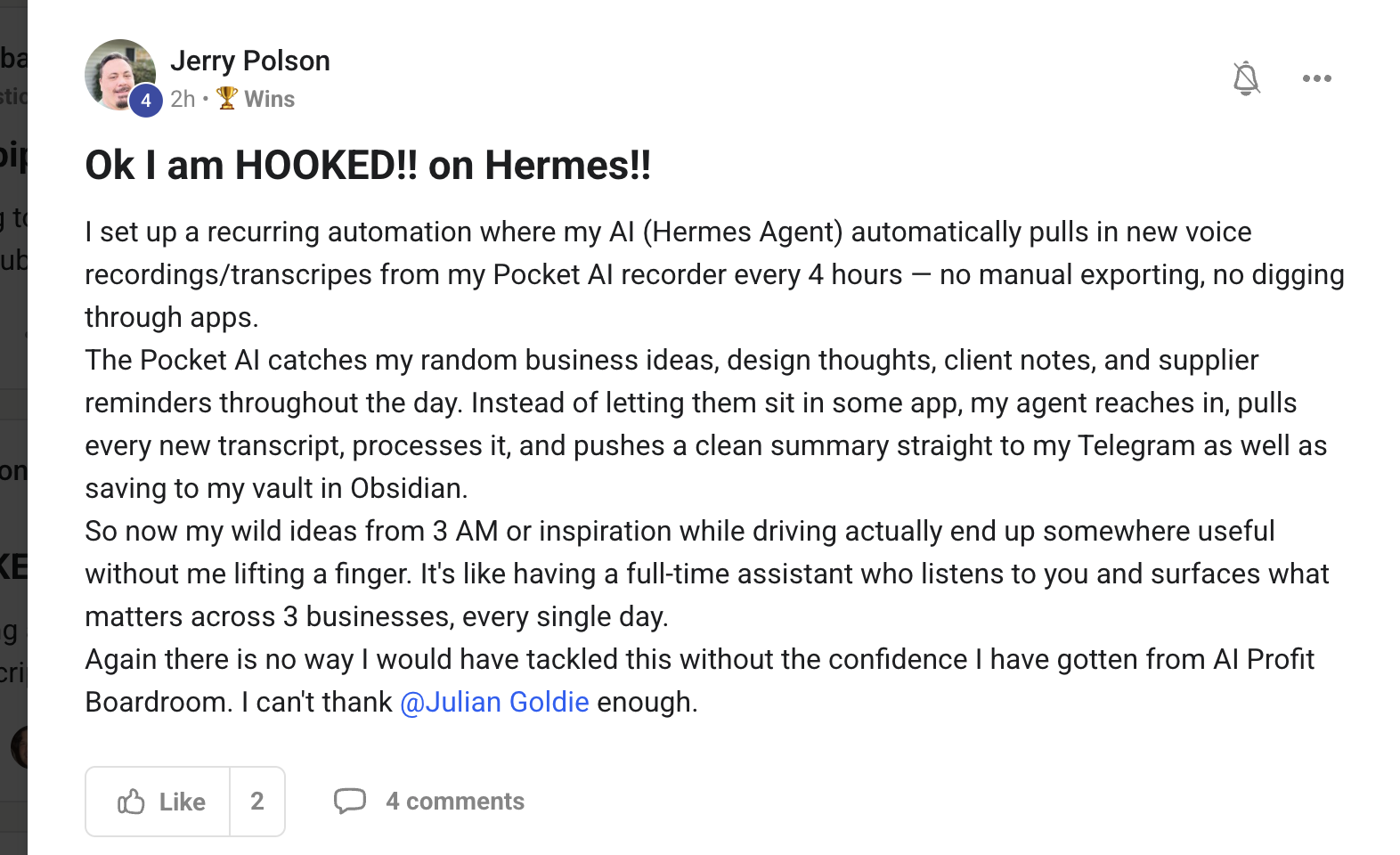
Jerry set up a recurring automation: his Pocket AI recorder dumps every 4 hours, Hermes catches the random business ideas + client notes + supplier requests, sorts them by day, processes them with his agent, and pushes a clean summary straight to his Telegram and his Obsidian vault.
His exact words: "It's like having a full-time assistant who listens to you and surfaces what matters across 3 businesses, every single day."
This is the move. Voice → agent → memory. Steal it.
"Hermes on my personal machine?"
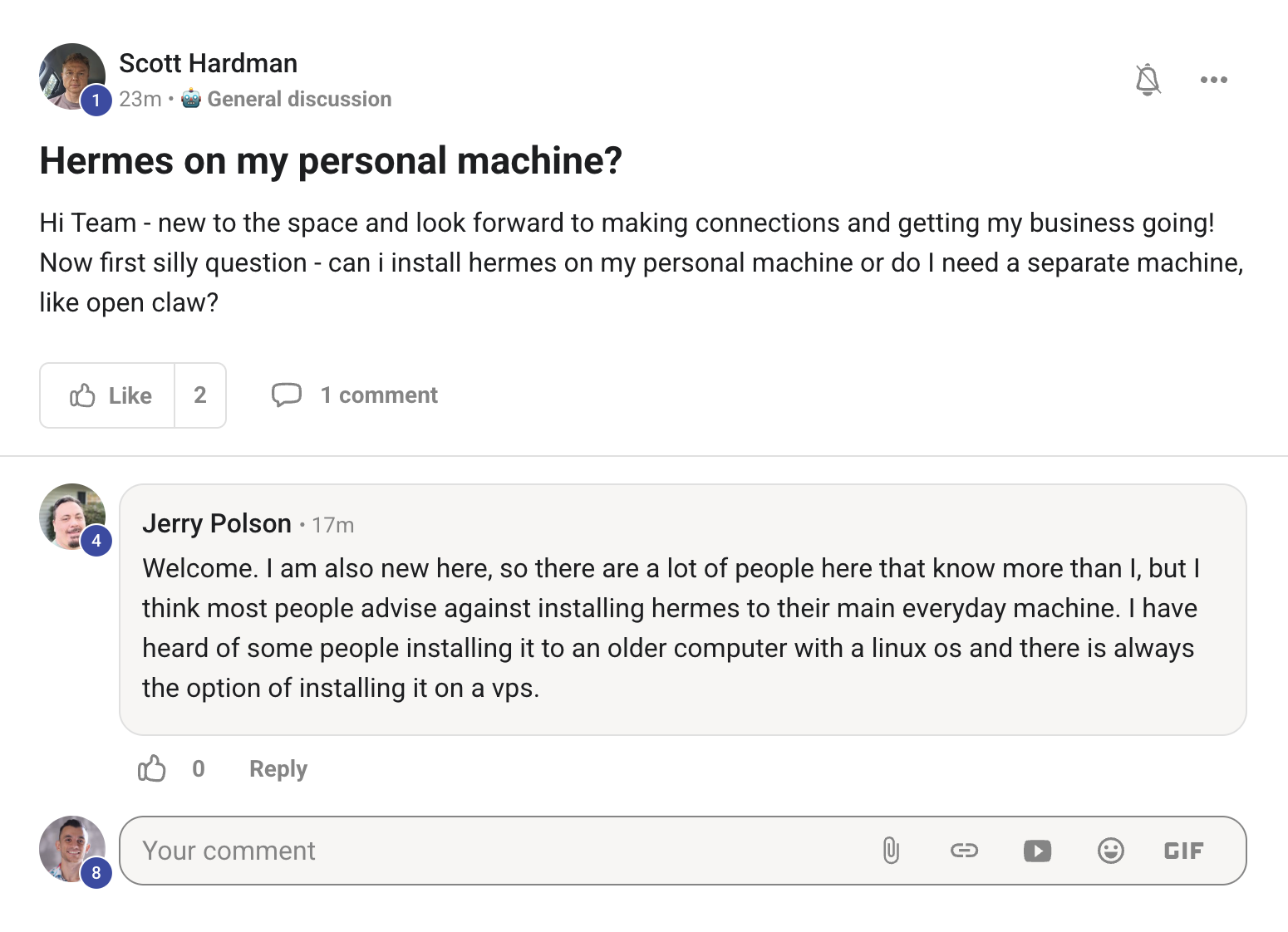
Welcome Scott. Short answer: yes, you can run Hermes on your personal machine. Most of us do.
The "use a separate machine" advice comes from people who got nervous early on about agents touching their main filesystem. Fair instinct — but the way Hermes is built, you scope it to a project folder, and that's all it sees. It's not running rampant across your hard drive.
Where OpenClaw does earn its keep: when you want hard isolation — sandboxed, throwaway, "I don't care what happens to this machine" experimentation. That's a separate flow. For daily-driver work, Hermes on your own laptop is fine.
"Don't quarantine the tool. Quarantine the folder."
Start small: one project, work inside it, expand as you trust it.
"SEO content pipeline + new Agentic OS?"
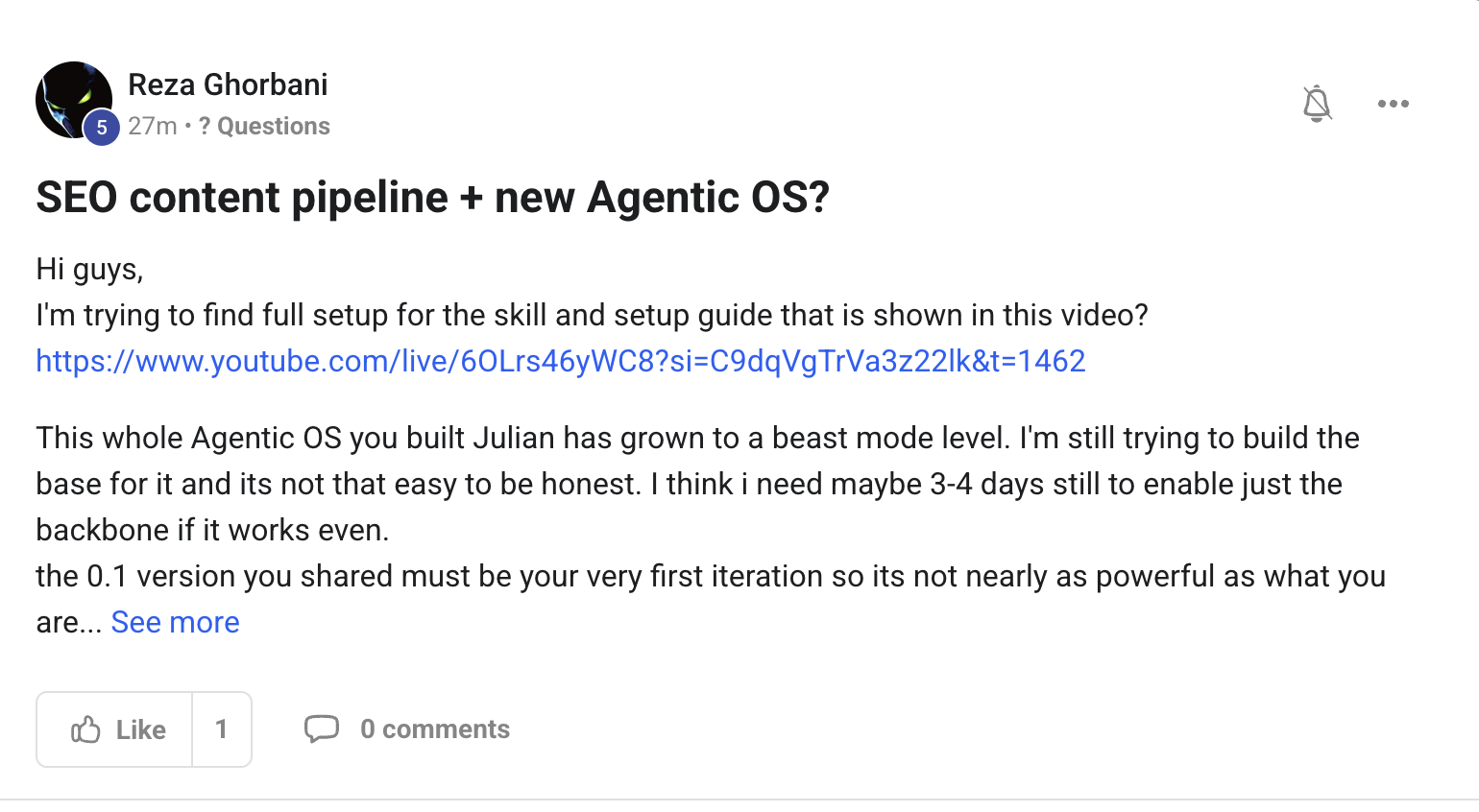
Reza — yes the Agentic OS has grown into something serious. You're right that the v0.1 you saw isn't nearly as powerful as where it is now.
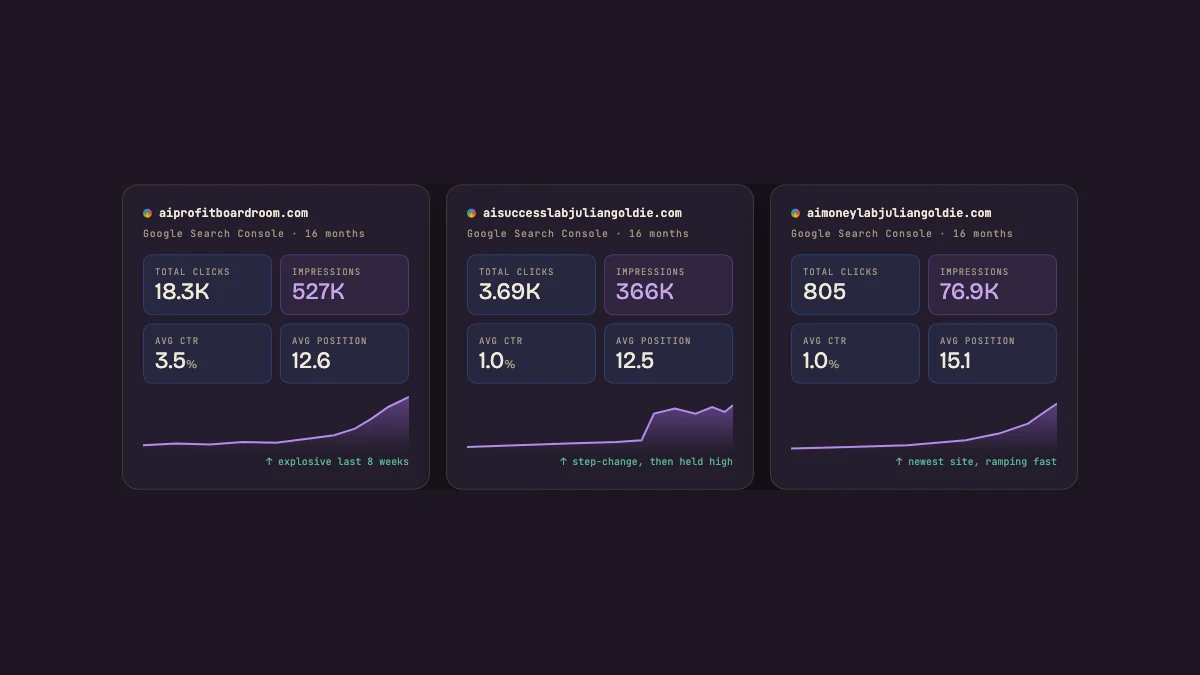
For the SEO content pipeline specifically, the full read-along is here: The Goldie Ranking Stack™ → (Brain → Execution → Memory, plus four case studies from 0→1,100 clicks/day).
For the backbone-only setup: 3–4 days is the right estimate. Don't try to enable everything at once — get the SEO module live first, prove it on one site, then layer the rest.
And for the love of it, don't rebuild this in n8n. The Agent OS SEO section is purpose-built for the pipeline. You just connect your site and it handles the rest. Building it in n8n is doing the same thing twice in the worse engine.
"Trello productivity board — not available anymore?"
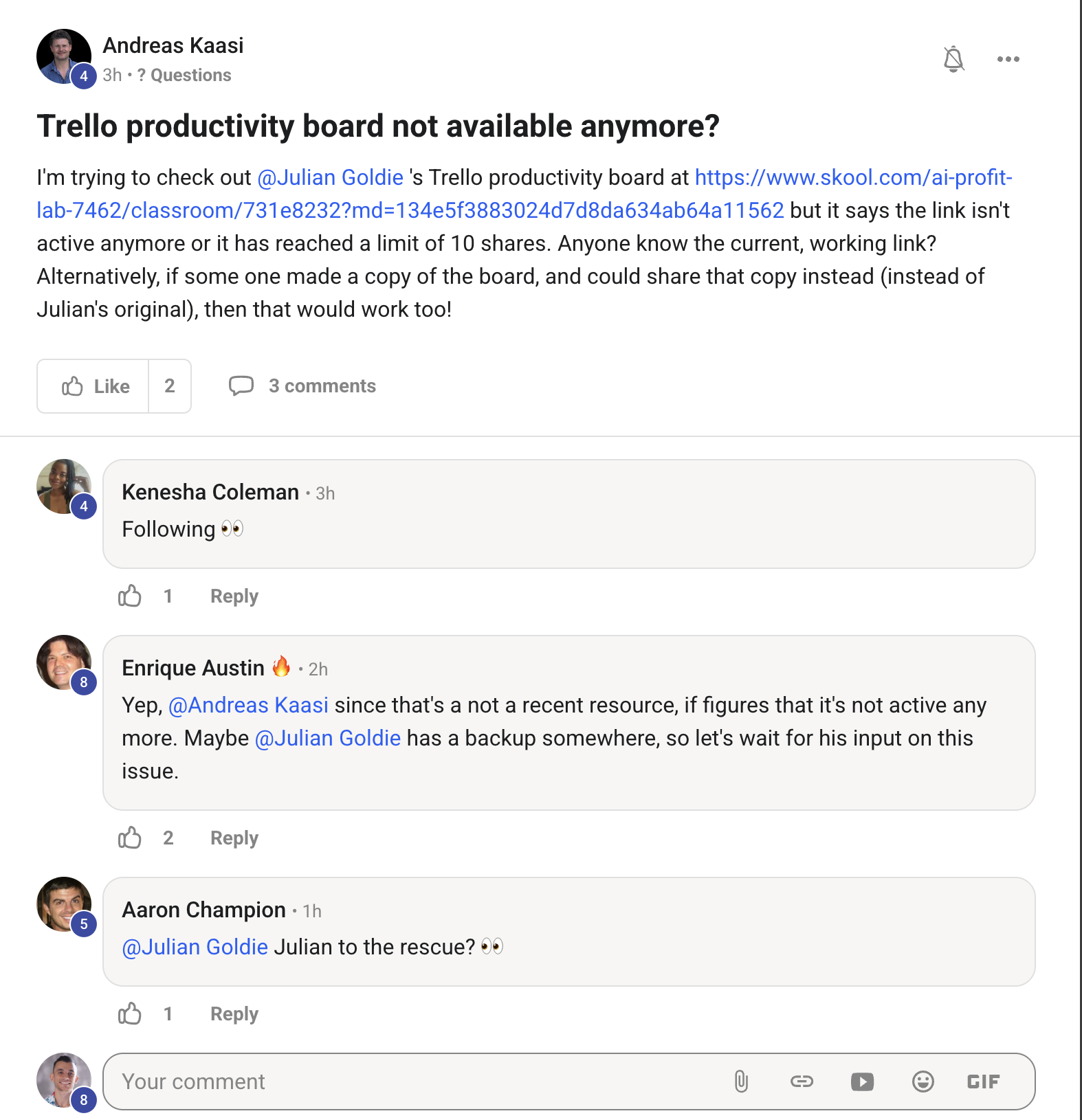
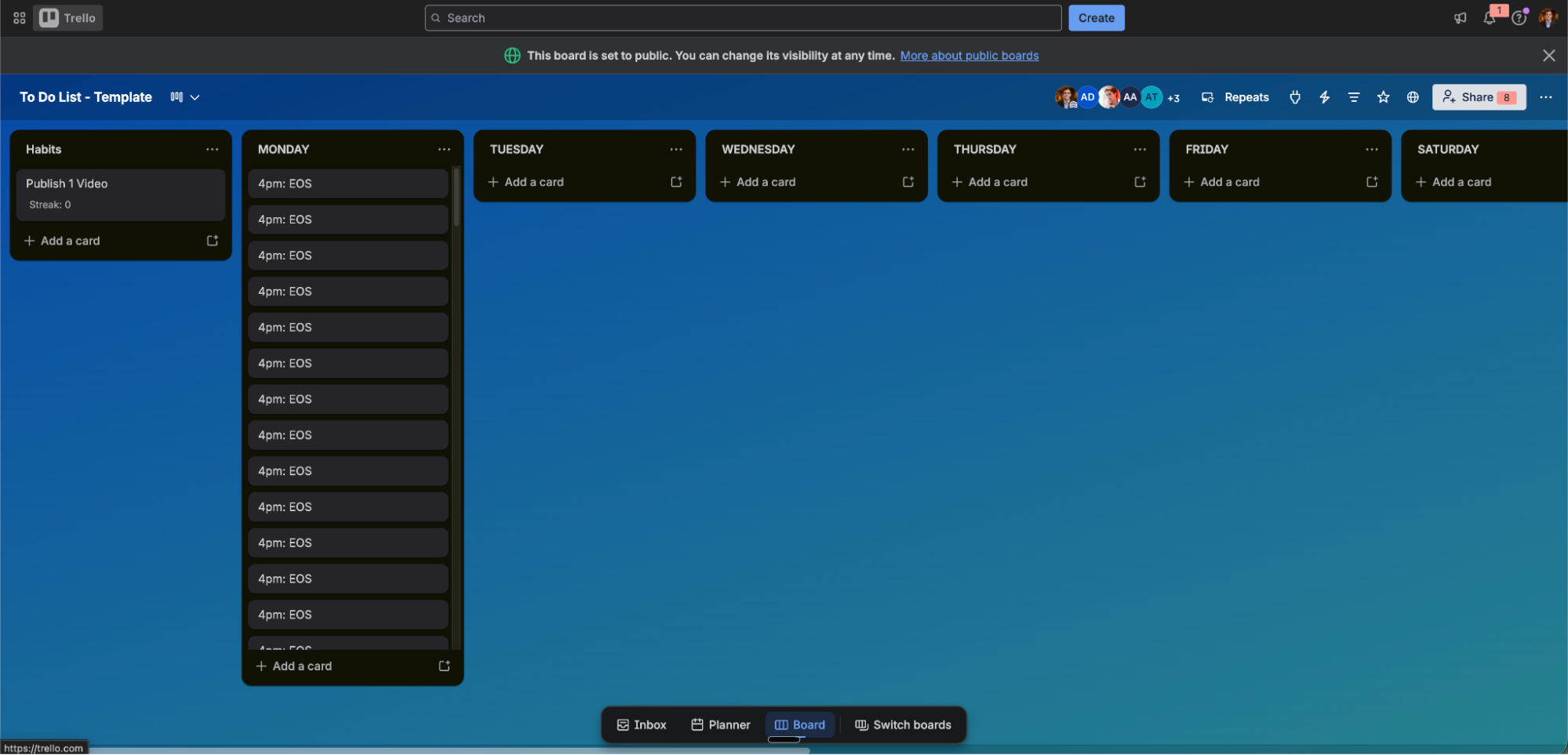
Andreas — apologies, you hit Trello's 10-share limit. I'll refresh the link in the classroom this week.
But honestly? The board's an artifact of an older workflow. Most of what was on that Trello is now baked into the Agent OS dashboard, where you don't get share limits and you can actually run the tasks instead of just looking at them.
Until the new link's up: use the productivity SOP module in the AIPB classroom. Same content, no Trello bottleneck.
Aaron, Kenesha, Enrique — thanks for jumping in on the thread. That's the room working.
"Need help moving Agentic OS to remote / cloud"
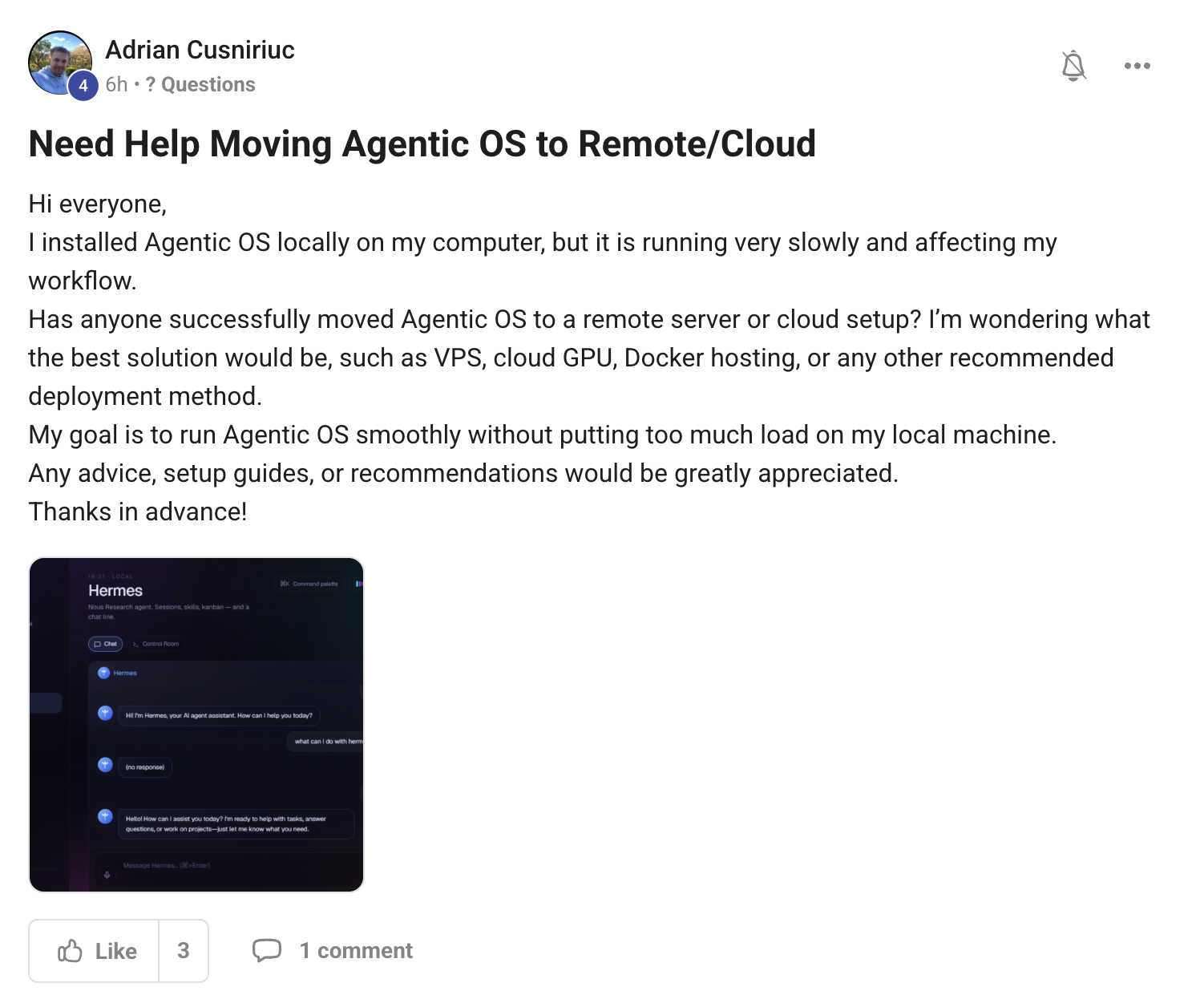
Adrian — running it locally was always the prototyping phase. Moving to a VPS is the right next step.
The stack I'd recommend:
- VPS: Hetzner CPX31 (~$11/month, fast, EU-based) or DigitalOcean droplet — either works.
- Container: Docker Compose. The Agent OS repo has the compose file ready.
- Remote access: Cloudflare Tunnel + Tailscale. Lets you hit Mission Control from your phone without exposing a port.
Skip cloud GPU — Hermes doesn't need it, you're routing to Claude/Grok/whoever anyway. You're paying for them, not for local inference.
The bigger win once you move: your agents keep running while your laptop's closed. That's the moment Agent OS clicks into "real" for most people.
"Backlink builder with Hermes?"
Mohammad — there are three ways we do this in AIPB. Pick whichever fits where you are:
- Outreach automation: Hermes drafts personalised pitch emails from a list of prospects. You approve, you send. The personalisation is the moat — generic outreach dies.
- Guest post pipeline: Hermes scrapes blogs in your niche, finds editor contacts, drafts angled pitches per blog. Much higher acceptance rate than mass outreach.
- HARO / SourceBottle responses: Hermes monitors live queries, drafts on-brand responses in your voice. Press mentions = high-authority backlinks.
"PBNs and spam links die. Earned links from real outreach compound forever."
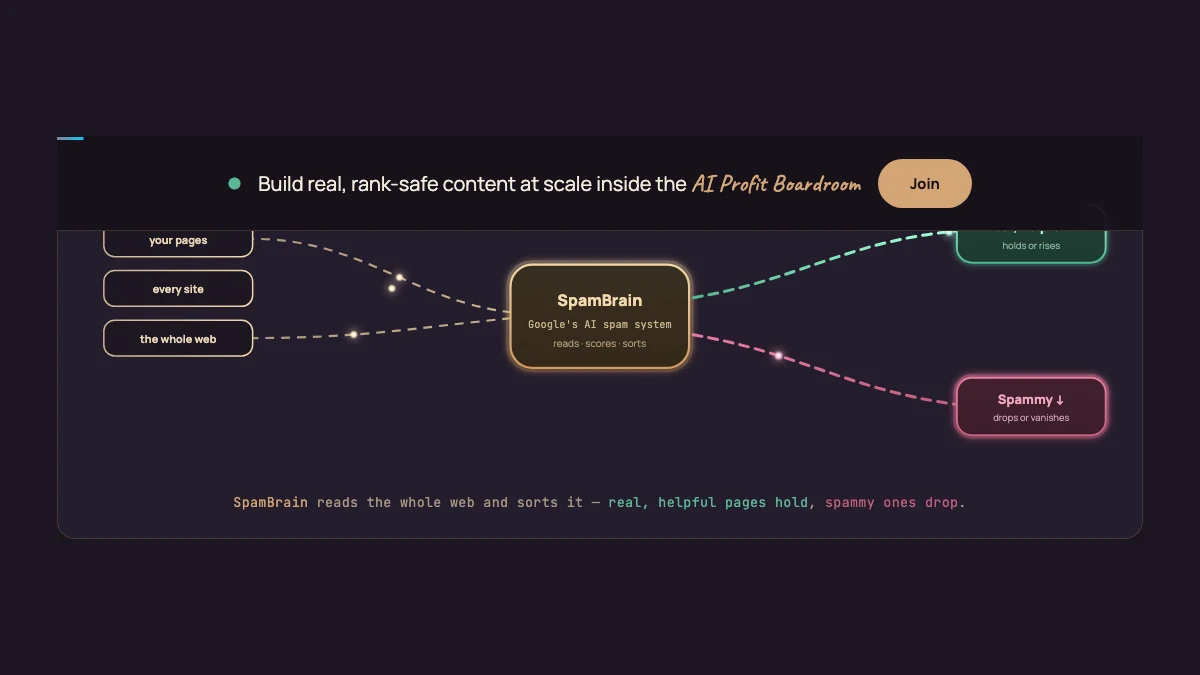
Whatever you do — don't use Hermes for spammy PBN-style stuff. Google's spam updates ate that whole category in 2024. You're building for 2027, not 2014.
Full case studies in The Goldie Ranking Stack →
"Bulk AI ecommerce product content generation"
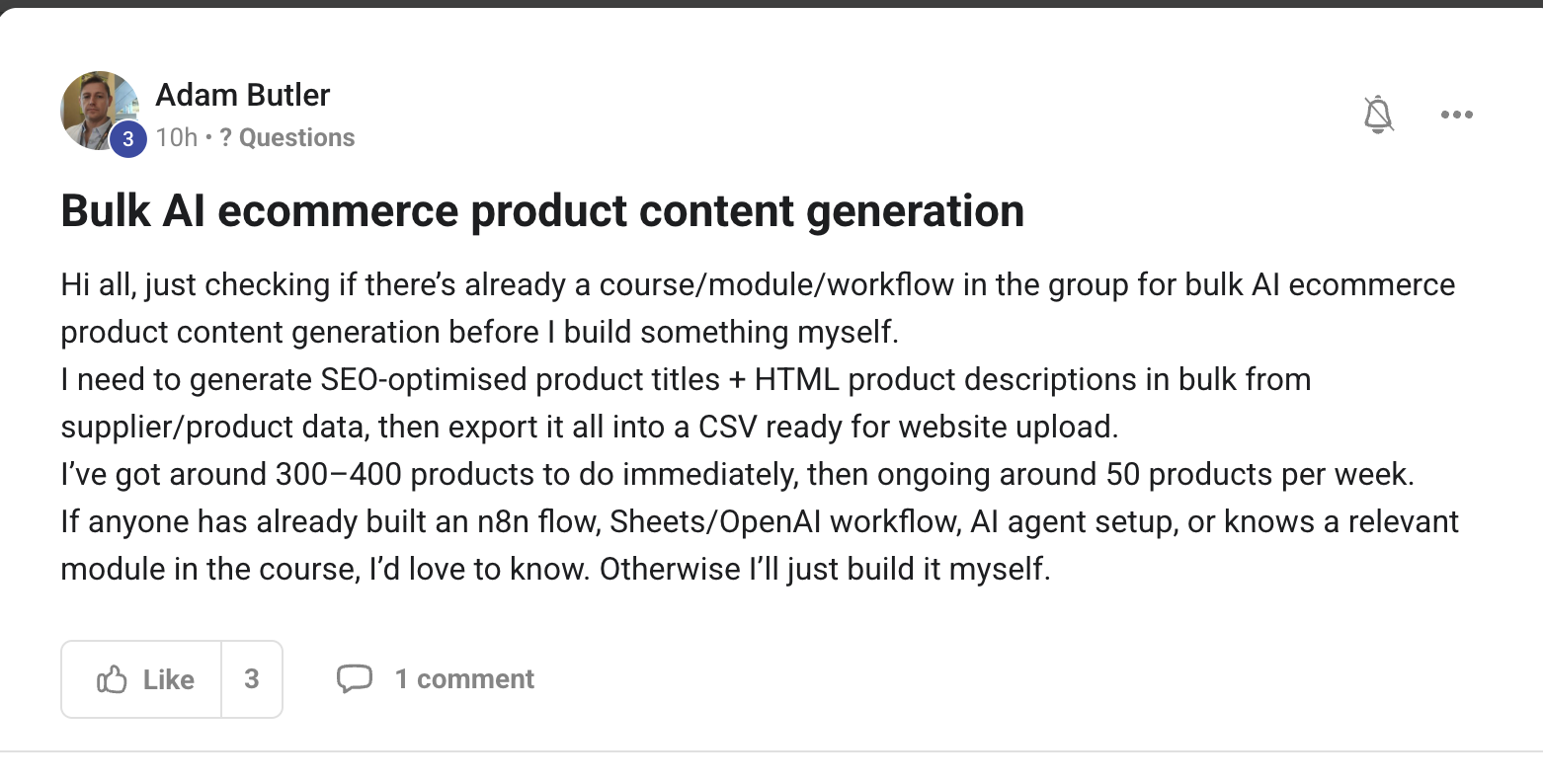
Adam — perfect Agent OS use case. Use the SEO section, not n8n.
The flow:
- CSV in (supplier titles + raw product data)
- Agent OS reads each row
- Generates SEO-optimised title + HTML description per product, in your brand voice
- CSV out, ready to upload to your store
300–400 products in one batch: easy. Run overnight, wake up to a finished CSV. 50/week ongoing: trivial.
The template you want is in the classroom — "Bulk Product Content Pipeline". I literally built it for this use case. Skip building it from scratch in n8n; you'll waste two weeks rediscovering the same problems we already solved.

The Agent Operating System
Every answer in this Q&A points back to the same place — the Agent OS classroom inside AIPB. The full stack, the templates, the SOPs, the rooms, the people. It's the operating system this community runs on.
Get Agent OS in AIPB →"Best model for Hermes — ChatGPT, Grok, Gemini, or Anthropic?"
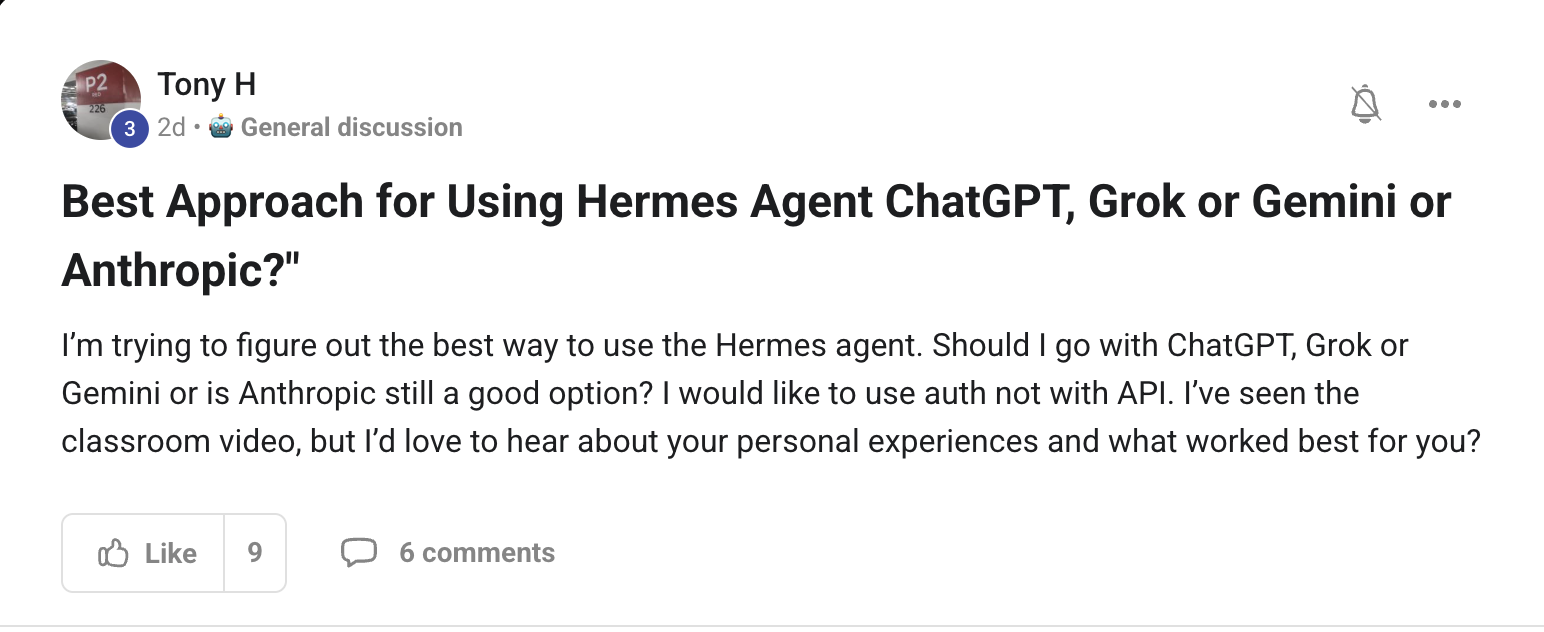
Tony — honest answer, this changes every 4–6 weeks. Where I'm at right now:
- Grok — my current favourite for agentic tasks. Best speed-to-quality ratio of anything I've tested this quarter.
- Claude — still the king of reasoning-heavy work. Long-form planning, code review, anything that needs depth.
- ChatGPT — creative writing, brand voice, where you want the model to play.
- Gemini — long context. Multi-million-token jobs where you're feeding it an entire codebase or 500 PDFs.
For free: go Owl Alpha on OpenRouter. Full setup walkthrough here → Free Claude Code + The Sovereign Stack →
Auth vs API: yes, you can use OAuth on Claude — that's what the free-claude-code project does. See the next question.
"Hermes + Claude subscription link?"
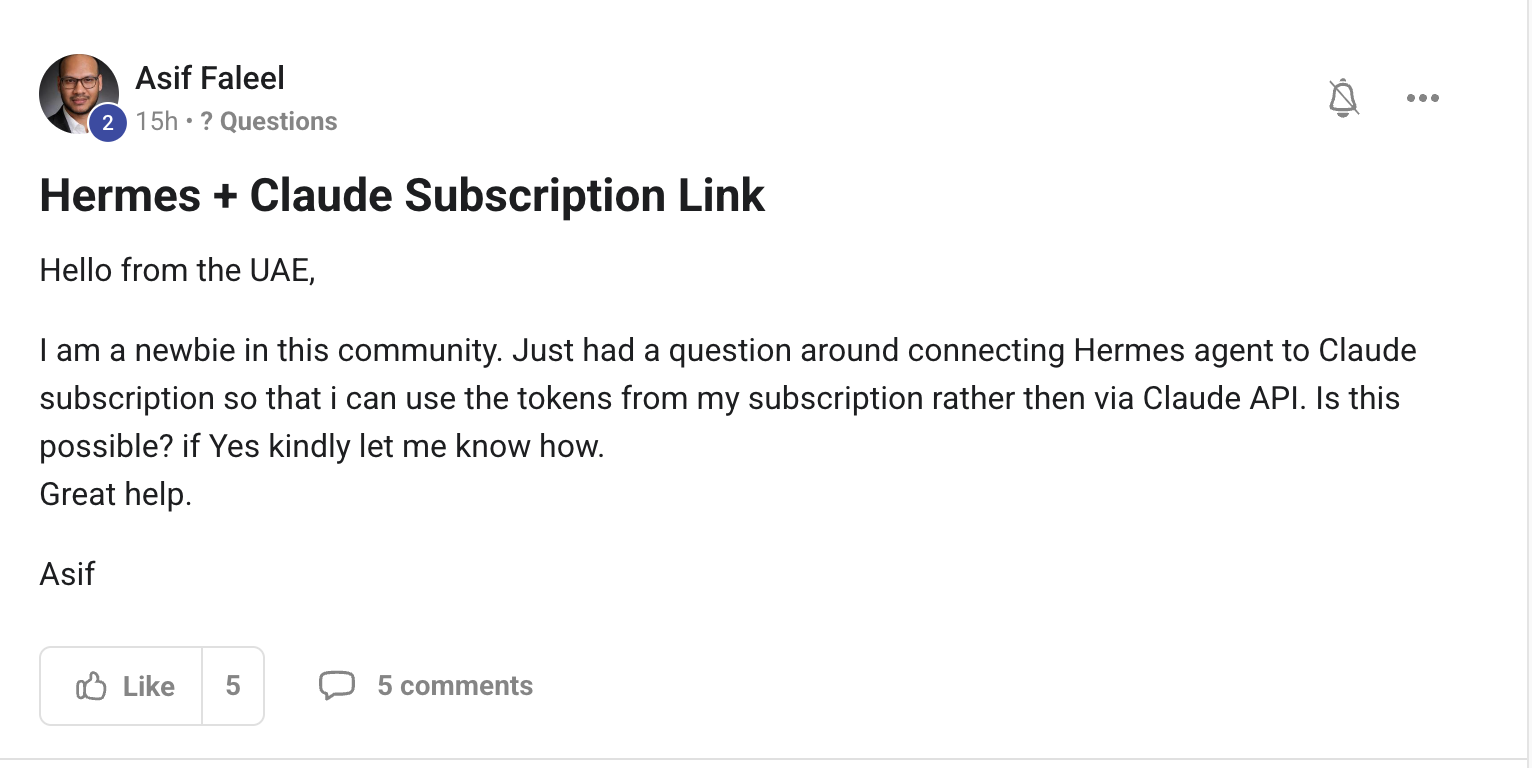
Welcome from the UAE, Asif. And yes — this is possible.
You connect Hermes to your Claude subscription via OAuth, so it uses your subscription tokens instead of hitting the API and stacking charges. The OSS project that does this is free-claude-code on GitHub.
Full setup, step by step (with the cost math that makes it worth the 30 min of fiddling): Free Claude Code + The Sovereign Stack →
"Stop renting access. Own the stack."
One thing to know: it's an OSS workaround, not officially supported by Anthropic. Works today. Could change. That's the deal with sovereign-stack moves — they're cheaper but they have a maintenance tax.
"The new Antigravity is insane… do we still need Hermes?"
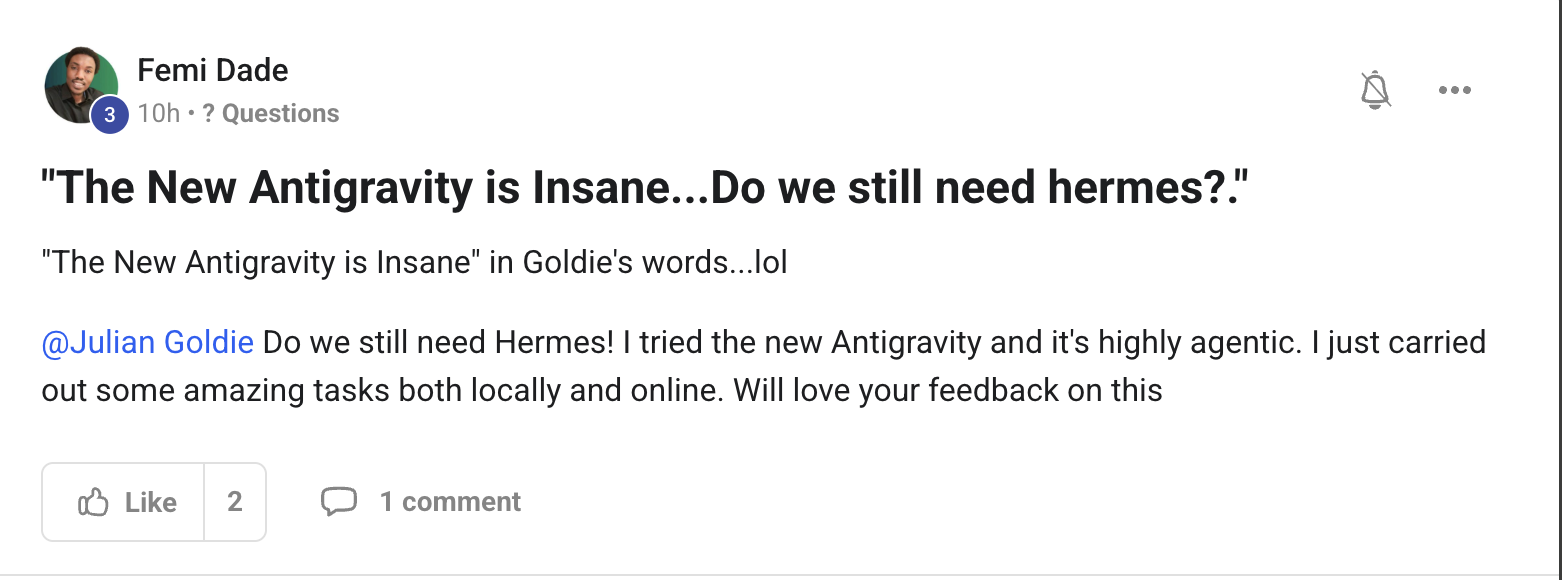
Femi — I love this question, and yes Antigravity is insane. Highly agentic, browser-native, fast. Anthropic shipped a great product.
But here's the framing I'd offer:
- Antigravity is rented. Closed-source, Anthropic-only, locked into their ecosystem. The day they change pricing or terms, your entire workflow shifts.
- Hermes is owned. You pick the model. You pick the host. You pick the deploy target. You can swap Claude for Grok in 30 seconds.
So: use both. Antigravity for one-off agentic experiments, Hermes for your daily business systems and anything you'd be furious to lose.
"Don't bet your entire stack on someone else's closed system. Ever."
This is the same lesson the Claude Mythos events surfaced — see Claude Mythos: The 6 Events That Changed AI Security Forever → for the full picture.
Clóvis Humes: "Obsidian vault on my Agentic OS interface."
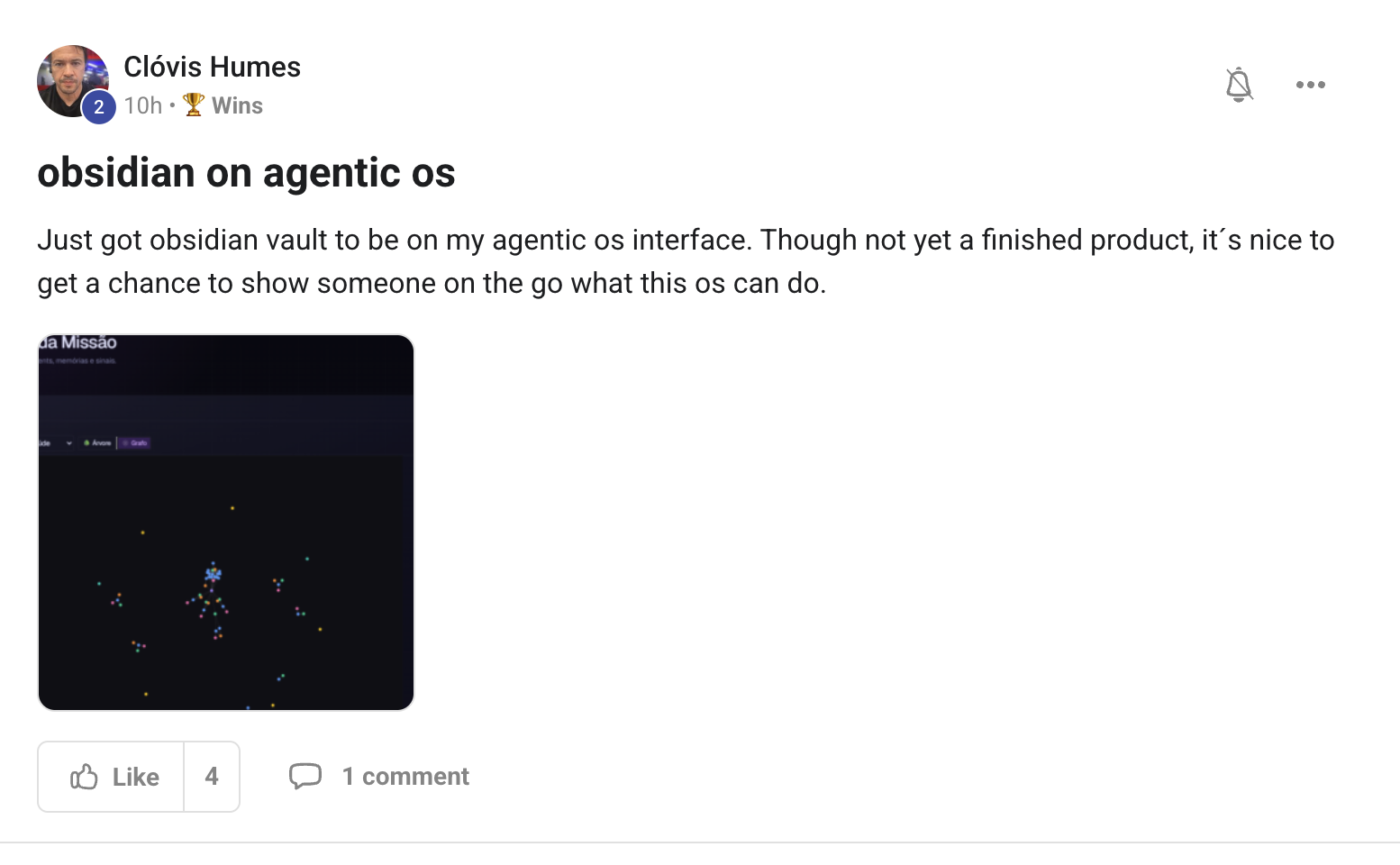
Clóvis got his Obsidian vault to display inside the Agent OS interface itself. Not a finished product yet — but the demo-ability of it is huge. Now when someone says "what does your AI know?", he opens his laptop and shows them the graph.
This is the move. Visible memory. Visible agents. Visible work.
"Obsidian as a memory layer for AI agents"
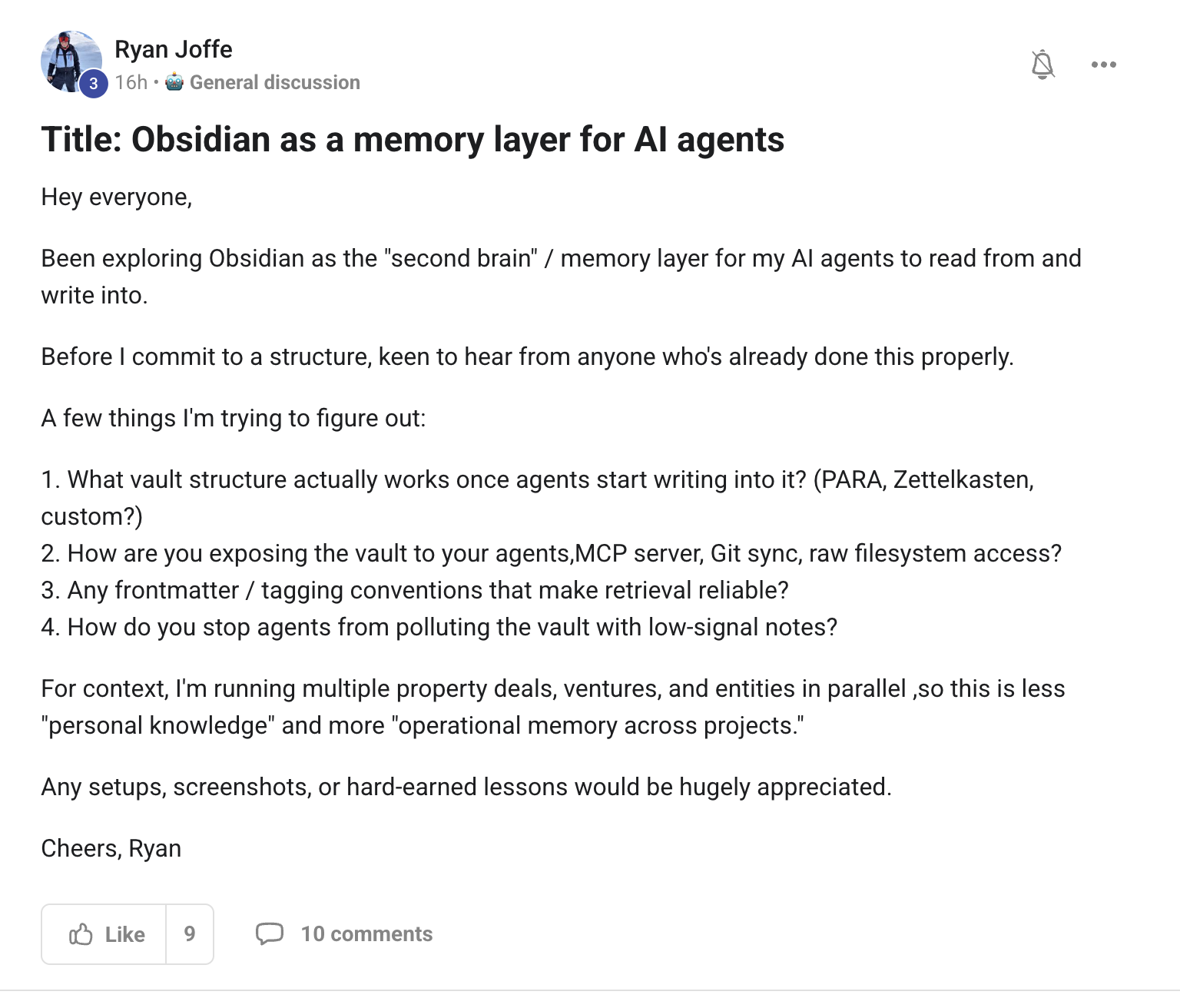
Ryan — these are exactly the questions everyone asks once they get serious. Let me hit them in order.
1. Vault structure when agents start writing into it? Skip PARA, skip Zettelkasten. They're built for humans browsing manually. For agent-readable, use a flat structure: one folder per project, plus a tags-based discovery layer. Agents reason about tags way better than nested folders.
2. How to expose the vault? Three layers — MCP server (we use obsidian-mcp) for direct read/write; Dataview for queryable views; Git sync if you need cross-device. Raw filesystem access works but you'll hate it within a month.
3. Frontmatter / tagging conventions? Required fields on every agent-written note: tags, created, updated, agent_origin (which agent wrote it), confidence (1–5). That last one's the secret — it makes review trivial.
4. Stopping vault pollution? Write a "review" agent that runs nightly. It reads new notes, flags low-signal ones (confidence ≤ 2, no backlinks, no tags), and moves them to /archive/. Set it, forget it, vault stays clean.
Full canonical pattern: the Infinite Context Engine in the AIPB classroom, and the deeper walkthrough in The Goldie Infinite Knowledge Engine →
"Speed to lead — AI outbound call within 60 seconds?"
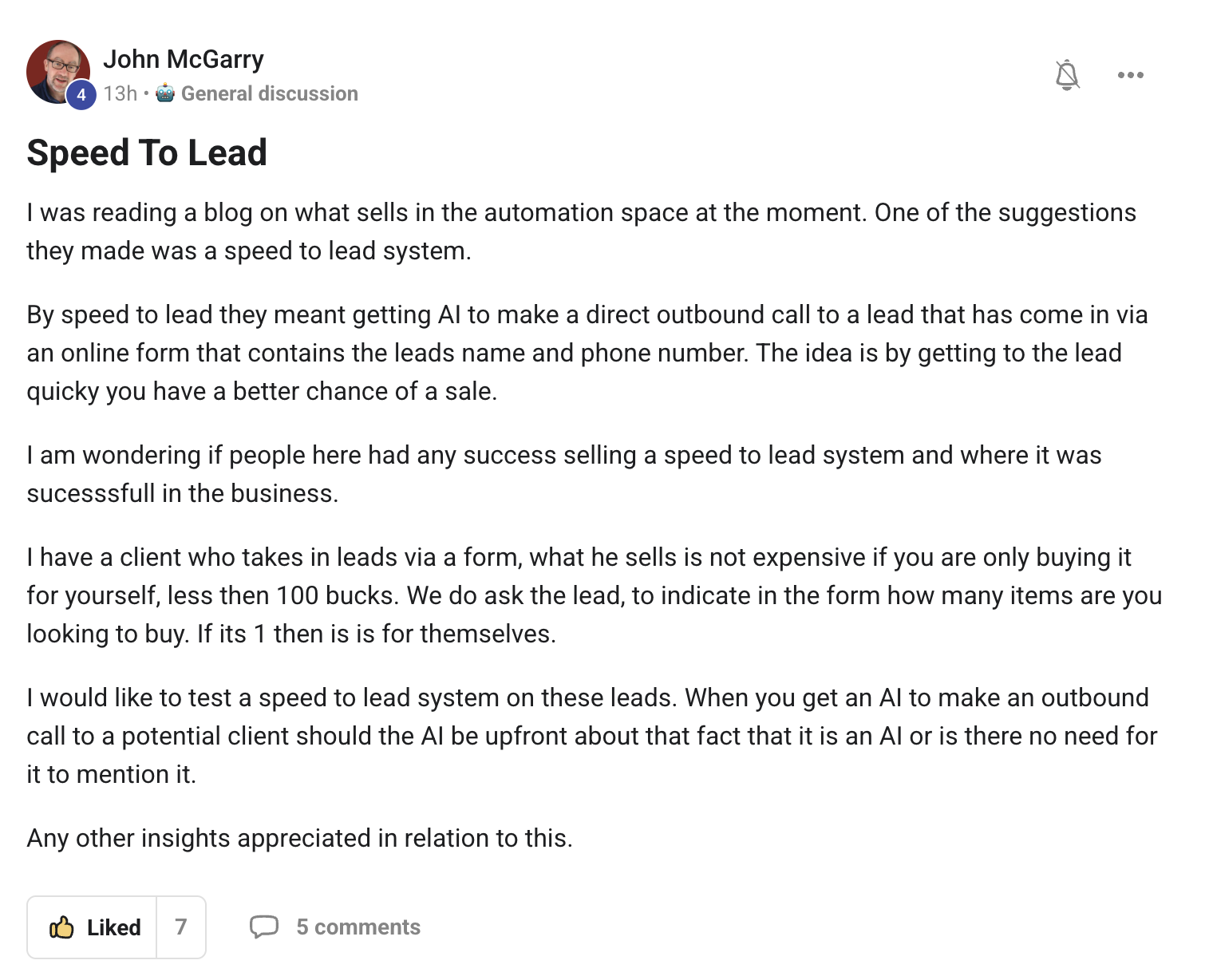
John — yes this works, and it's one of the higher-leverage plays in the room right now.
The stack:
- Voice: Bland.ai or VAPI — both production-grade.
- Trigger: form submission → webhook → call within 30–60 seconds.
- Conversion lift: roughly 30–50% over the "human callback in 24 hours" baseline. Speed is the variable.
On your "should I disclose it's AI" question — yes, always. Two reasons: legal (most jurisdictions require it; TCPA in the US, GDPR in EU), and trust (you don't want to be the brand caught pretending). The lead doesn't care if it's AI — they care that someone showed up fast.
"The lead doesn't care if it's AI. They care that someone showed up fast."
Watch out for TCPA and time-of-day rules — don't outbound at 9pm just because the form fired.
"Agent OS on Unraid / Docker / as a mobile app?"
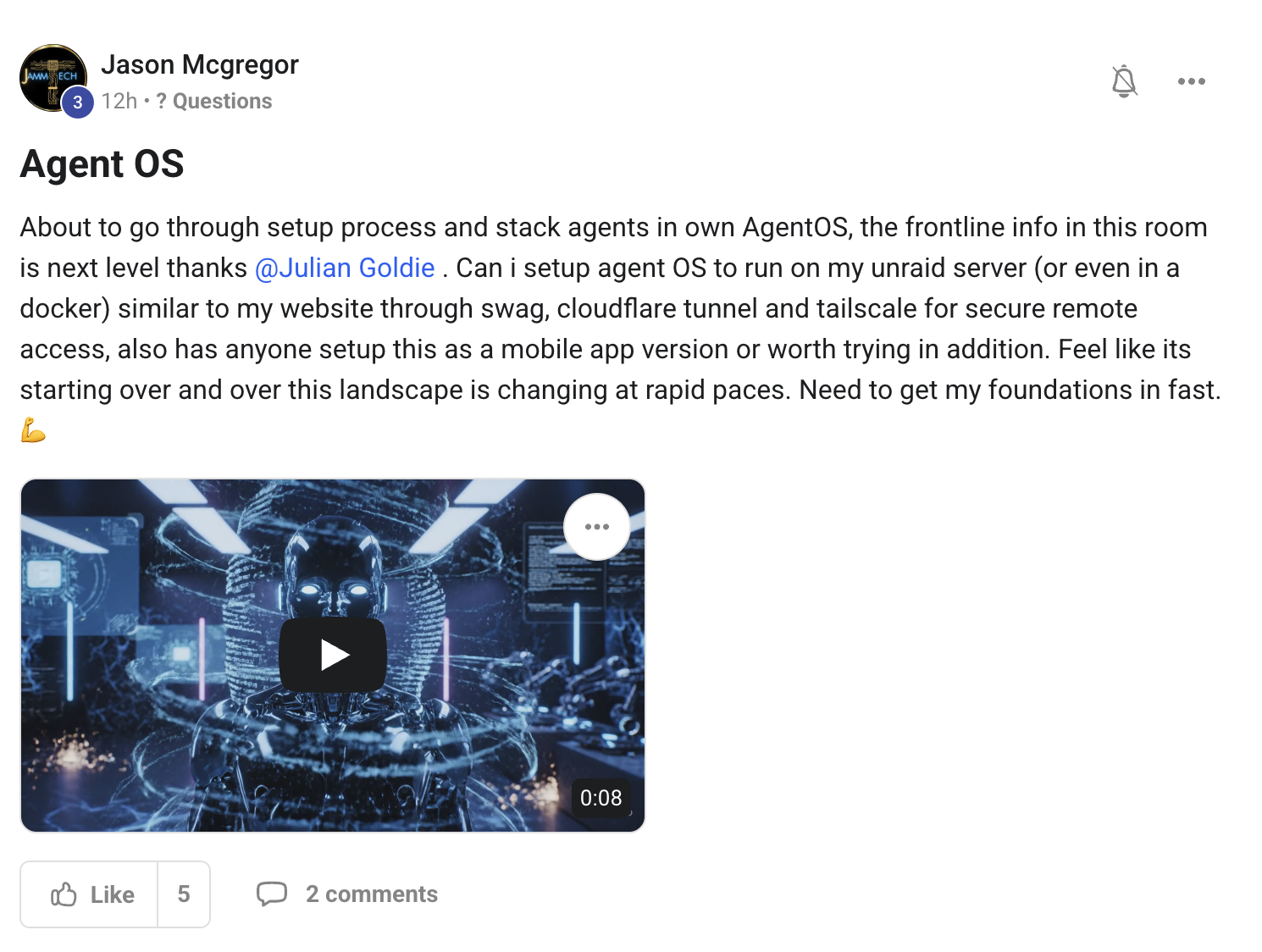
Jason — yes, yes, and kind-of.
- Unraid: totally works. Treat it like any Docker host.
docker compose upand you're running. - Cloudflare Tunnel + Tailscale: use the exact same setup you've got for your website. That's the right pattern. SWAG works too.
- Native mobile app: we don't ship one. But Mission Control is responsive — works fine on phone Safari/Chrome. PWA install on iOS gives you the icon-on-home-screen experience without us shipping an App Store binary.
One real-talk note: a lot of us run Agent OS on a $11/month Hetzner VPS instead of local Unraid. Cleaner separation, no "my home internet went down so my agents are dead." Up to you.
"Memory & context in larger AI agent systems?"
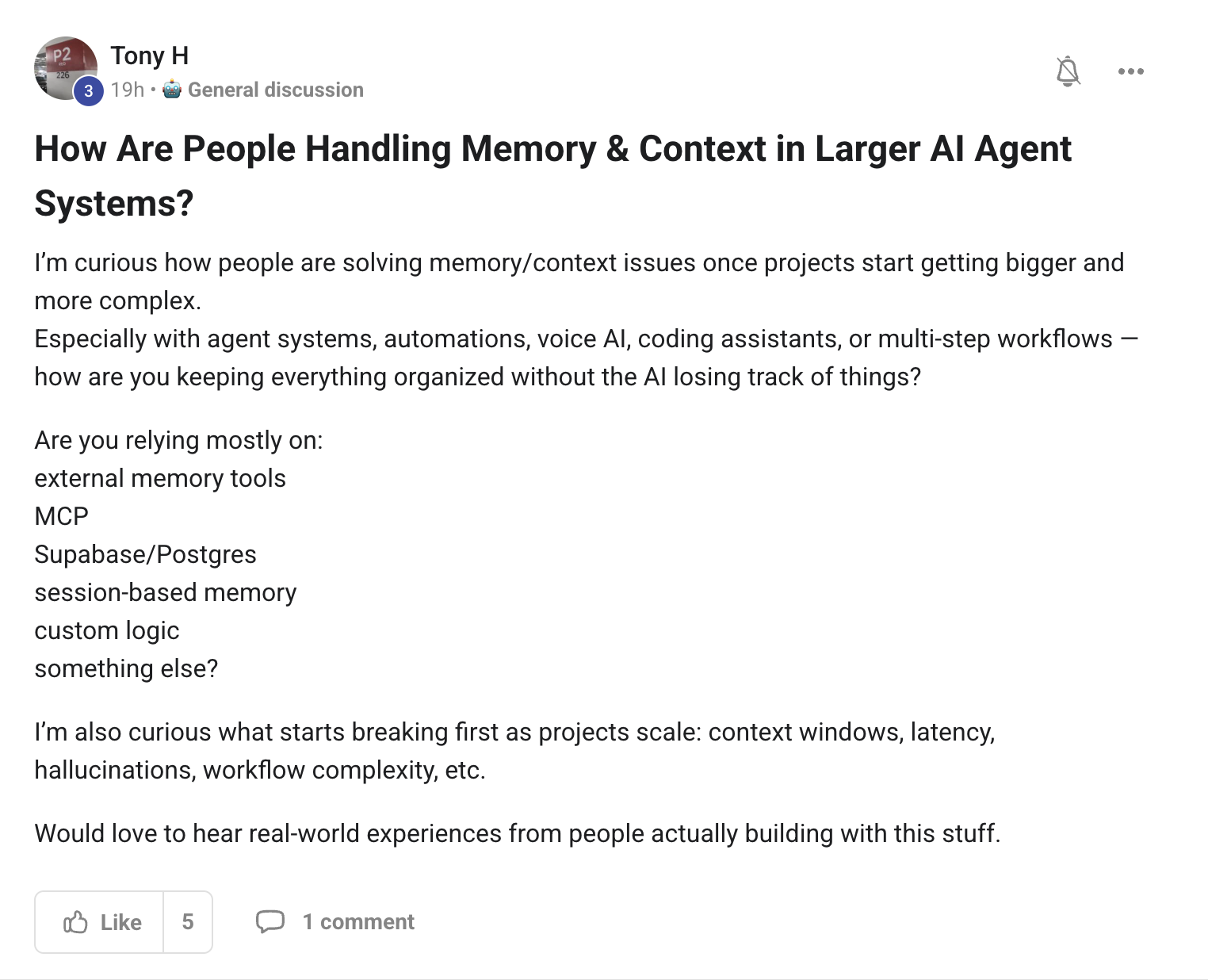
Tony, second question from you in this drop — great one. Three-layer model is how we handle it in AIPB:
- Layer 1 — Short-term: per-session context (Claude/Hermes default). Lives for the conversation, dies after.
- Layer 2 — Mid-term: vector DB. Supabase pgvector if you're self-hosting, Pinecone if you want hosted. This is your "remembers across sessions" layer.
- Layer 3 — Long-term: Obsidian vault. Markdown, queryable, versionable, human-readable. Your audit trail.
What breaks first at scale: cost, not quality. Context windows are huge now — but feeding 200K tokens to Claude on every turn at scale gets expensive fast.
The fix: aggressive summarization. Every 10–15 turns, your agent summarizes the conversation, writes it to Layer 3, and resets Layer 1. You keep the signal, you ditch the bulk.
Full setup is the Infinite Context Engine in the classroom — the canonical AIPB pattern.
"Agentic OS — sync the conversation between Claude App and Mission Control?"
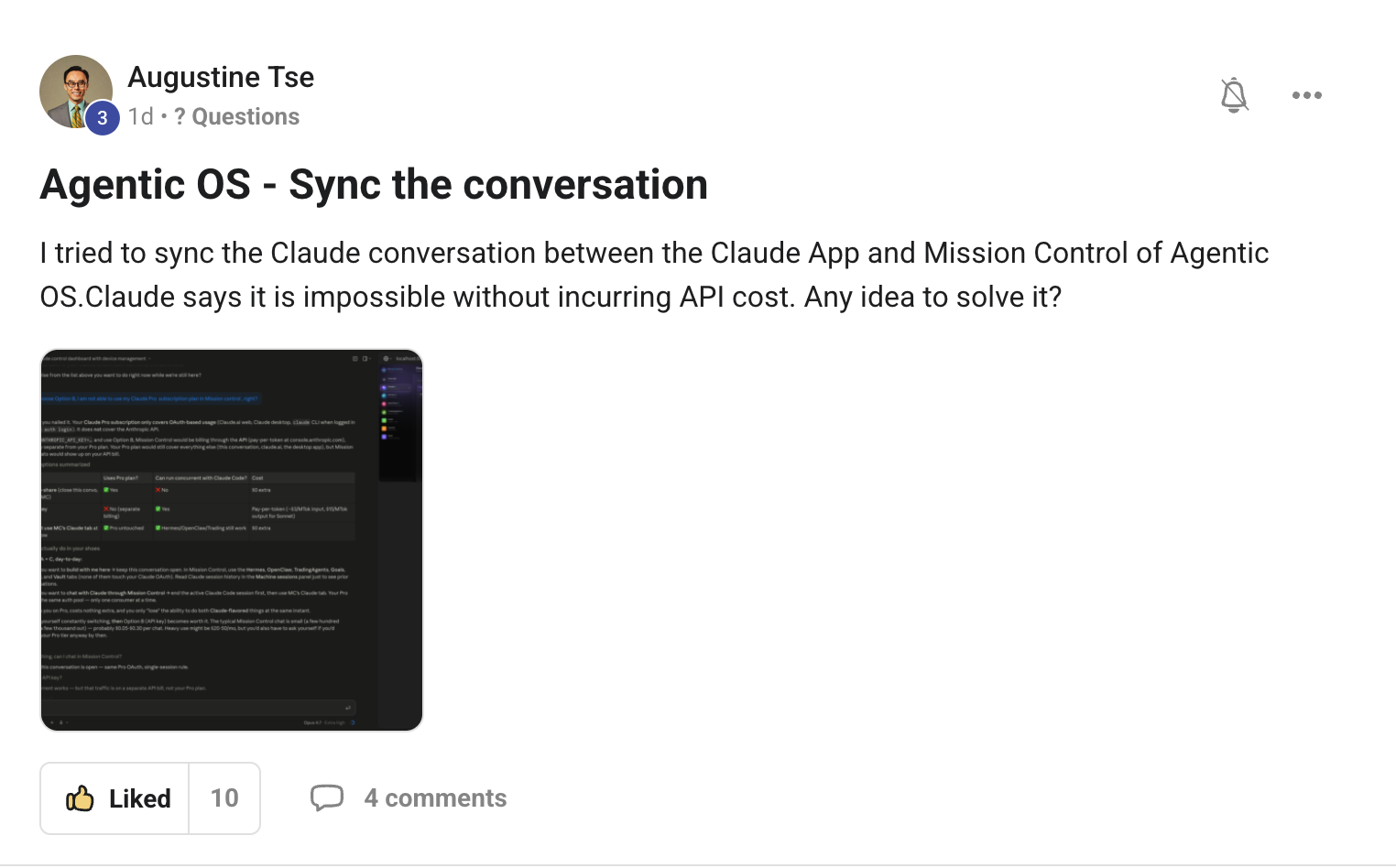
Augustine — Claude's right. Anthropic doesn't expose a sync API for sessions between their consumer app and external tools without going through the paid API. Not a workaround issue — a deliberate product boundary.
But the workaround we use is better than literal sync anyway:
- Mission Control writes conversation summaries to your Obsidian vault after each session.
- Any Claude session (app, web, Hermes-driven, doesn't matter) can read from Obsidian via MCP.
- Result: persistent, queryable memory across every AI tool you use, not just within one app.
"You don't want to sync sessions. You want to sync memory."
Setup walkthrough is in the NotebookLM + Obsidian classroom video.
"Transferring ChatGPT & Perplexity knowledge to Obsidian?"
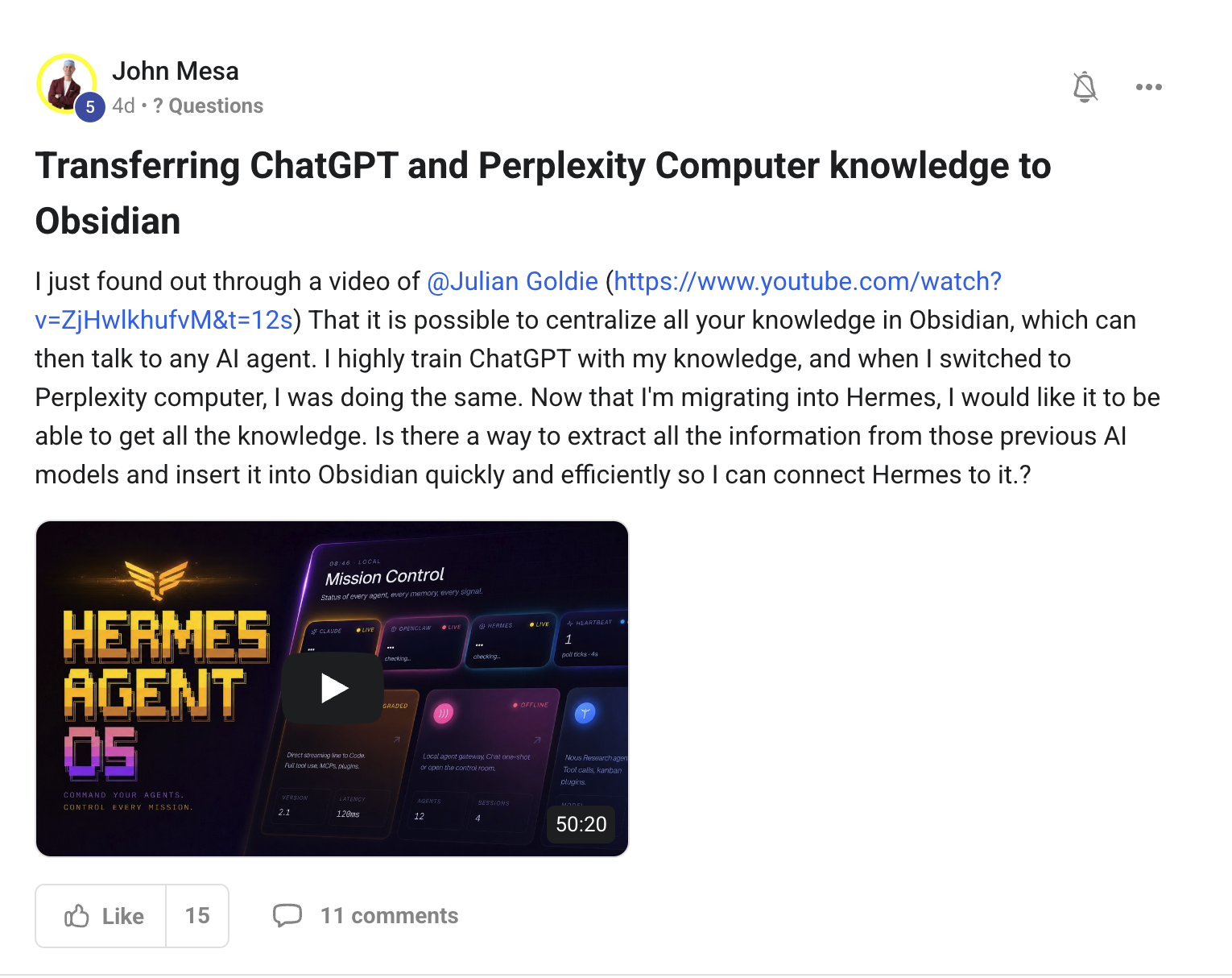
John — great instinct. Migrating your old AI history into Obsidian means Hermes can read it all on day one instead of you starting from scratch.
ChatGPT: Settings → Data Controls → Export Data. You get a JSON of every conversation. Run it through the "ChatGPT → Obsidian" script in the AIPB classroom — it splits each conversation into its own markdown file with proper frontmatter.
Perplexity: trickier. No native export. Two options: (a) use their API to pull your threads programmatically, (b) browser-scrape with a Playwright session. Both are in the classroom video.
Once both are in Obsidian — Hermes reads the vault via MCP. The whole point of doing this is that your AI tools get to stand on the shoulders of every conversation you've ever had with another AI tool. That compounding is the moat.
About 30 mins for the full migration if your ChatGPT history isn't enormous. Worth every minute.
Bring your question. Get it answered.
Every Q&A drop is built from questions members posted that week. If you've got one — Hermes setup, Agent OS structure, Obsidian, SEO pipelines, anything — drop it inside AIPB and it'll be in the next session.
Join the AI Profit Boardroom →