JoinThe Goldie framework · K3 vs Fable 5 vs GPT-5.6 · live scores
The Frontier Shootout.
Three frontier models, identical one-shot build tasks, one tough judge — my GoldieBench leaderboard, not launch-thread vibes. GPT-5.6 Sol, Claude Fable 5, and this week's newcomer Kimi K3, with the same-task builds embedded so you can drive all three yourself.
the whole method in one line — same bullets, one referee, published evidence
50
identical tasks per model
1
judge, same rubric for all
8.16
the solo score to beat (GPT-5.6 Sol)
3.3×
price gap between the contenders
✦
I · the problem
The Launch-Thread Verdict Problem.
A new model drops and the verdicts arrive in minutes.
"Better than GPT." "Fable killer." "Benchmarks are rigged anyway."
None of those people ran the same task on all three models.
So you finish the thread knowing everyone's opinion and nobody's evidence.
Meanwhile the only comparison that matters for YOUR work — same job, same judge, same bar — never happens.
The Frontier Shootout breaks that cycle for good.
Thinking it?"Aren't all benchmarks gameable?"
Vendor-run ones, often. This one is mine: one-shot builds, real rendered screenshots, an independent judge model scoring the whole field on one rubric — and every build is published so you can check the judge.
When the evidence is playable, the argument gets short.
✦
II · how it works, in simple words
Same task. Same judge. Playable receipts.
GoldieBench is my model leaderboard. Every model gets the identical job list — one-shot, single-file builds: games, shaders, sims, tools. No retries, no hand-fixing.
Each build gets rendered for real, screenshotted, and scored 0–10 by the same judge model against the same rubric. Blank screens score 1. Task winners get medals.
This week Kimi K3 joined the board — same 50 tasks GPT-5.6 Sol and Claude Fable 5 already ran, and its full run is now complete: every launch-week rate-limit failure was re-run until all 50 tasks had a real judged build. What's left in its average are genuine results, including genuine wrecks.
·
GPT-5.6 Sol
Claude Fable 5
Kimi K3
Bench average
8.16 / 10 (50 tasks)
8.10 / 10 (47 tasks)
7.89 / 10 (50 tasks — every one scored)
Task medals 🥇🥈🥉
9 · 9 · 7
4 · 2 · 2
11 · 8 · 8 — most golds on the podium
Context window
1.05M tokens
200K (1M extended)
1M tokens
Price per M (in/out)
$5 / $30
$10 / $50
$3 in · or $0 on the Kimi coding plan
Personality on the bench
consistent all-rounder
shader/GPU-physics specialist
highest peaks, lowest floor — three 9.0s AND two broken builds
Live numbers from goldiebench.com — K3's full 50-task run is complete; click through for the current board.
three frontier averages, to scale — 0.06 separates first and second
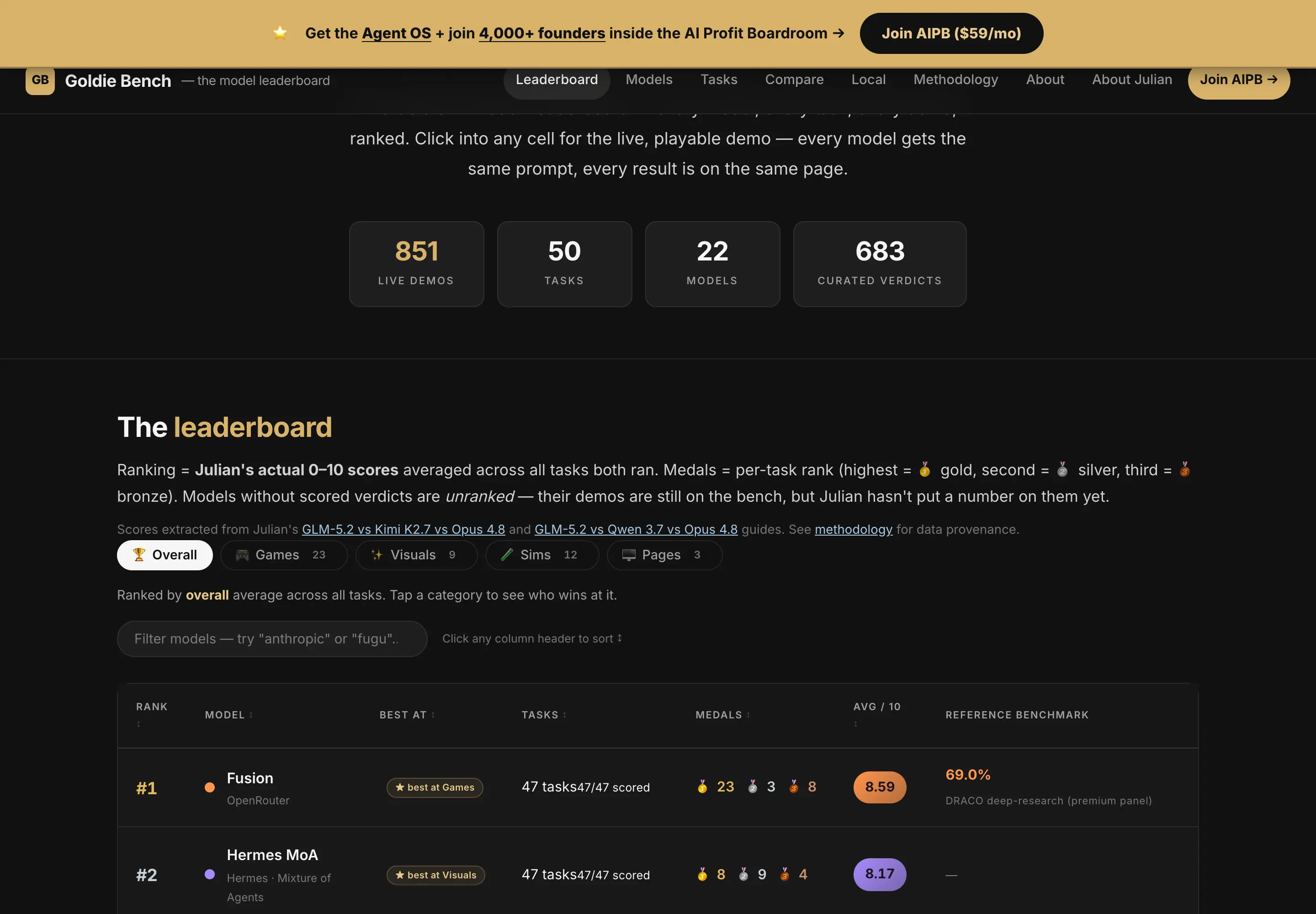
What you're looking at: the actual board — 851 live demos, 50 tasks, 22 models. Every number in this guide clicks through to a playable build there. The two rows above 8.16 are multi-model ensembles (Fusion, Hermes MoA) — this shootout is the solo-model podium.
Thinking it?"Why is K3's average lower if it has more golds than Fable 5?"
Because averages punish failures and medals reward peaks. With all 50 tasks now scored, K3 holds ELEVEN golds — more than either rival — alongside two genuinely broken builds (Galaxy, Dogfight) that drag its average to third.
Highest peaks + lowest floor = read both numbers, not one.
outright task wins — the THIRD-place model by average holds the MOST golds
✦
III · exactly how it works — 18 tests, three builds each
Same brief, three machines, eighteen times over.
Below: 18 of the 50 bench tasks, most impressive first — real games leading, then physics sims, shaders, and a working web desktop. Every cell is that model's ACTUAL one-shot build: the still is its real render, and one click loads the live, playable file. Scores and medals are the judge's, from the live board.
Nothing is hidden — including the wrecks. Where a score sinks to 3.x, that model shipped a genuinely broken build on that task. That's data too.
GAME
Voxelcraft
Minecraft-style sandbox — place and break blocks in a live world
Every score above clicks through to a playable artifact — 54 builds on this page alone. This is what "comparison" should mean: not a table of adjectives.
Thinking it?"Why does K3 score 9.0 on one row and 3.0 a few rows later?"
Because both are real. K3's full run mixes outright task WINS (black hole, fluid, synthwave — three 9.0s, eleven golds total) with genuine faceplants (Galaxy, Dogfight — real builds that shipped broken). Highest peaks, lowest floor — exactly why you read medals AND averages, never one number.
Boards that hide the wrecks aren't benchmarks; they're brochures.
"🚨 BREAKING: Kimi K3 benchmarks have released and it's ~Fable/Sol level"
— leo (@synthwavedd), on X, 16 July 2026 — the claim this guide puts to the test
The claim · now testable
"~Fable/Sol level" — is it?
This launch-day post set the frame: K3 belongs in the Fable/Sol tier. On my board the claim holds up with an asterisk — K3 took MORE task golds than Sol or Fable 5 (eleven), but two broken builds pin its average to third at 7.89. Peak-tier: yes. Reliability-tier: not yet.
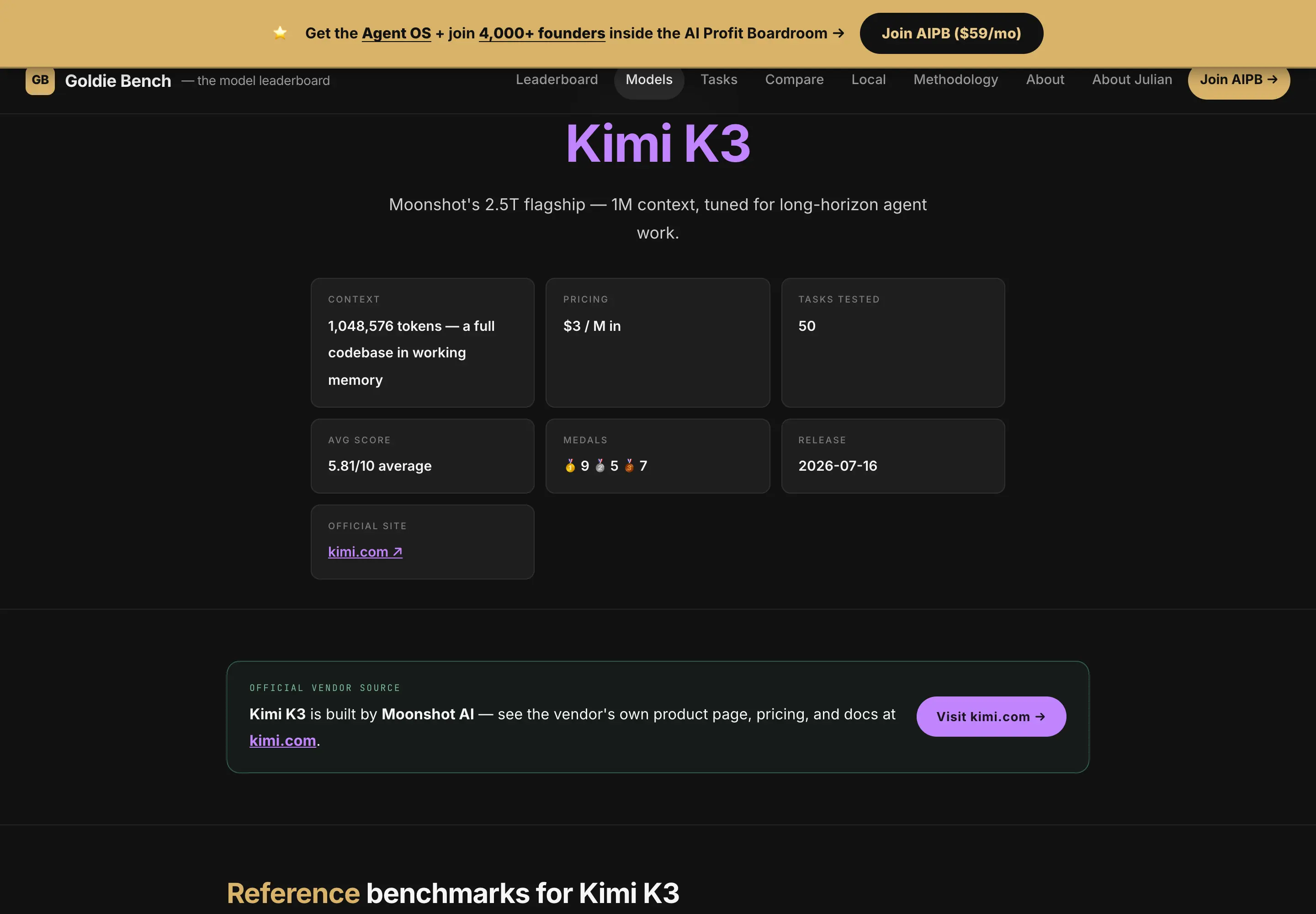
What you're looking at: K3's live scorecard on the board — the 1M context, the $3/M pricing, 50 tasks tested and the day-one medal haul, one day after release.
When the evidence is playable, the argument gets short.
V · the framework
The five rounds of the Frontier Shootout.
same scale, real list prices — a 3.3× spread between the top two contenders and the rookie
i.
Same Bullets
Identical prompts for every contender — one-shot, no retries, no favours. Different tests can't be compared; identical ones can't be argued with.
ii.
One Referee
A single judge model scores the whole field on one rubric, looking at real rendered screenshots. Consistency beats sophistication.
iii.
Published Evidence
Every build ships to the site, playable. A score you can't check is a rumour with decimals.
iv.
Peaks AND Floors
Read medals for capability, averages for reliability. K3's nine golds and its climbing average are both true — lanes come from both.
v.
Price In The Frame
8.16 at $5/$30, 8.10 at $10/$50, high-peaks at $3-or-$0. The score without the invoice is half a comparison.
the whole framework in one line — every round removes a way to fool yourself
✦
VI · old way vs new way
Picking a model, two ways.
Old way
hours of threads, zero evidence
Read forty launch-thread verdicts from people who ran nothing
Compare vendor benchmarks that test different things
Switch your whole stack to whatever won the news cycle
Discover its weaknesses on YOUR work, in production
Repeat next launch, from zero
Never once see the same task run on all contenders
New way
one board, playable proof, per-job routing
Identical tasks, one judge, whole field — automatically per launch
Open the same-task builds side by side and drive them
Read peaks (medals) and floors (averages) separately
Divide by price: Sol for balance, Fable for shaders, K3 for long context at $0-on-plan
Route jobs by lane; keep every model that wins one
Next launch: same harness, evidence by dinner
Thinking it?"Just tell me which one to use."
By the current board: GPT-5.6 Sol if you want one all-rounder; Fable 5 if your work leans visual/shader-heavy and budget allows; K3 if million-token context or plan-included pricing is the constraint — with its ranking still settling.
But the honest answer is the framework: route by lane, not by loyalty.
Thinking it?"Doesn't running the Agent OS burn a fortune in tokens?"
No — that's the biggest myth about it. The everyday 90% runs on free local models on your own machine, and free APIs slot in for more — one of this guide's three contenders is included in a coding plan many members already pay for.
For the frontier work, the Agent OS drives the plans and CLIs you already own — Claude's CLI with your Claude subscription, K3 with the Kimi plan. A layer on top, never a second meter.
And inside the AI Profit Boardroom there are full token-optimisation tutorials, so usage drops even further.
✦
VII · three beliefs to drop
What's actually holding you back.
Wrong: "There's one best model and the game is finding it."
Right: The board shows three different winners depending on the lane — balance, shaders, long context. The game is routing, and routers beat loyalists every month.
Wrong: "Day-one scores are final scores."
Right: K3's published average climbed from 5.81 on launch day to 7.89 once every failure was properly re-run. Launch-day numbers are opening bids — trust boards that keep re-running, not screenshots of hour one.
Wrong: "Benchmarks don't transfer to my real work anyway."
Right: Generic ones don't have to — the same harness runs on YOUR briefs. Fifty of my real tasks judged consistently beats any public leaderboard for my routing decisions, and the harness is reusable.
Don't take my word for it
Members post their wins every day — agency owners, ecom founders, course creators, solo operators across 38 countries. Real businesses, real numbers, in their own words.
GoldieBench is public — 29 models, 50 tasks, over a thousand published builds, every score checkable against a playable artifact. The three-way table above links straight into it.
The AI Profit Boardroom is where the actual Agent OS lives — the templates, the prompts, the daily rooms, the weekly walkthroughs. Same builds you read about here, taught hands-on inside.