Hermes Web SearchYour agent stops guessing from memory — and starts reading the live web.
Every model is frozen on the day its training stopped. Hermes Web Search unfreezes it. Two built-in tools — web_search to find, web_extract to read — give your agent live eyes on the internet, so it answers with what's true today, with sources. There's a free way to run it, and I use it every day for three things: video research, learning anything, and the Oracle.
My agent kept confidently telling me yesterday's answer.
Before
I'd ask my agent about a tool that shipped this week.
It answered from training data months old — smooth, confident, and wrong.
No sources. No way to know what it made up.
So I'd stop, open ten tabs, and do the research myself. Every single time.
Then I turned on web search.
After
Now my agent searches the live web the moment it needs to.
It reads the actual pages, summarises them, and answers with what's true today.
With links I can click to check.
It researches my videos, teaches me new topics, and powers my whole trend radar — while I do something else.
Same two tools. You can switch them on today, for free.
Real builders. Real agents. Running live.
This is the stack the founders in the AI Profit Boardroom run every day — agents that research, write and ship with live web access, not stale guesses.
A model on its own is frozen in time.
Every model has a training cutoff. Ask it about anything newer and it either says "I don't know" or — worse — invents a confident, wrong answer with no way to check it. For anyone building with AI on fast-moving topics, that's the whole ballgame. Here's the shift the moment your agent can read the live web.
- Only knows what it saw in training
- Guesses at anything recent — confidently
- Gives you no sources to verify
- You end up doing the research by hand
- Hallucinations you can't catch
- Searches the web the second it needs to
- Reads the actual pages and summarises them
- Answers with what's true today, with links
- Does the research for you, in seconds
- You can click through and check every claim
Two tools. Find, then read.
Hermes ships two model-callable web tools. The agent decides when to use them — you don't script it. Together they're the difference between a chatbot and a researcher.
web_search — the agent runs a live search and gets back ranked results (titles, links, snippets). This is how it finds the right pages for whatever you asked.web_extract — the agent opens a URL, pulls the readable content, and auto-summarises long pages (a 200-page report becomes a tight brief) so it fits in context. This is how it actually reads.web_extract will chew through — long pages get chunked and summarised down to a clean brief automatically, so your agent never chokes on a giant page. Find it, read it, brief it — hands-free.You can run this for $0.
Web search needs a backend — the engine that actually queries the internet. Hermes supports eight, and most have a real free tier. The easiest of all: if you're on Nous Portal, it's managed for you — no key, nothing to set up. Here's the full menu, free ones first.
Bottom line: between DuckDuckGo, SearXNG self-host, and the free monthly credits on Firecrawl, Brave, Tavily and Exa, you can give your agent live web access without paying a cent.
Switch it on in one command.
The fastest path: run hermes tools, open Web Search & Extract, and pick a provider. That's it. If you'd rather set it by hand, drop your key in the env file and name the backend in the config.
# the one-liner — pick a backend from the menu
hermes tools    # → Web Search & Extract → choose a provider

# on Nous Portal? zero keys needed — just:
hermes setup --portal

# or wire it by hand — 1) key in ~/.hermes/.env
FIRECRAWL_API_KEY=fc-your-key-here
# (or BRAVE_SEARCH_API_KEY / TAVILY_API_KEY / EXA_API_KEY / SEARXNG_URL)

# 2) name the backend in ~/.hermes/config.yaml
web:
  backend: "firecrawl"   # firecrawl | ddgs | brave-free | searxng | tavily | exa | xai

# verify it's live
hermes setup    # shows the detected web backend
Want search from one provider and page-reading from another? Split them: set web.search_backend and web.extract_backend separately. And if a page is huge, Hermes summarises it with a cheap auxiliary model you can point anywhere.
Three ways it earns its keep every day.
The feature is simple. The leverage is in what you point it at. Here are the three I run inside the Agent OS.
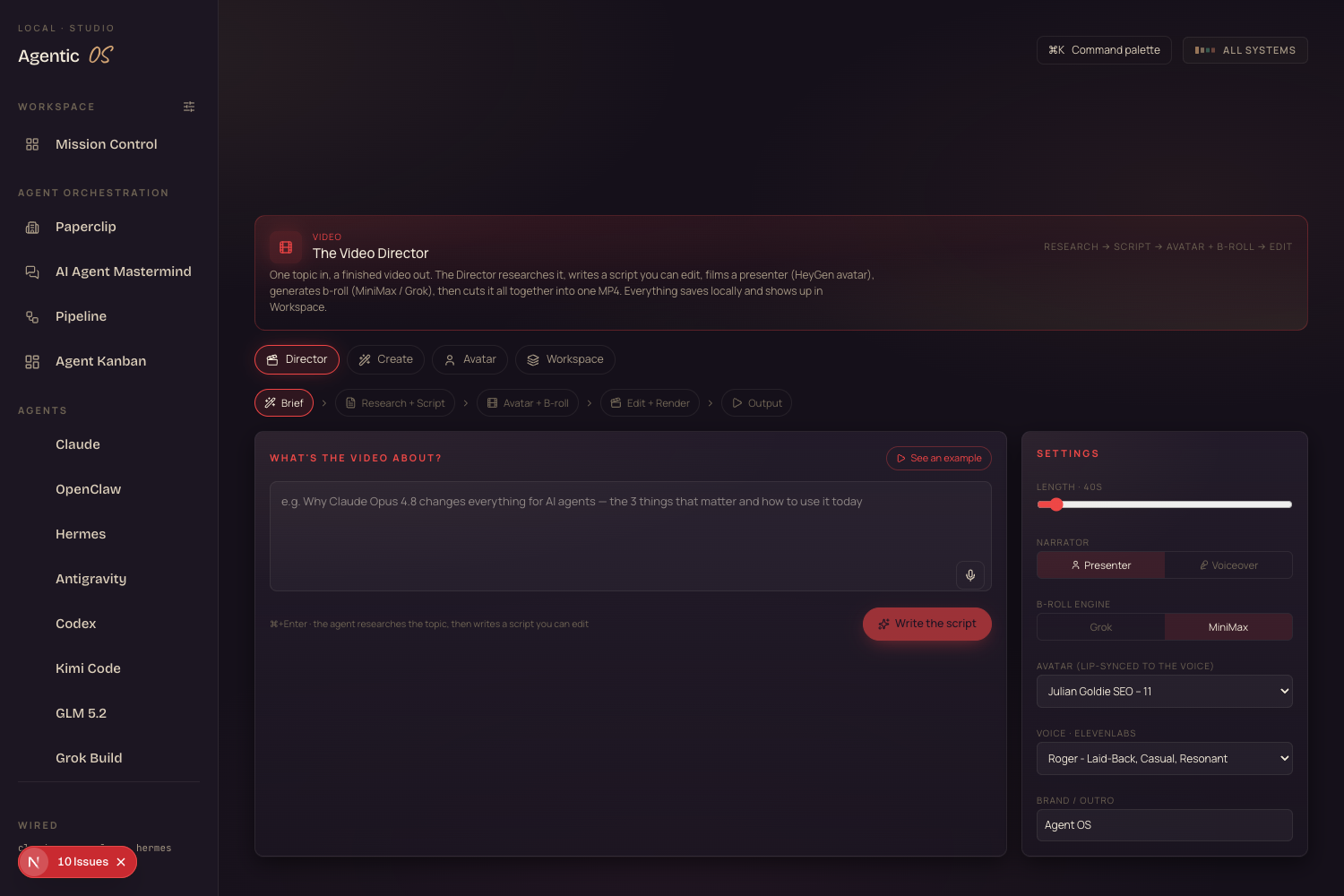
In the Agent OS Video Director, you give it a topic and it builds a finished video — research & script, then voiceover, b-roll, and render. The very first step calls web search: Hermes goes and reads what's actually true right now about your topic before it writes a word of the script. So the video isn't built on nine-month-old training data — it's built on today's facts, with the sources sitting right there in the research.
Point Hermes at anything you want to understand — a new model, a competitor, a market, a piece of code — and say "learn this and teach me." It searches, opens the best pages, extracts and summarises them, and hands you a clean brief with links. It's the difference between asking a model what it remembers and asking a researcher to go find out. You get the current state of the thing, not the frozen one — and every claim comes with a source you can open.
you: Research the DeepSeek V4 release from this week and teach me
     what's actually new — with sources.

hermes → web_search("DeepSeek V4 release")
hermes → web_extract(top 3 result URLs)
hermes: Here's what shipped, what changed vs V3, the benchmarks,
       and 4 links to verify each point ↓
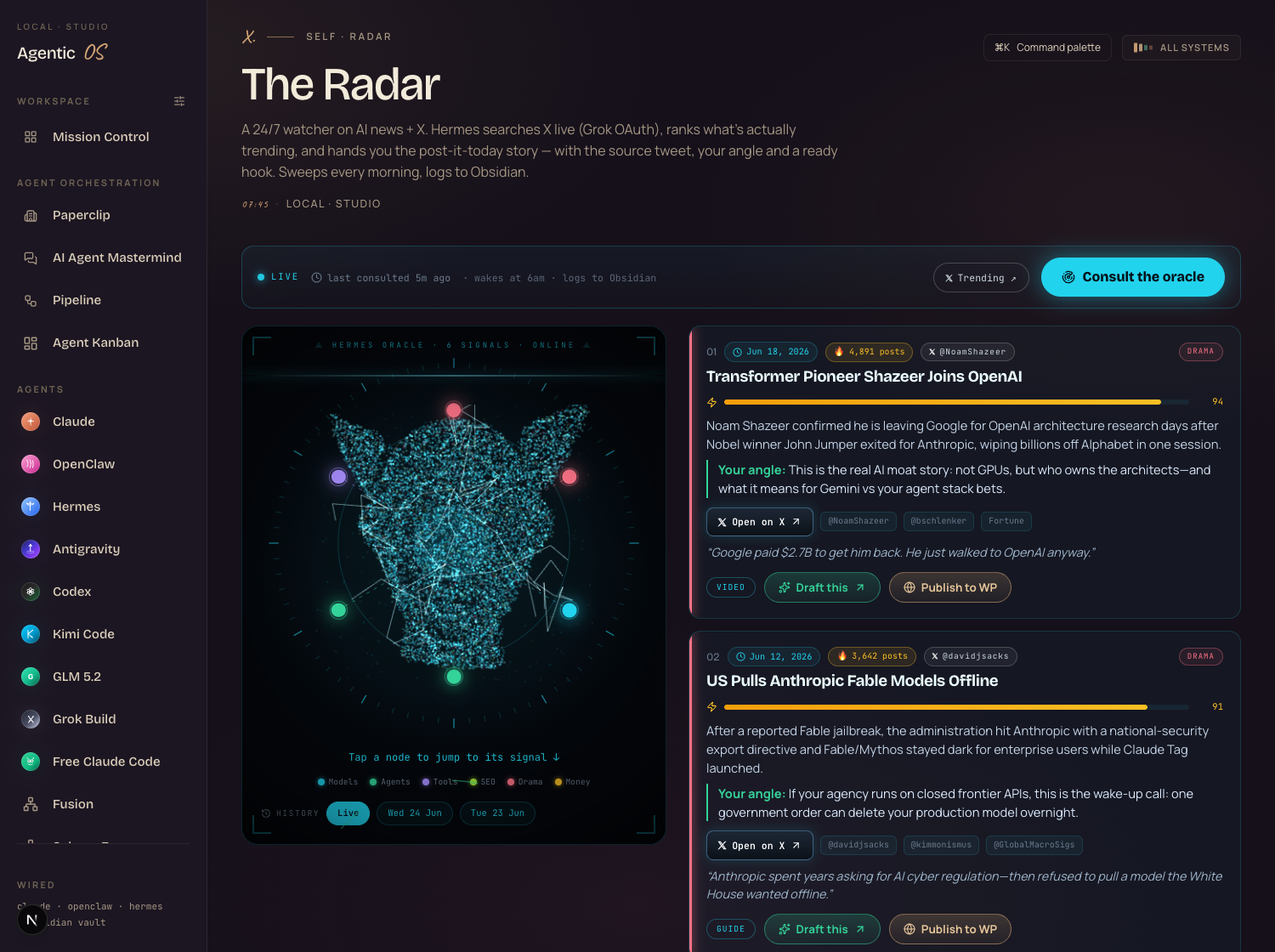
The Hermes Oracle in the Agent OS is web search pointed at one place: X. It uses the Grok search backend to read what's trending in AI right now, ranks it, and hands me the story to post about today — with the source tweet, my angle, and a ready hook. Same feature, aimed at the firehose instead of the open web. It's the clearest proof of what live search unlocks: a system that watches the world and briefs you every morning while you sleep.
Hermes — and all three use cases — ship with the Agent OS.
You don't wire up a research tool, a video pipeline and a trend scraper separately. Hermes with web search is already inside the Agent Operating System in the AI Profit Boardroom — the Video Director, the learn-anything agent, and the Oracle all run on the same live-web feature, set up for you.
- Hermes web search — wired in, free backends ready to pick
- The Video Director — topic in, researched video out
- The Oracle — your 24/7 AI-trend radar on X
- 4 coaching calls a week + daily tutorials as we ship more
- 3,900+ members across 38 countries building live agents
What to take away.
web_search finds, web_extract reads, and it answers with today's web.hermes tools → Web Search & Extract → pick a backend. Done.Stop asking your agent what it remembers. Let it go find out.
Give your agent eyes. Today.
The agents that win the next year aren't the ones with the biggest memory — they're the ones that can go and read the live web the second they need to. Hermes web search is the switch, and it's free to flip. Inside the AI Profit Boardroom it's already on, wired into the Video Director, the learn-anything agent, and the Oracle — so you're researching, learning and trend-spotting with today's internet from day one.
- The full Agent OS — Hermes, web search, and every engine that rides it
- The setup walkthrough, done with you, step by step
- 4 weekly coaching calls, daily tutorials, a 30-day roadmap
- 3,900+ members, a member map, a 24/7 community
- 158 pages of member wins — read them here →